Rapid urbanisation in many Indian cities highlights a widespread challenge — inadequate quality of life in public spaces, regardless of location or economic status. This is a common scenario experienced by most Indian cities today, irrespective of their geographical location, level of development and state of economic stability. The quality of life in the public realm is extremely poor.
Reimagining city landscapes/commons
Launched in 2021, The Urban Revamp Design Challenge aims to identify distinctive public spaces for redevelopment, fostering imaginative futures centred around inclusiveness, climate sustainability and community engagement. The Challenge facilitates collaboration among urban planners, designers, architects, local communities, technical experts, and implementation bodies to bring innovative design concepts to life.
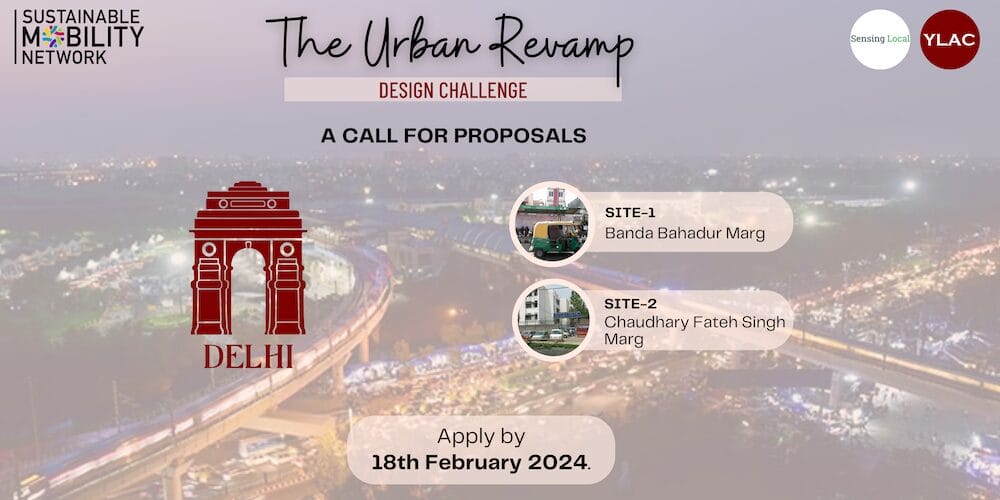
Young Leaders for Active Citizenship (YLAC), and Sensing Local as part of the Sustainable Mobility Network (SMN) have opened registration for the Urban Revamp Design Challenge 3.0, being held in New Delhi for the first time. Professionals and students from the fields of architecture, urban design, public space design, spatial planning and other allied fields have the opportunity to submit proposals to reimagine public spaces in two locations in Delhi – Banda Bahadur Marg, GTB Nagar and Chaudhary Fateh Singh Marg, Timarpur.
Read more: Guess why women avoid cycling in our city
How to register
The competition is open to participants who are professionals or students in the fields of architecture, urban design, urban planning, civil engineering, public space design, spatial planning, and other related disciplines.
- Entries can be submitted either as a team of individuals or as a firm/office. At least one team member should reside in New Delhi or be able to commute to New Delhi for the public engagement events (visioning workshop and presentation to the community if shortlisted).
- Interested teams can find the design brief, competition and registration details in the following link: https://www.urbanrevamp.in/
- The registration deadline is February 18, 2024.
Winners will have the opportunity to pitch to the Government of the National Capital Territory of Delhi and/or relevant government authorities for budget allocation and implementation. Additionally, there is a total prize of ₹50,000 for each site.
So, don your thinking caps and grab your drawing boards, apply now.
[The article is based on a press release from Young Leaders for Active Citizenship, and has been republished with minimal edits.]