Webinar alert: Why not public transport?

What stops Bengalureans from choosing buses and metro over cars and bikes? Join us as we discuss how we can overcome barriers to public transport usage.

The last phase of the Byappanahalli-KR Puram metro line is slated to be completed by the Bangalore Metro Rail Corporation Limited (BMRCL) mid-July or August. The Kengeri-Byappanahalli corridor will be connected to the Whitefield-KR Puram stretch. According to media reports, the ridership on the Whitefield-KR Puram stretch is about 28,000 passengers a day, and once the Purple Line is completed, the numbers are expected to rise significantly and travel time will be reduced too. All stakeholders, BMRCL, BMTC, Auto Unions, BTP, company associations like ORRCA, NASSCOM, and civil society groups, are being asked to get working together to get commuters to opt for travelling by metro at least two days a week.

But the question is will commuters be encouraged to take the metro to work? What needs to change for that to happen, should last mile connectivity be taken into consideration? Is the convenience of using cars and bikes over the metro and bus a reason for commuters not opting for public transport? Citizen Matters Bengaluru’s webinar: Why not public transport? will look at these trends across the city to understand what it will take for Bengalureans to shift to public transport-a viable solution to reduce traffic and pollution.


Read more: Public data enthusiasts evaluate access to public transport in Bengaluru


If you are interested in exploring these questions, and hearing experts and citizens from different walks analyse the issue and discuss solutions, join the discussion below, to be hosted by Citizen Matters Bengaluru this Friday (July 21st).
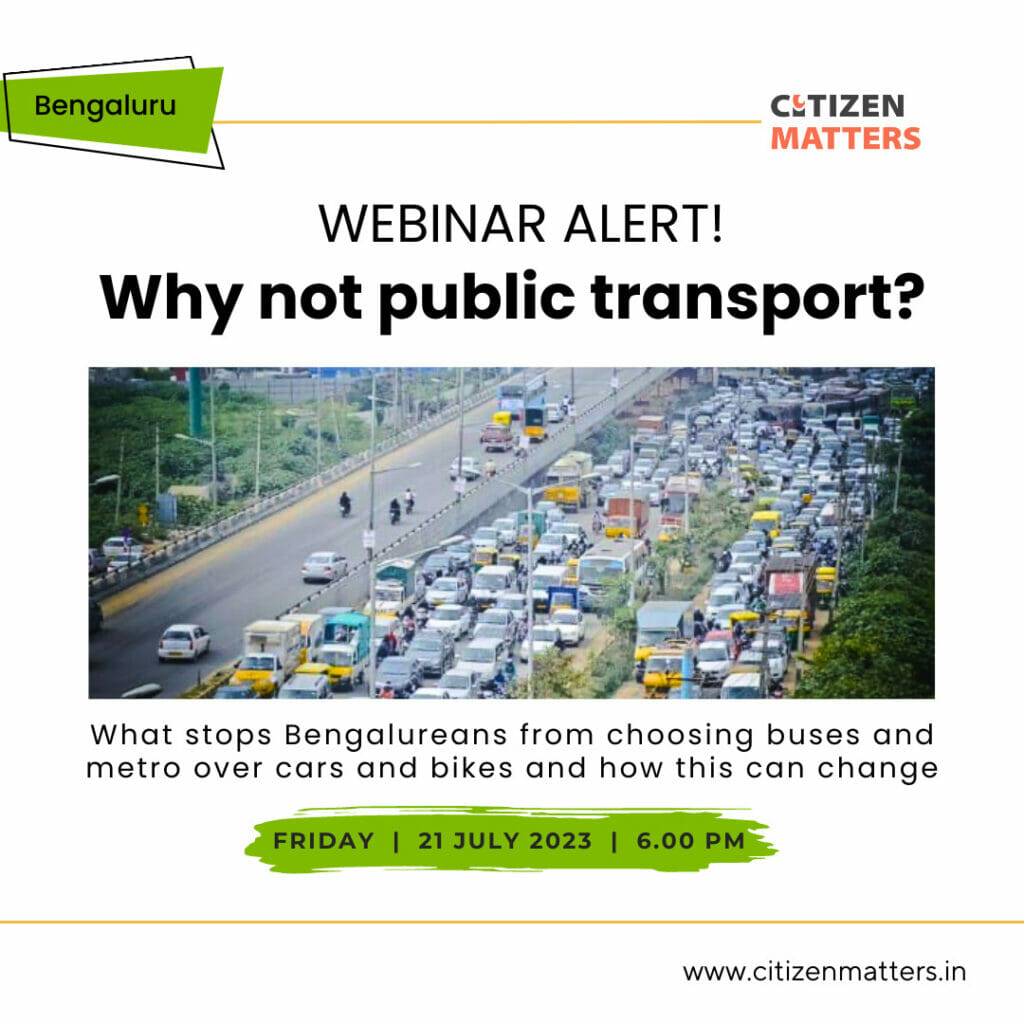
Webinar alert poster why not public transport

Event details:

  • Topic: Why not public transport?
  • Date: 21 July 2023
  • Day: Friday
  • Time: 6 pm onwards
  • Registration link

Speakers

  • Shreya Satish Mokhashi – Assistant Urban Planner at Directorate of Urban Land Transport
  • Lalithamba Vishwanathaiah – former IT Professional and an advocate of sustainable transport
  • Jayen Desai – VMware India, Founder – Sustainability Ecosystem Connect
  • Srinivas Alavilli – WRI India
  • Moderated by Meera K – co-founder, Citizen Matters

Also read:

Leave a Reply

Your email address will not be published. Required fields are marked *

Similar Story

Civil society groups push for cleaner, safer and accessible transport in TN cities

The Tamil Nadu Urban Mobility Charter 2031 urges more buses, EV adoption, and safer streets to make cities equitable and people-first.

A collective of active citizens, non-governmental organisations, sustainable transport experts, and other stakeholders has called for strengthening the public transport network in Tamil Nadu's cities, making it accessible to all and creating low-emission zones across urban centres. The Sustainable Mobility Network (SMN), a coalition of over 30 civil society organisations across India, has released the 'Tamil Nadu Urban Mobility Charter 2031', a comprehensive roadmap urging political parties and governments to put sustainable mobility at the heart of the state’s development agenda. The Charter was shaped through a multi-stakeholder roundtable convened by ITDP India, Citizen consumer and civic Action Group (CAG),…

Similar Story

Freebies or freedom? What bus subsidies do for Indian women

Free bus travel for women in Indian cities cuts transport costs by 50 per cent and boosts jobs. Watch this interview to know more.

Across Indian cities, women depend heavily on buses to get to work, school, healthcare, and to manage everyday caregiving. In recent years, several states have introduced women-specific bus fare subsidy schemes. Delhi, Karnataka and Tamil Nadu offer completely free rides for women in state-run buses, while Maharashtra offers 50% subsidy. Read more: Who benefits from the free bus for women scheme? These schemes have been both vilified as 'freebies' or touted as transformative solutions for women’s mobility. But do these schemes actually work? In 2025, the Sustainable Mobility Network commissioned a study to answer this very question. Beyond Free Rides…