Maya Pawar was only 14 when she got married and moved to Pardhi Wada, an informal settlement located at Raey Road in Mumbai. Surprisingly, it was just a month ago that Maya, now a 62-year-old woman, received a legal water connection in her home.
For nearly fifty years, she was deprived of access to water. Her daily routine of fetching water was filled with challenges. Along with a group of other women, she walked 1.5 kilometres four to five times a day to collect water from a Brihanmumbai Municipal Corporation (BMC) toilet. At one point, their desperation led them to collect rainwater dripping down a warehouse roof. At times, they had to buy water at exorbitant rates. Initially, it seemed impossible to change their situation. But things changed—through the efforts of Pani Haq Samiti, a Mumbai-based citizens’ collective working on the right to water in informal settlements.
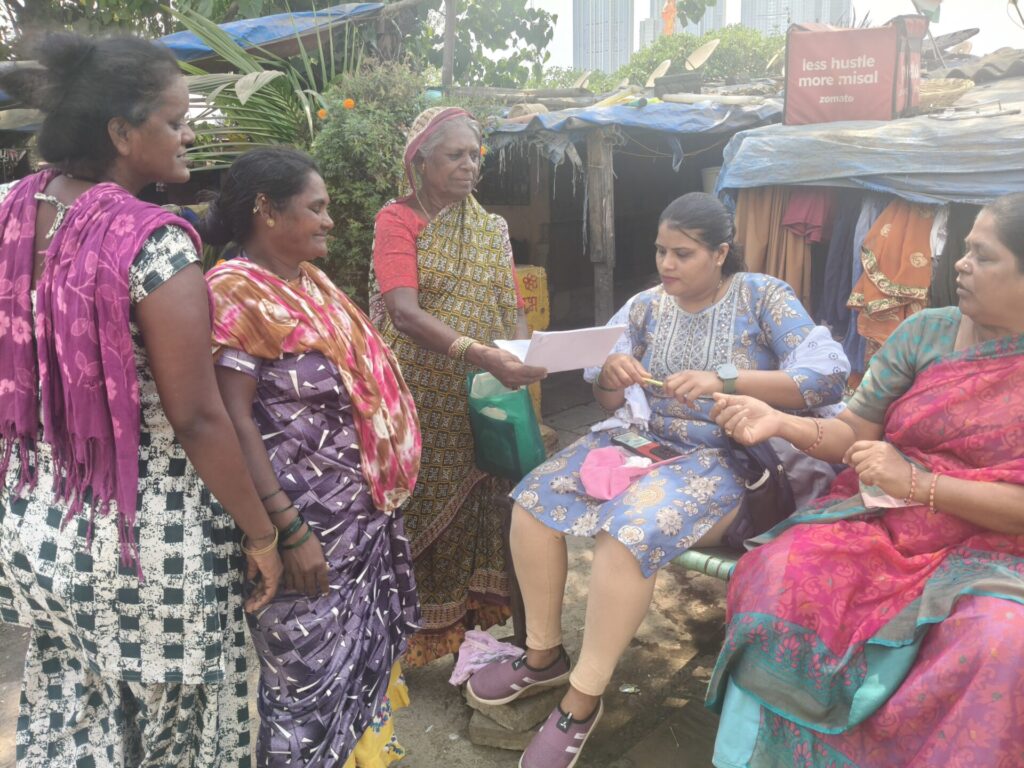
Akshata Bole, who handles their operations in Mumbai City, says that when she first approached residents of Pardhi Wada, it was difficult to win over their trust. Maya says that they had approached so many people, including local corporators and MLAs, but in vain. So, they were filled with hopelessness.
But Akshata persisted. And today, more women have come forward with their forms and documents. But then, persistence does flow through the very existence of Pani Haq Samiti.
The fight for right to water in Mumbai
This fight for water started the way so many campaigns for public amenities begin—the threat of privatisation. In 2007 the BMC proposed the Water Distribution Improvement Project for the K-East Ward. Although this project was presented as a step toward progress, it aimed to privatise water distribution, including control over tariffs.
A joint effort by concerned individuals and activists led to the initiation of a movement called the Pani Haq Abhiyan. They demanded improvement of the BMC water services rather than outsourcing it. They believed water was a public good, and should remain in the public’s hands. And, they were successful.
However, even in celebrating the achievement, a deeper, more lasting challenge remained unaddressed—the lack of equal access to water. The magnitude of the problem became clear when they surveyed 106 bastis. The survey uncovered a troubling situation. It revealed that BMC policies denied water connections to settlements established after January 1, 1995, as well as to unauthorised units located on private lands, or land belonging to the Railways, the Bombay Port Trust, or the Forests Department.
The survey also revealed issues of corruption and significant disparities. According to this survey, residents in informal settlements received only 45 litres of water per person, compared to 145 litres in formal housing areas.
In 2010, they launched a movement with the support of 35 organisations and leaders. They also made their findings public. They named the campaign Pani Haq Samiti.
Read more: Exclusions and evictions: Mumbai Pardhi community’s struggle for shelter and dignity
Obstacles in the way
One of the biggest challenges Pani Haq Samiti faced was the BMC stonewalling them. Pani Haq Samiti approached government-based rights bodies, who asked the BMC to provide water to everyone, but to no effect. Approaching the state government also proved futile. “They actually didn’t want to give water, because by denying people water many opportunities to make money opened up for several people,” explains Sitaram Shelar, founder and convenor of Pani Haq Samiti. For example, he says, people who need to buy water pay almost a hundred times the money paid for water through a legal connection.
The Samiti also organised a series of protests at Azad Maidan. Appeals to policymakers, officials, and elected representatives all failed. They finally filed a PIL in the Bombay High Court in 2011. Though the court admitted the petition, there were interminable delays in getting hearings, till 2014 when the case was heard by Justice Abhay Oka, who ruled that everyone, including those living in unauthorised settlements, should have access to water.
This was a victory for Pani Haq Samiti, but they hadn’t reckoned with the stubbornness that is the BMC.
Read more: How long before “water for all” becomes a reality in Mumbai
Water for all policy
Shakir Husain, who grew up in M east ward, one of the most neglected wards in Mumbai, oversees Pani Haq Samiti’s operations in the eastern suburbs of Mumbai. He recalls a time when his household would use the water of a creek after straining it through a cloth multiple times.
He explains that after waiting for a year for the BMC to implement the court’s judgement, they carried out a demonstration. It was called ‘Pani Pilao Andolan’.
In a move embodying Gandhian satyagraha, 1500 people reached the BMC headquarters, with an application and bottles of unpotable water that they were forced to drink every day. The message was clear—if you can’t give us water, give this undrinkable water to your families.
This andolan brought results where nothing else had. The BMC passed the water for all policy in 2017.
A policy that was not for all
Pardhi Wada is one of the many informal settlements across Mumbai living without a water connection though the BMC has a ‘water for all policy’.
Pravin Borkar, co-convenor of the Pani Haq Samiti, who oversees its daily operations, points out the irony of the ‘water for all’ policy. “Although it was called the ‘water for all’ policy, it did not truly serve everyone,” he says. “It began with the promise of ‘water for all’. But then went on to specify exclusions. People living on footpaths, those on central government land, and even communities along the coastline were overlooked,” he adds.
Determined to address this gap, the Samiti worked from 2017 to 2022 to advocate for the basic right to water for everyone. Often, they used creative methods to get through to the BMC. Shakir recounts how they got water at Siddharth Nagar in Versova. They warned the BMC that they would break the pipeline to get water. They reached the basti, sang songs to the beat of the dholak with the community and approached the pipeline to break it. They intended to draw the BMC’s attention and pressurise them. This strategic move worked, and the corporation agreed to give them a water connection.
With the support of P. Velarasu, Additional Municipal Commissioner at the time, they began shaping a revised version of the policy. After years of effort, their work finally paid off. In 2022, the modified version of the policy was successfully passed, expanding the scope of documentation and making it easier for people.
Read more: How water crisis deepens gender inequality
The cost of fighting for water
The demand for water has come at a considerable cost. According to Pravin, the bureaucracy is designed to favour systems over people. Another significant challenge has been a lack of trust within the communities they work with.
Sunil Yadav, who looks after Pani Haq Samiti’s work in the western suburbs, gives the example of people living at Aarey who came here in the sixties to work at the dairy. They never got a legal connection. Sunil spent months creating awareness about the water for all policy. Not only did they not believe him, but people with vested interests dissuaded them from filling the forms. But Sunil’s persistence paid off. The BMC has laid the pipeline, and many households will soon get water.
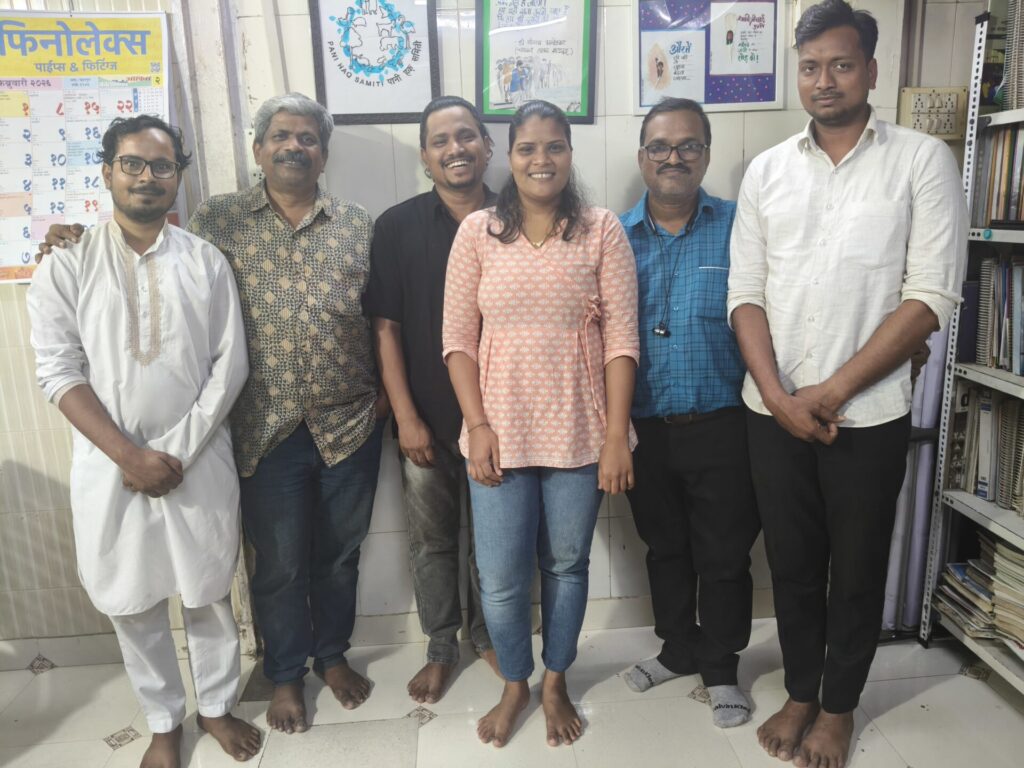
The activists have faced numerous threats, and even violence at times. Pravin has been abducted and threatened, while Sunil and other members of the group were once locked in a room by a local politician. One activist was even attacked with stones while on their way to court. Despite these challenges, they continue to fight for their rights, as access to water significantly changes lives. There’s nothing as empowering as getting a water connection, says Sunil. Getting a legal connection spurs people to make their lives better in other ways. They build toilets, and work towards getting an electricity connection. This is what keeps them going: the commitment they have made to the people they work for and their hope for a better life.
Today, the movement includes five permanent staff members, around 5,000 members, along with volunteers, and has facilitated nearly 1,500 legal water connections.
A sense of hope is palpable at Pardhi Wada. Sakhubai Pawar, a resident, says, “My children’s children were born here, but we have not got water.” But today she has brought her forms and documents to give to Akshata. Hope ripples across the community again.
Also read:
- Gross inequities exist in Mumbai’s water supply, says water researcher Sachin Tiwale
- Living on the edge: Mumbai’s Appa Pada residents still await safe housing
- Explainer: Where does Mumbai get its water from?