For two decades now, the Women’s Reservation Bill, which was proposed to amend the Constitution of India to reserve 33% of all seats in the Lower house of Parliament of India, the Lok Sabha, and in all state legislative assemblies for women, has either been defeated or has lapsed. The law, which would give a boost to active political participation of women and help them fight the abuse, discrimination and inequality they have historically suffered, has sadly not received enough importance even from parties headed by women.
On March 5th, Satta Panchayat Iyyakam, a Chennai-based NGO fighting to protect the fundamental rights of the people by ending corruption in government through greater transparency, has organized a one day simulation of a model assembly session to discuss the Women’s Reservation Bill. The session will also explain and educate women participants about the protocol and flow of the functions of the Legislative Assembly.
The context
It is March and the countdown has begun to the 8th of the month when the country will be hailing women throughout the day — on radio, television, newspapers and most avidly on social media posts to mark International Women’s Day. People will talk about women’s empowerment, women’s safety, their strengths and gender equality in general. While these are discussed endlessly on traditional and social media, the spaces where the most meaningful discussions should occur — our Parliament and Legislative Assemblies — will continue to witness the usual noise, bickering and pointless exchanges.
According to data from the Election Commission of India, out of the total 4896 MPs/MLAs across the country, only 418 or 9% are women. Among MPs, Lok Sabha has 59 (11% of 543 MPs) and Rajya Sabha has 23 (10% of 233 MPs) women.
India has also had poor representation of women in the workforce in junior, middle and senior management levels. Women make up a disappointing 24 percent of the workforce in India, which boasts of one the largest working populations in the world. Only 5 percent of these reach the top layer, compared to a global average of 20 percent. A recent study by Booz and company says that if men and women in India were to be equally employed, India’s GDP could go up by 27 percent.
The issues faced by women in India are many and complex. It is time to address all of these effectively and give the women their rightful place and voice in Indian society. For that we need voices to represent us in the Parliament. The day-long model Women Parliament seeks to bring all these issues into focus and encourage women to engage and talk about these.
The event
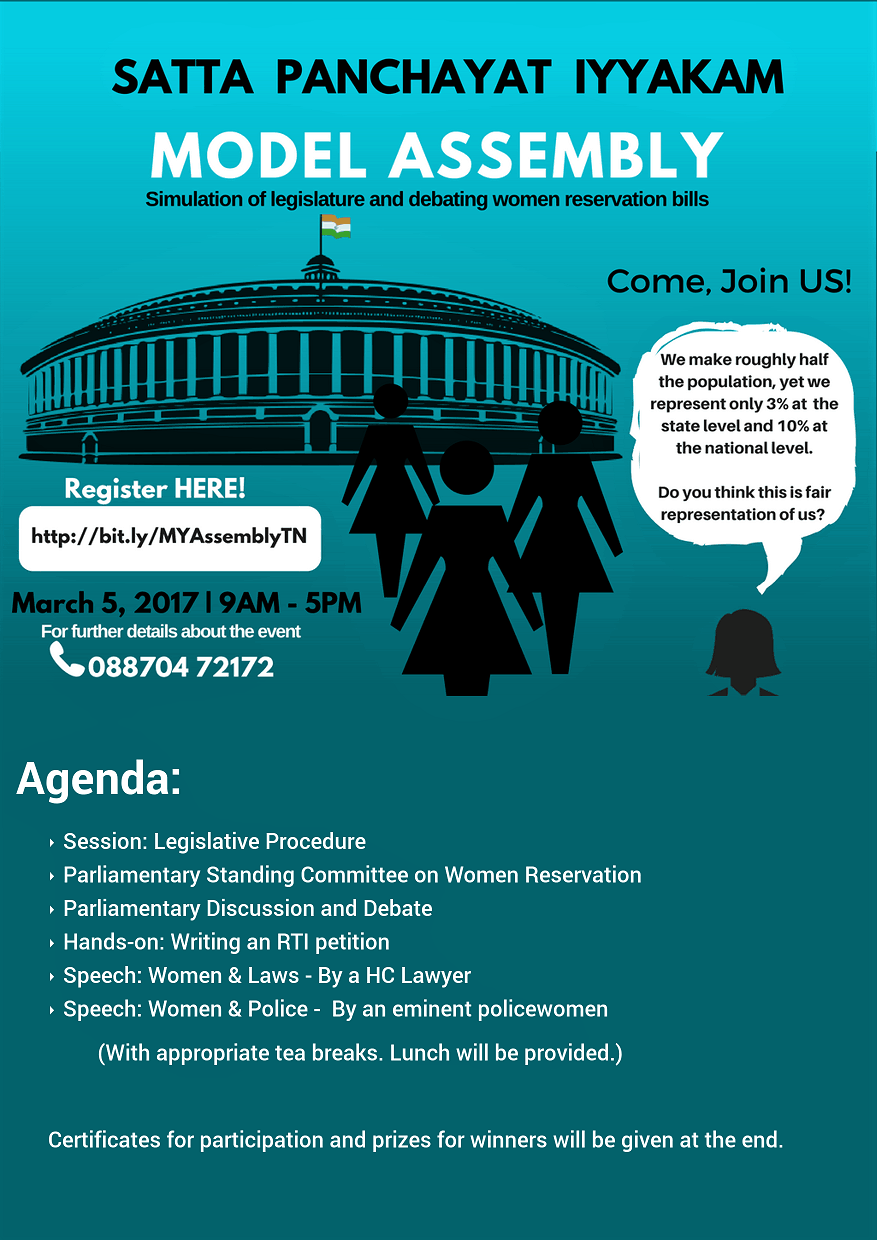
Click on image to see full poster
“Model Women Assembly”
Date 5th March 2017 (Sunday)
Time: 9AM to 5PM (Lunch included)
Venue: Asha Nivas Social Service Centre, 9, Rutland Gate, 5th Street, Thousand Lights, Chennai – 600006
Event page: https://www.facebook.com/events/1851080965181688/
Registration link: http://bit.ly/MYAssemblyTN
Entry FREE, NO Registration Fee.