Banganga is known as the mini Banaras of Mumbai. It is a popular tourist attraction, with hundreds of tourists visiting the Walkeshwar temple every day. It is located at Malabar Hill, one of the posh areas in Mumbai, known for its charm and beauty. However, a stark contrast to everything around Banganga, is the condition of the informal settlements, especially the sanitation facilities.
Most of the community toilets are not usable. They are either locked or are not well maintained. Kalimata Nagar and Sagar Nagar in Banganga are the closest to the sea front. The two toilets constructed for women in Sagar Nagar overlook the Arabian Sea.
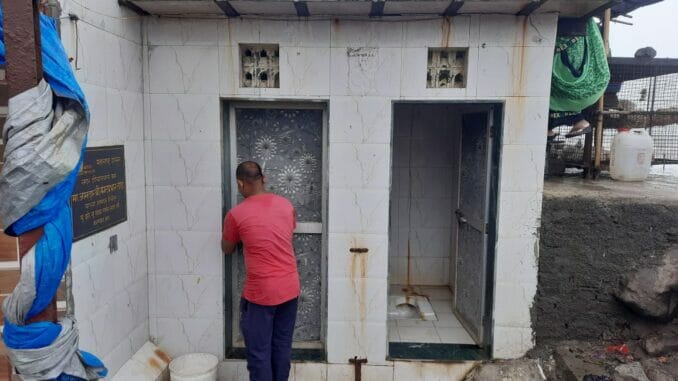
Every morning, each of the public toilets is used by more than 50 people. Residents say every morning when they are in a hurry to go to work, they have to wait in a long queue to use the toilet. The toilet has leakage from its roof. There is no water facility and people carry heavy water buckets to the toilets. The septic tanks get filled and the septic pipes are broken, which leads to infections and diseases.
In Kalimata Nagar Vacuum technology public toilets have been installed for women. It was made by BMC in the year 2017. Women in the area don’t remember when it last worked. Kavita Mankar, a resident says, “I have been hearing for the past 20 years that funds for these toilets are not sanctioned. It is so dark early morning, we have to use a torch and go.”
Read More: People in this Mumbai slum barely make it to 40; here’s why
Defecation at sea is a common practice
Men, who live in the same settlements, go to the sea front. The nearest toilet is a 10-minute walk from Kalimata Nagar. Moreover, it does not have regular water supply either. Male senior citizens, who cannot walk or have any health conditions use the women’s toilets. Mostly the toilets are clogged and have broken doors.
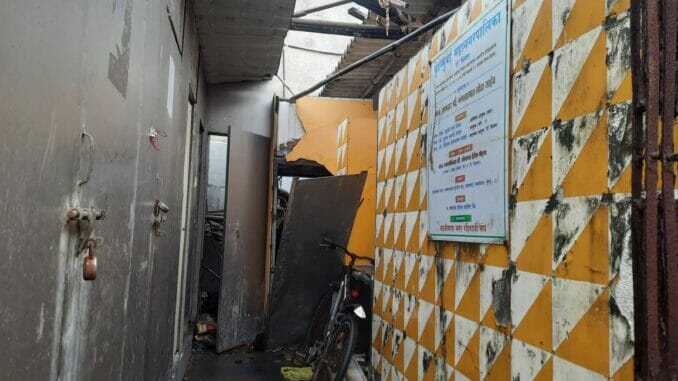
“When the toilets were newly constructed, many people used to go. Some people didn’t go. But people stopped using the toilet because dirty water fills up in the toilet. We go to the crematorium to relieve ourselves. We have to take water from our friends who live near the toilets,” says Batrababu who lives in Kalimata nagar. He finds it cumbersome and he prefers to use the toilet in the building where he goes to work. He says he comes home only to eat and sleep. However, this option may not be possible for many and they end up using the poorly maintained toilets or resort to open defecation.
BMC’s plan for sanitation
The BMC budget of FYI 22-23 shows 266 toilet blocks having 6635 seats as an achievable target. The target was supposed to be completed by April 2022.The FYI 23-24 of the BMC budget under the sanitation programme states the construction of 20000 new toilets as well as the maintenance of 3000 toilets in the slum areas of Mumbai.
Whose responsibility is it?
According to the ex-corporator of D Ward Jyotsana Mehta, the absence of a community-based organisation (CBO) is one of the major factors in poor maintenance of the toilets. CBO works for sanitation in slum areas, they are people who take accountability for the maintenance of public toilets. Until and unless the CBO form is filled nothing can happen. The people of the area have not made their CBO form. The form procedure for Sagar Nagar is going on, she informs.
“Today many more toilets have been constructed. BMC is trying to create awareness about sanitation. If someone is found defecating in the open, BMC fines them as well. The situation has improved compared to past few years,” adds Mehta.
The figures shown by the local body for toilets under their budget may seem promising but the reality for many people in informal settlements like these is different. The state of sanitation facilities at Banganga makes it clear that the task of local body is to construct toilets but also ensure adequate number of toilets and a mechanism for maintenance.