Reality check on the new helmet rule

Recently, the Bangalore Traffic Police made it mandatory for pillion riders to wear helmets. It’s been a law, for some years now, for two-wheeler drivers to wear them.

Here’s a family I snapped…
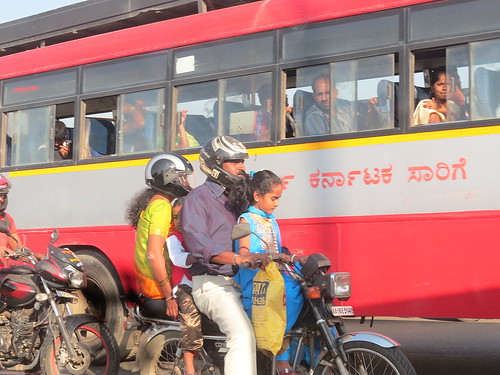
IMG_8190


This was not on any side road, it was on the main highway leading to the airport from the city.

 I’ve had a neurosurgeon neighbour, and two of my surgeon brothers in law, tell me what horrific head injuries can happen when a two-wheeler is involved in an accident. The pillion rider can, in fact, be thrown even further than the driver, and head injuries are even more likely to happen.

So the wearing of a helmet is more to do with one’s personal safety; the law is secondary. But one would think that at least the threat of a fine would make two-wheeler riders comply.

The problem seems to be that no one thinks of a helmet as something that might save one’s life. The helmet rule is viewed as another inconvenient thing that “they” (the Government) push upon “us” (road users.)

One would think that one’s children are very precious to one. But the attitude is always that “such an accident won’t happen to me.” How else to explain a family of four on a two-wheeler (illegal in itself) with the children not wearing helmets?

Another problem is that our traffic police do not sustain the enforcement of rules. While a “drive” is on, people are caught and fined. After that, it’s back to business as usual.

I hope the family made it home safely…and that they buy their children helmets, too, as they brave the chaotic traffic of our city.

Leave a Reply

Your email address will not be published. Required fields are marked *

Similar Story

Cycle city no more? Audit reveals only 11% of Pune’s roads pass the test

Pune is set to host the 2026 Grand Tour, but a Parisar audit reveals unsafe, narrow, and encroached cycle tracks across the city.

Children and adults pedalling to school, work and play — this was a common sight on Pune's streets not so long ago. Once known for its vibrant cycling culture, the city still has many groups and communities that promote non-motorised transport. However, with the rise of motorised vehicles, cycling has not only taken a back seat, but has also become unsafe and inconvenient due to poor infrastructure. This is despite Pune having dedicated cycle tracks and lanes. The decline in cycling infrastructure is reiterated by a recent audit, which found that only 11% of cycle tracks in Pune fell in…

Similar Story

Why accessibility remains elusive at Bengaluru’s bus stops and terminals

Our reality check of the city's major bus stops revealed that most do not adhere to MoRTH guidelines, excluding persons with disabilities.

Bengaluru is racing to bridge the gap between first-mile and last-mile connectivity in public transport, but for people with disabilities, the journey is riddled with obstacles. Inaccessible bus stops and terminals in the city keep them excluded. “I have been travelling on muscle memory alone. There are no supportive facilities or infrastructure in bus stops or terminals,” says Mohan Kumar, a visually-impaired person who has been commuting in Bengaluru buses since 2012.  The exclusion starts at the bus stop. “Even if buses are inclusive, it is nearly impossible to reach the bus stops in Bengaluru due to poor design and…