Reality check on the new helmet rule

Recently, the Bangalore Traffic Police made it mandatory for pillion riders to wear helmets. It’s been a law, for some years now, for two-wheeler drivers to wear them.

Here’s a family I snapped…
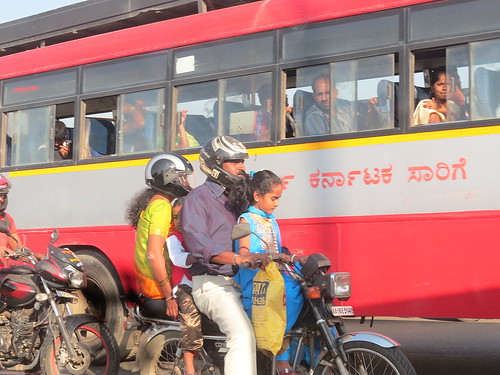
IMG_8190


This was not on any side road, it was on the main highway leading to the airport from the city.

 I’ve had a neurosurgeon neighbour, and two of my surgeon brothers in law, tell me what horrific head injuries can happen when a two-wheeler is involved in an accident. The pillion rider can, in fact, be thrown even further than the driver, and head injuries are even more likely to happen.

So the wearing of a helmet is more to do with one’s personal safety; the law is secondary. But one would think that at least the threat of a fine would make two-wheeler riders comply.

The problem seems to be that no one thinks of a helmet as something that might save one’s life. The helmet rule is viewed as another inconvenient thing that “they” (the Government) push upon “us” (road users.)

One would think that one’s children are very precious to one. But the attitude is always that “such an accident won’t happen to me.” How else to explain a family of four on a two-wheeler (illegal in itself) with the children not wearing helmets?

Another problem is that our traffic police do not sustain the enforcement of rules. While a “drive” is on, people are caught and fined. After that, it’s back to business as usual.

I hope the family made it home safely…and that they buy their children helmets, too, as they brave the chaotic traffic of our city.

Leave a Reply

Your email address will not be published. Required fields are marked *

Similar Story

The infrastructure of waiting: How Bengaluru’s gridlock steals our right to time

Bengaluru needs accessible infrastructure that makes life easier for everyone, not tunnels and corridors built for a privileged few.

Selomi's text arrived at 7 am. "Let's leave by 8.30. The traffic will be brutal otherwise." We both live about 10 kilometres from the government office we had been going to every day for the last two weeks. The nearest metro station is four kilometres from our homes, which means forty minutes to reach it, twenty on the metro, and twenty-five on foot from Vidhana Soudha to the office. An hour and twenty minutes each way, assuming nothing goes wrong. In Bengaluru, something always does. By the end of the second week, we had the routine down. Coffee in a…

Similar Story

How accessible is Koramangala? A case study on bus connectivity challenges

While 318 routes touch this Bengaluru suburb, gaps in last-mile connectivity and weak connections remain a problem.

Koramangala is one of Bengaluru’s most recognisable neighbourhoods. Originally planned as a suburb, it witnessed a transformation in the 1990s thanks to its connectivity to Electronic City and the IT corridors along Outer Ring Road. This boom drew skilled professionals from across the country, converting Koramangala into a vibrant commercial hub. With its rapid growth, the question of public transport became even more important, not just for residents, but also for the businesses that thrive here. During OpenCity’s Bengaluru Datajam, organised around the theme of public transport, our group focused on Koramangala’s bus connectivity with the rest of the city.…