At the Neralu 2014, a discussion on the cultural meaning attached to some of the older, shade-giving trees in the city led to the awareness that people continue to worship the Peepul tree AND informally generate community spaces within their neighbourhoods. This led me to research this idea further and to look at how the peepul tree (Ficus religiosa) shrine with its serpent stones and the raised platform around it, locally called the Ashwath katte, contributes to the making of urban space in the city of Bangalore.
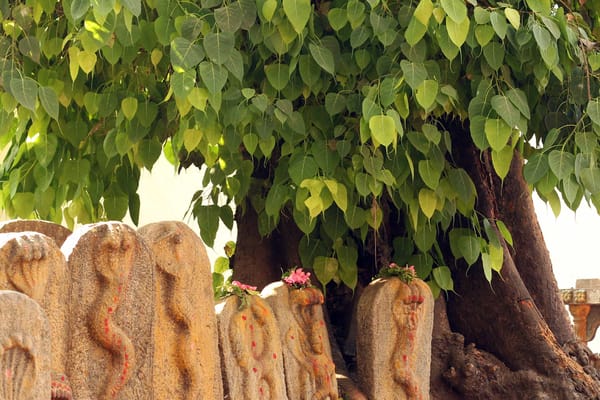
The Serpent represents rebirth due to the casting of its skin and being symbolically “reborn“
The origin of the ashwath katte lies in the rural areas of India. In Bangalore, the city has been absorbing many of the villages surrounding it into the urban fabric. Janaki Nair points out in her book, ‘The Promise of the Metropolis’ that from 1901-1971, the city absorbed around 100 villages into the city structure. In 2001, Bangalore had an additional 218 villages located within it. Nair notes that even as the city engulfs the villages as it expands, the rural street patterns sometimes survive in the middle of a geometrical grid of the new layout. The integration of the older streets, temples or kattes into the city layout has never been attempted in the formal planning exercises.
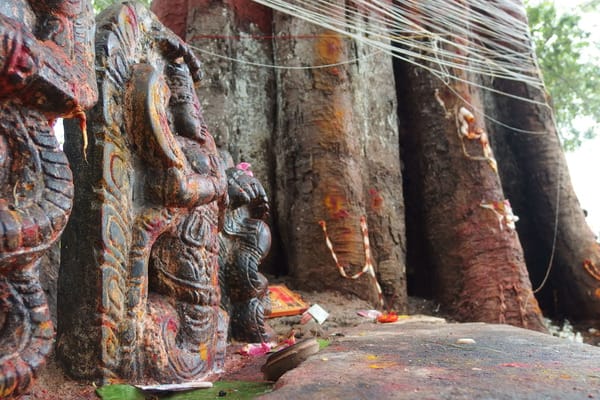
The tying of the sacred thread is like making a vastra-dan to Vishnu & asking for his protection in return
I looked at kattes in different locations in the city and found that the urban space differed from one katte to another. As the geographical location changed, the social and cultural context seemed to change as well. The nature of the urban space changed from being a silent space to being a noisy, crowded space; from being enmeshed with modern urban infrastructure to being untouched by it; from being part of an ecological system of water conservation to being an entity growing in its disconnectedness from both plant life and water systems.
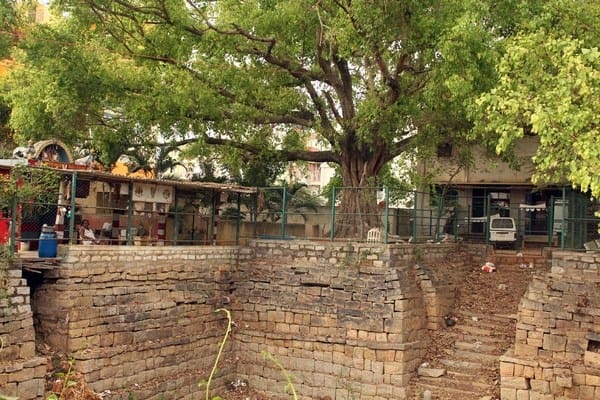
A Katte next to a Kalyani at Gottigere on Bannerghatta road
The research attempted to identify, map and categorise kattes and found that they were used either for religious activities or for both religious and non-religious activities. For example, the katte is used as a religious space at the Ranganatha Swamy temple, which was established in 1628 and is located on Ranganatha Swamy Temple street in Chickpete. Within the temple grounds, there are two peepul trees and kattes around them. It is a place that women from the neighbourhood find conducive for their group meetings.
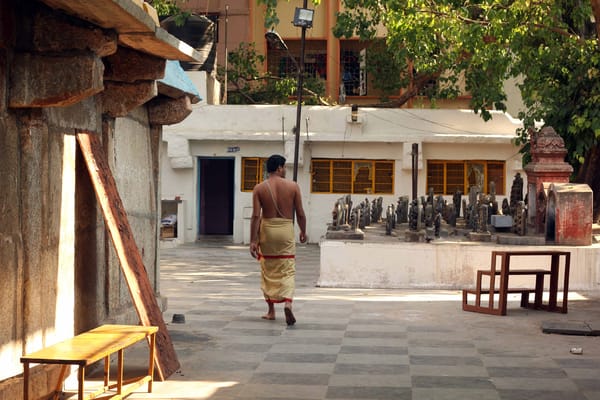
The Katte within the Ranganatha Swamy temple with its Peepul tree and the serpent stones
It is used both as a Religious and Social space at the Panchalingeswara temple, next to the Siddappa Mess which is a popular breakfast place in Sampangiramnagar. The mess is run from the house where the owner Siddappa and his family live. There is an old Kalyani (tank) across the road from the temple. In this urban space, there are no distinct areas for what belongs to katte and what belongs to the waiting area of the mess. The new physical development in the last few months has been the renovation of the temple by the local Corporator, the collections for which have come from the residents of Sampangiramnagar.
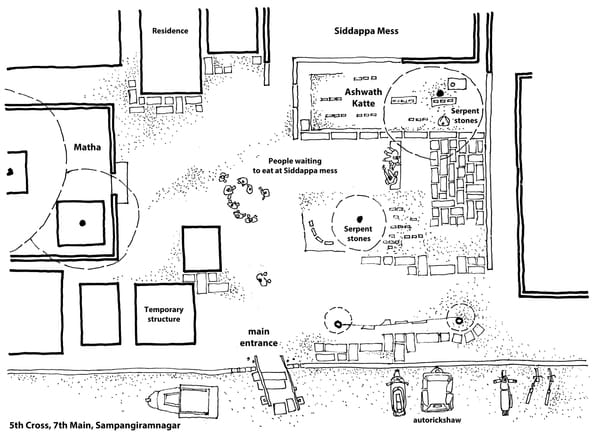
Plan of the Katte at Panchalingeshwara temple next to Siddappa Mess at Sampangiramnagar
And then, there is the Katte which is used for Religious and Economic activities as seen at the Mariamma Devasthanam at Dodda Mavalli which is both a marketplace and a religious space. As you enter from Susheela Road into a gated enclosure, on one side is the platform with the peepul tree and the snake-stones; on the other side is the Mariamma shrine and in front is an open space where an open market or santhe takes place everyday. The temple, the peepul tree and the open market are said to be all more than 150 years old. It is maintained by the Mariamma Grama Seva Sangha, a trust that was formed 50 years ago by the residents of the Mavalli neighbourhood.
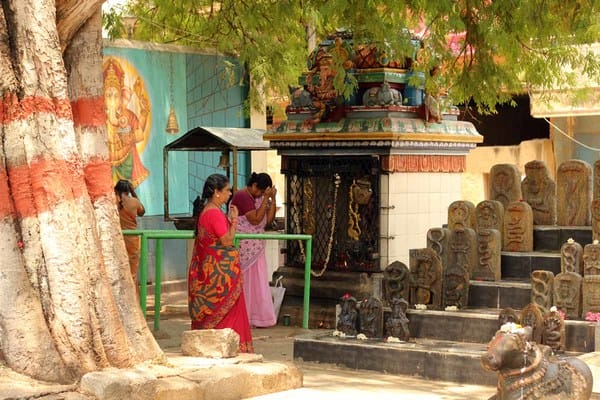
Women pray at the shrine & do the pradakshina around the peepul tree at Dodda Mavalli
It is interesting to note that while the Administrators imagine a city that meets global standards of urban form and infrastructure, at the neighbourhood level, people continue to pray at the local tree shrines making the spaces around these trees into places of memory and cultural value.
At NERALU: the Bengaluru Tree Festival that will take place on 7th, 8th & 14th Feb 2015, you can experience this yourself at the Katte event on 7th Feb at Dodda Mavalli. On 14th Feb, Lathashree KS will be conducting the Ashwatha Katte Samvada. There is SO much more at Neralu 2015, so do check out the ENTIRE SCHEDULE!
Note: This article draws upon a paper I presented at the Asia Research Institute, NUS, Singapore in November 2014.
Update as on 8th Feb 2017: This paper has now been published in the Journal of Urban Design and can be accessed at: The Practice of Tree worship and the Territorial Production of Urban space in an Indian neighbourhood