In the western suburbs of Mumbai, the Mount Mary and Kane Road areas in Bandra comprise a diverse neighbourhood of 38 high-rise apartments, bungalows, four religious institutions, a school, an orphanage, a hospice, and a women’s hostel.
Since 1998, this locality has been actively served by ALM 33 — an Advanced Locality Management unit recognised by the Brihanmumbai Municipal Corporation (BMC) for its proactive resident group, working to improve the quality of life in the area.
For years, the BMC did not have a consistent waste management programme in ALM 33. This led to sanitation issues, including overflowing bins, clogged drains, garbage piling up on street corners, and open spaces littered with mixed waste. The situation called for urgent action and a shift in how residents managed waste.
With Mumbai generating over 10,500 metric tonnes of waste per day, many questions lingered: Where would all this waste go? How could there be relief for those living near the city’s overflowing dumps? We decided to take action and initiate sustainable waste management in our locality. After thorough research, on May 1st, 2013, Vaikunth Apartments, where I reside, inaugurated its on-site composting project.
Read more: How a community initiative is working towards a cleaner Elephanta Island
The beginning of a community initiative
The ALM committee started by educating house helps and waste collectors, using posters and presentations on waste segregation, and distributing awareness charts to every household. But convincing residents to segregate wasn’t easy. There was resistance: “Why should we segregate?” “We pay taxes to the BMC.” “Maintaining two bins is a problem.” “Would it be enforced on the slum dwellers?”
To make things worse, BMC continued to accept mixed waste. However, the ALM persisted. The committee started monitoring the waste collection in societies and ensured that the BMC did not collect unsegregated waste. Gradually, people began to comply. We then introduced the societies to NGOs involved in composting – Arregogreen and Stree Mukti Sangathan. The outcome was good. Fifteen societies hired them and began to utilise their services for waste composting.
Meanwhile, on May 5th, 2015, a division bench of Justices NH Patil and VL Achiliya of the Bombay High Court passed an order in reply to a PIL filed by KD Gokhale and others regarding disposal of solid waste which stated, “The authorities should make it mandatory for every society to dispose waste within their premises through composting instead of throwing it on the road.”
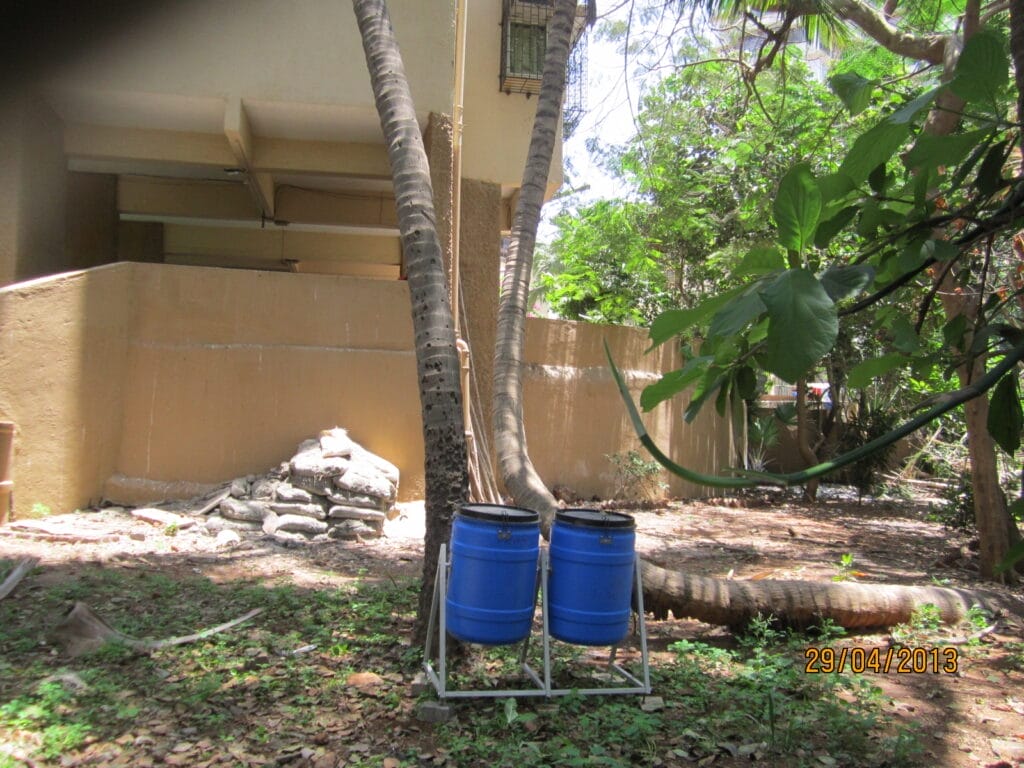
Households were motivated to adopt composting following a presentation on the status of the landfills, the condition of the people, especially children living near them, challenges faced by garbage workers and ragpickers. It also highlighted the ill-effects of single-use plastics, the impact of microplastics on land and wildlife and humans, leaching, and environmental degradation. The BMC had also promised a reduction in property taxes for those who composted.
Challenges along the way
Zero waste is difficult to achieve, but our ALM has found a way. Our e-waste goes to two NGOs – Aasra and Threco, and BMC collects biodegradable waste every day. Non-biodegradable waste is collected twice a week by Aasra. Textile waste and e-waste are collected on the second and fourth Tuesdays of every month. The BMC is making a plan for the disposal of sanitary waste and will notify residents soon.
Read more: How a city-farmer partnership can help smaller cities solve their waste conundrum
How BMC’s announcement hinders community initiative
Our composting project was highly successful initially. The manure from composting was used in the society garden, saving money, and there were no complaints of odour, proving that the system was foolproof. While not zero-waste, the trash going out was minimal. Even during the pandemic, societies managed well.
However, in 2022, the BMC announced that since ALM 33 was effectively segregating waste, they would use it as a model and compost the locality’s waste at the BMC’s composting unit at Kanjurmarg. Following this, housing societies lost interest in spending on infrastructure and employing NGO services. Currently, people continue to segregate, but after BMC became lax in ensuring proper segregation of waste, the fervour is missing.
With regard to the BMC’s promise to exempt property tax, the onus fell on the residents to do all the work. We are supposed to weigh the garbage being composted each day, and keep a record of it, and the property tax reduction would be calculated according to their terms. It seemed there was too much to do for a reduction of a few hundred rupees.
If the BMC were serious in its plans, it would have seen to it that all its promises were kept, and people, too, would have gone all out to work towards that goal. But the spirit of the people of ALM 33 is high, and they are willing to cooperate fully with the BMC. After all, we have only one Earth, and it is our home. We need to preserve it.