Sanitation workers’ protest: How the privatisation push deepens inequality for Chennai’s marginalised

In Part 1 of this video, we break down how the outsourcing of waste management impacts thousands of sanitation workers across Chennai.

In August this year, over 2,000 sanitation workers from Central and North Chennai staged a peaceful protest against the Greater Chennai Corporation’s (GCC) decision to privatise waste management services in Zones 5 and 6. Their demonstration was met with force and allegations of police brutality, just one day before Independence Day.
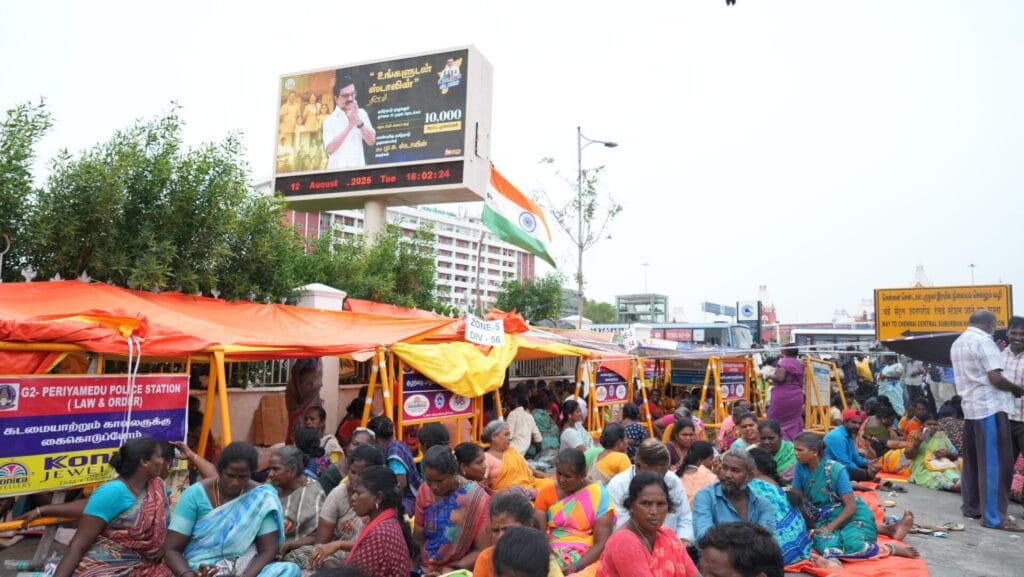
Sanitary workers protest against privitisation of waste management in zones 5 and 6 in Chennai.
Sanitary workers protest against the privatisation of waste management in zones 5 and 6 in Chennai. Pic courtesy: Sakthivel/Vyasai Thozhargal

Over the years, GCC has outsourced solid waste management to private firms in 13 out of its 15 zones. The latest was in June this year, which approved the handover of Zones 5 and 6 to Delhi MSW Solutions, part of the Ramky Group. This move has left long-serving sanitation workers in a state of uncertainty.


Read more: The plight of conservancy workers in singara Chennai


Impact of privatisation of waste management on workers

Previously employed under the National Urban Livelihoods Mission (NULM), these workers are now being offered only contractual positions with the private company, that too with a significant pay cut.

The DMK had made a poll promise to regularise the jobs of sanitary workers working for over a decade. However, the state government has made no attempts to address their concerns.

While officials claim privatisation will bring better benefits, many workers argue the opposite. Advocate Kannan of the Uzhaippor Urimai Iyakkam points out that regularisation, not privatisation, is key to ensuring job security and dignity of the workers and their future generations.

The move to privatisation has raised many such concerns. In Part 1 of a video on this issue, we have broken down how the privatisation of waste management will affect thousands of sanitary workers in Chennai. 

For the workers, who are already marginalised because of caste and social stigma, privatisation brings more discrimination through pay cuts and loss of already precarious livelihoods.

But the story doesn’t end there. Privatisation also raises questions of accountability and public money. In Part 2, we will look at what this means for Chennai’s taxpayers.

Also read:

Leave a Reply

Your email address will not be published. Required fields are marked *

Similar Story

To fix its waste crisis, Bengaluru first needs a ward-level land audit

Bengaluru generates tonnes of waste daily with little space to process it. A ward-level land audit can map space to build local units.

When Lokayukta officials conducted a surprise inspection of Gottigere, Anjanapura, and JP Nagar 9th Phase in early April 2026, they found what residents of these neighbourhoods already knew: large heaps of uncollected garbage piled along roadsides, a city generating 5,000–6,000 tonnes of solid waste every day and visibly failing to manage it. Lokayukta Justice BS Patil summoned the Chief Operating Officer and senior officials of Bengaluru Solid Waste Management Limited (BSWML), directed them to appear for a hearing, and asked for a detailed report on the lapses and remedial measures. It is a familiar script. Inspection. Summons. Report. Repeat. Howoever,…

Similar Story

Beyond the bin: How a Mumbai neighbourhood inspired a community waste recycling movement

From plastic and paper to books, clothes and e-waste, a Shivaji Park initiative has expanded steadily since its first collection drive in 2020.

On the last Sunday of every month, a lane in Mumbai's Shivaji Park becomes a collection point for dry waste. Residents bring paper, plastic, glass, e-waste, clothes, books and household items for recycling, reuse and upcycling. Volunteers receive, weigh and sort every donation before it is sent to the appropriate recycler or organisation. What began with six volunteers and 450 grams of plastic has grown into a community initiative attracting participants from across Mumbai. From Covid volunteers to community dry waste recyclers The origins of the initiative lie in an entirely different crisis. During the Covid-19 pandemic, residents of Madhli…