Sanitation workers’ protest: How the privatisation push deepens inequality for Chennai’s marginalised

In Part 1 of this video, we break down how the outsourcing of waste management impacts thousands of sanitation workers across Chennai.

In August this year, over 2,000 sanitation workers from Central and North Chennai staged a peaceful protest against the Greater Chennai Corporation’s (GCC) decision to privatise waste management services in Zones 5 and 6. Their demonstration was met with force and allegations of police brutality, just one day before Independence Day.
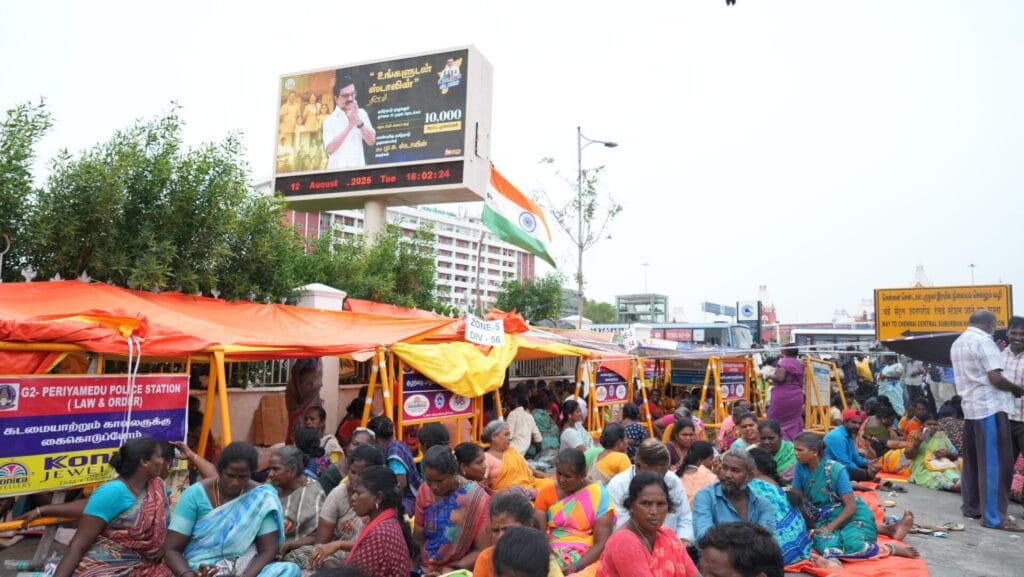
Sanitary workers protest against privitisation of waste management in zones 5 and 6 in Chennai.
Sanitary workers protest against the privatisation of waste management in zones 5 and 6 in Chennai. Pic courtesy: Sakthivel/Vyasai Thozhargal

Over the years, GCC has outsourced solid waste management to private firms in 13 out of its 15 zones. The latest was in June this year, which approved the handover of Zones 5 and 6 to Delhi MSW Solutions, part of the Ramky Group. This move has left long-serving sanitation workers in a state of uncertainty.


Read more: The plight of conservancy workers in singara Chennai


Impact of privatisation of waste management on workers

Previously employed under the National Urban Livelihoods Mission (NULM), these workers are now being offered only contractual positions with the private company, that too with a significant pay cut.

The DMK had made a poll promise to regularise the jobs of sanitary workers working for over a decade. However, the state government has made no attempts to address their concerns.

While officials claim privatisation will bring better benefits, many workers argue the opposite. Advocate Kannan of the Uzhaippor Urimai Iyakkam points out that regularisation, not privatisation, is key to ensuring job security and dignity of the workers and their future generations.

The move to privatisation has raised many such concerns. In Part 1 of a video on this issue, we have broken down how the privatisation of waste management will affect thousands of sanitary workers in Chennai. 

For the workers, who are already marginalised because of caste and social stigma, privatisation brings more discrimination through pay cuts and loss of already precarious livelihoods.

But the story doesn’t end there. Privatisation also raises questions of accountability and public money. In Part 2, we will look at what this means for Chennai’s taxpayers.

Also read:

Leave a Reply

Your email address will not be published. Required fields are marked *

Similar Story

Community-led segregation helps Mumbai’s informal settlement clean its neighbourhood

In Mumbai’s Bhim Nagar, residents join Green Communities Foundation to segregate waste, plugging gaps left by BMC’s system.

On a Friday mid-morning in Bhim Nagar, a hillside settlement in Mumbai's Ghatkopar, a small community room is abuzz with activity. Families stream in, some with children in tow, all carrying sacks filled with dry waste. Volunteers weigh the waste and make a note of the quantity. This bustling scene is part of a waste segregation initiative that Green Communities Foundation (GCF), a non-profit organisation working in sustainable waste management, is running in partnership with the community.   The Brihanmumbai Municipal Corporation (BMC) is responsible for providing solid waste management services in Bhim Nagar, an informal settlement. However, there are major…

Similar Story

Bengaluru’s SwachaGraha: 10 years of citizen action for sustainability

Three words that sparked a citizen-led waste management movement across homes and communities: compost, grow, cook.

Ten years ago, in 2016, SwachaGraha began with a simple yet powerful invitation: “Start a green spot.” It started as a call to action for individuals, families, and neighbourhoods to look at waste differently, not as garbage, but as a resource: one compost bin, one garden, and one shared meal at a time, to turn everyday habits into acts of care for the planet. Compost: The first 'green spot' begins right in your kitchen, where vegetable peels and food scraps are transformed into nutrient-rich compost. Grow: The second 'green spot' takes root in your garden, balcony, or terrace, where that…