Dr Sanjeevani Rajwade (60) from Mumbai’s Vile Parle fractured her foot this rainy season after stepping into a hidden pothole. She walks to her clinic daily, a 10-minute commute from home. “I’ve tried all kinds of footwear to avoid falling,” she says, “but with broken footpaths and uneven roads, nothing really works. Every day, just walking safely to my clinic is a struggle.”
Earlier this month, Siddesh Narvekar (31) had his leg trapped in a 10-centimetre-wide drainage hole near Jogeshwari Metro station. The fire brigade took nearly four hours to free him using chipping hammers and cutters, working cautiously as his oxygen levels began to drop.
The National Crime Records Bureau (NCRB) Report 2023 records 414 road accidents in Mumbai, causing 1,924 injuries and 414 deaths, including 443 injured pedestrians and 56 pedestrian fatalities, almost three deaths per 100,000 residents. The Mumbai Road Safety Report 2023 notes that these numbers are likely underreported, as many accidents go unrecorded by the police. “We see injuries not only among older adults but also in young people rushing to meet deadlines, college students, office workers, or parents picking up children,” says Kurla resident and physiotherapist Poonam Patil.
Mumbai is one of the most densely populated megacities in the world, with a population of 12.44 million (Census 2011) living in an area of 483 sq km. In the last three decades, as the number of vehicles in Mumbai has grown rapidly, the city’s mobility plans have mainly focused on building big roads and flyovers. This has overlooked the need for better walking, cycling and public transport infrastructure, leading to uneven and dug-up roads, damaged and encroached footpaths, and continuous construction. Such development takes a daily toll on commuters, residents, and pedestrians — not only denting their physical well-being but also worsening their mental health.
Poor road conditions affect mental health
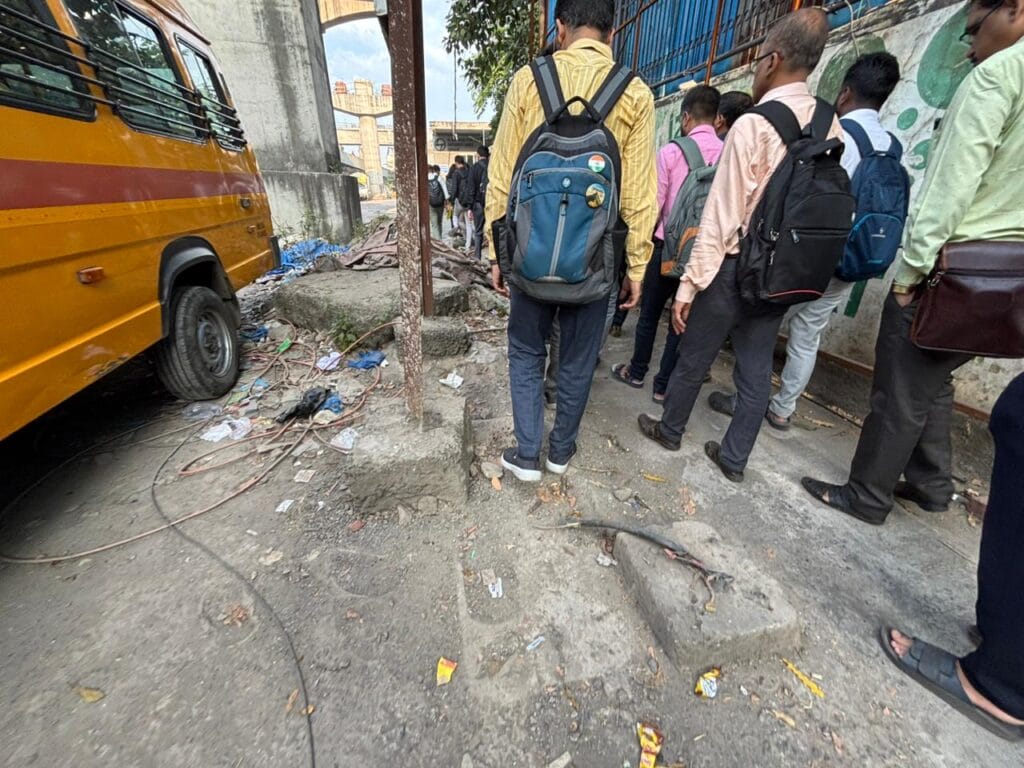
Manoj More (35), who commutes daily from Ghansoli to Powai for work, shared his experience. “From Ghansoli to Kanjurmarg, I reach in about half an hour. However, the 4-km stretch from Kanjurmarg to Powai takes more than an hour due to heavy traffic and damaged roads on the Jogeshwari-Vikhroli Link Road (JVLR). In the evening, it takes more than two hours to get home,” he says.
The daily struggle with traffic has steadily increased Manoj’s stress. Reaching home late leaves him anxious and irritable, and he misses valuable time with his family. It also affects his family relationships. His sleep is affected; he wakes frequently at night to care for his twin daughters, but has to leave early in the morning to reach the office on time. This chronic sleep deprivation leaves him exhausted and struggling to concentrate at work.
“I am even thinking of changing my job if this continues,” Manoj says. His story highlights how Mumbai’s traffic and poor road conditions are not just an inconvenience but a serious factor affecting mental health, family life, and overall well-being.
Read more: Making mental healthcare more accessible for students
Stress built into streets
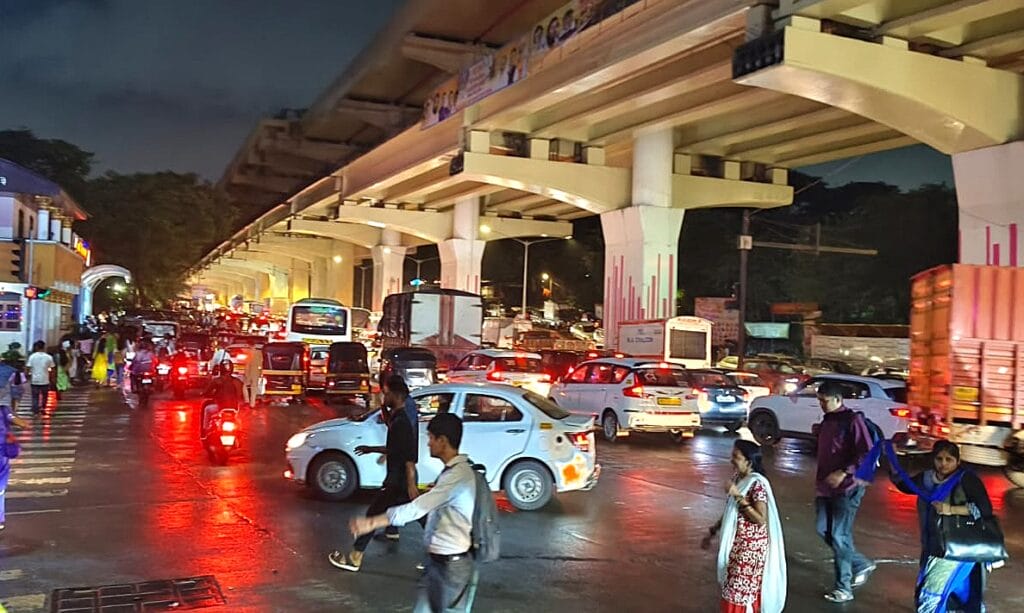
Psychiatrist Dr Manoj Bhatwadekar says long hours spent on Mumbai’s roads disrupt time management, family life, and work focus. Chronic stress, coupled with limited physical activity, increases the risk of non-communicable diseases such as diabetes and hypertension. Unpredictable traffic and consequently uncertain travel times disrupt daily routines. Over time, this fuels anxiety, erodes mental peace and diminishes the overall quality of life.
“The stress becomes even more evident when you travel on smooth, uncongested roads elsewhere; the contrast shows how much tension the city’s traffic quietly imposes every day,” Dr Manoj observes.
Transportation, as a social determinant of health, is known to impact mental health. Drivers face mental health impacts from traffic stress, delays, and long commutes. Transit users struggle with concerns about service reliability, personal safety, and limited comfort. Studies also highlight that traffic congestion can increase stress, anger, and frustration, and negatively impact the mental health and well-being of individuals.
Dr Alka Subramanyam, Professor in the Psychiatry Department at Topiwala National Medical College & BYL Nair Charitable Hospital, noted that in a city like Mumbai, people are constantly on the move and their brains are always ‘on,’ with little opportunity to switch off or unwind. The persistent dust, continuous construction, overcrowding, lack of clean air and heavy congestion prevent both the body and mind from entering a state of rest. “Without moments of stillness or natural surroundings, the brain and body remain in continuous overdrive, leaving no time to recharge truly,” she adds.
The struggle of the elderly
Mumbai’s ongoing concretisation drive aims to solve the city’s long-standing pothole problem. However, roads are not just for vehicles; they are shared spaces intended for everyone, including pedestrians. Footpaths across Mumbai are often discontinuous, encroached upon, or blocked by parked vehicles, forcing pedestrians to walk on busy roads. This affects senior citizens in particular, for many of whom stepping outside their homes has become a daily struggle.
“I hesitate to go out alone, even to buy groceries,” says 68-year-old Meena Patil (name changed) from Vile Parle. Once an active participant in local cultural life, attending bhajans, theatre performances, and community events, Meena has now withdrawn from these gatherings. Broken roads and inaccessible footpaths have made her feel unsafe. “I miss my friends, the joy of meeting them, and watching cultural performances. But at my age, I can’t risk falling on roads that no longer have safe space for walking,” she says. The fear of accidents keeps many confined indoors, fostering a deep sense of isolation and anxiety.
For many elderly residents, even a short walk feels risky. “I have several elderly patients who avoid going outdoors because they fear accidents,” says a psychiatrist, Dr Manoj. He has experienced it himself at his clinic in Andheri. It is just across the road, but crossing safely is often impossible. “The zebra crossing is painted in a place where it isn’t needed, and there’s none at the right spot,” he says.
Prakash Borgaonkar, formerly with HelpAge India and now CEO of Aaji Care Sevak Foundation, highlighted that as life expectancy rises, more elderly people are living independently. Without reliable public infrastructure or support, many feel confined to their homes. Limited mobility, reduced outdoor activity, and fewer social interactions have intensified their feelings of isolation.
Urban growth squeezes Mumbai’s green spaces
The lack of accessible green and open spaces in Mumbai is also responsible for the mental and physical toll on residents. Although the city has parks like Nana-Nani Park, unsafe roads and damaged footpaths make it difficult for senior citizens to reach these. In Vile Parle, residents say there are hardly any nearby green spaces, forcing most people to exercise indoors or in gyms.
There is growing evidence that living close to and spending time in and around green or blue spaces is associated with fewer mental health problems. Studies using simulation models to assess how the brain responds to green spaces have found that the amygdala (a part of the brain that primarily regulates emotional responses) is more affected in city dwellers due to overwhelming urban infrastructure.
A recent Lancet study also reported that every 10% increase in access to green and blue spaces is associated with a 7% reduction in the risk of anxiety and depression.
“These findings underscore the need for city planning to include not just green areas, but green areas spread across neighbourhoods so that everyone has equal access,” says Dr Alka.
According to the Mumbai Development Plan (DP 2034), 40.2% of the city’s population lacks access to daily recreational spaces, such as parks, playgrounds, or maidans, within a one-km radius.
Challenges of accessing open spaces
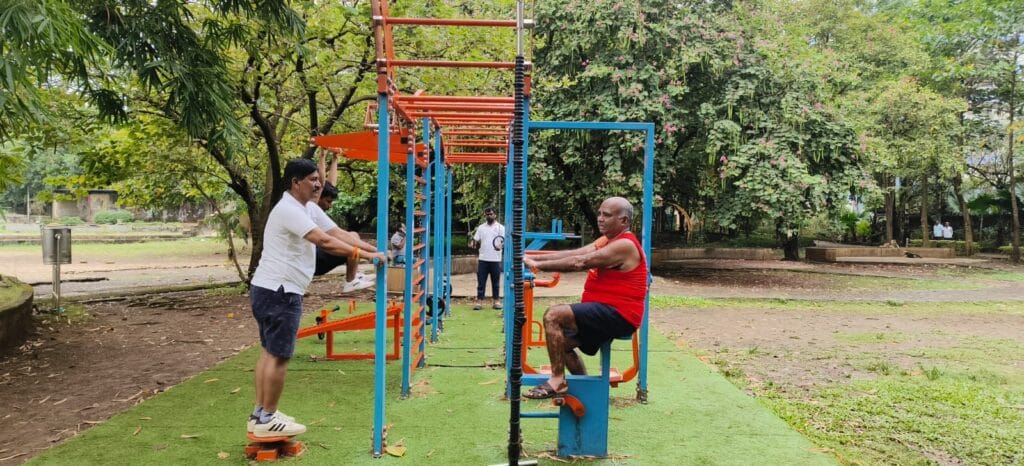
Even in areas with large parks, challenges persist. At Shivaji Park, high-speed cyclists frequently use the walking tracks, making them unsafe and causing accidents. Sudhir Joshi (63), a chemist and long-time resident of Shivaji Park, says, “We can’t even keep our windows open because of the massive dust pollution from the ground.” He adds that the park once had lush grass that helped prevent soil erosion, but today it is mostly bare soil and dust, especially when children play on the ground.
Dilip Herlekar (73), who was born and brought up in Vile Parle, says that the open spaces and playgrounds around their society have steadily disappeared. “When we were children, we played on school grounds or the open plots near our homes. However, over the past decade, many buildings have undergone redevelopment, built up to eight or more floors from two or three. It has reduced the gaps between buildings and wiped out the open areas where children once played,” he says.
“The constant noise of digging and hammering in my area irritates me and gives me a headache almost every day,” says Kirti Sawant (43), a resident of Nehru Nagar in Kurla, another neighbourhood that has been witnessing continuous redevelopment. “The noise begins as early as 7 in the morning and continues until 7 pm,” she says, “I can’t even open my windows because of the dust and the noise.”
Dilip also recalls that they once used bicycles to commute within Vile Parle. “Now, with constant traffic jams and roads packed with parked vehicles, you hardly see anyone using a bicycle in Vile Parle anymore,” he adds.
Read more: Fighting for cleaner air in Mumbai: The role of GRAP and beyond
Climate stress
As redevelopment and infrastructure projects are taken up relentlessly, Mumbai grapples with rising heat, dust and pollution. In recent years, dust-related illnesses have surged, affecting not just the elderly but also children. Doctors are reporting an increase in cases of respiratory diseases: asthma, sinus infections, persistent coughs, and allergies, all of which are linked to prolonged exposure to construction dust.
Dr Sarika Dakshikar, a psychiatrist at St. George Hospital, notes that these physical ailments are often accompanied by mental stress. Many patients rely on medications that cause drowsiness or require extended rest. Disturbed sleep cycles create a ripple effect, such as fatigue, irritability and loss of focus during the day. Over time, such stress can become chronic. Breathing difficulties also limit physical activity. Heat, sweating and dust-related skin problems add further discomfort and emotional strain.
For working women juggling household and professional responsibilities, this slower pace often fuels frustration and anxiety. Doctors observe restlessness, low confidence and mild depression among those affected.
Need of the hour: Climate-resilient and inclusive roads
The streets of Mumbai, like those of many other Indian cities, are critical, open, contributory spaces where several functions intersect. “It is crucial to design the streets to meet all users and uses,” says Dhawal Ashar, programme head, WRI India. “Over the past few years, we have witnessed a rise in climate-related risks, including increased heat and more frequent instances of localised flooding. In this context, the future streets of Mumbai must also be climate-resilient. We have to plan for access, but also shade, pollution, percolation and most importantly, inclusion.”
Dr Alka Subramanyam emphasises that Mumbai can take inspiration from several European cities with designated vehicle-free zones in their centres or specific neighbourhoods. “You either walk or cycle in these areas, which helps maintain clean, pollution-free spaces,” she explains. Mumbai has tried similar initiatives in places like Kala Ghoda, where streets are occasionally turned into vehicle-free zones for cycling and walking events. “But instead of doing this only once a year or on select days,we should work towards creating permanent vehicle-free zones in the city,” she suggests.
She further underlines that relaxation and unwinding are essential, and recommends winding down at least 2–3 hours before bedtime: shutting off work, screens, and stressful tasks. Even if you use your phone an hour before sleep, keep it to light reading or music. Take out a minimum of 30 minutes daily for ‘me time’ — without phones or screens, and preferably while walking in a green space. Engage in playful, relaxing activities, from sports to simple games. Amid the frantic pace of urbanisation, these small acts of self-care could help people stay mentally and physically well.