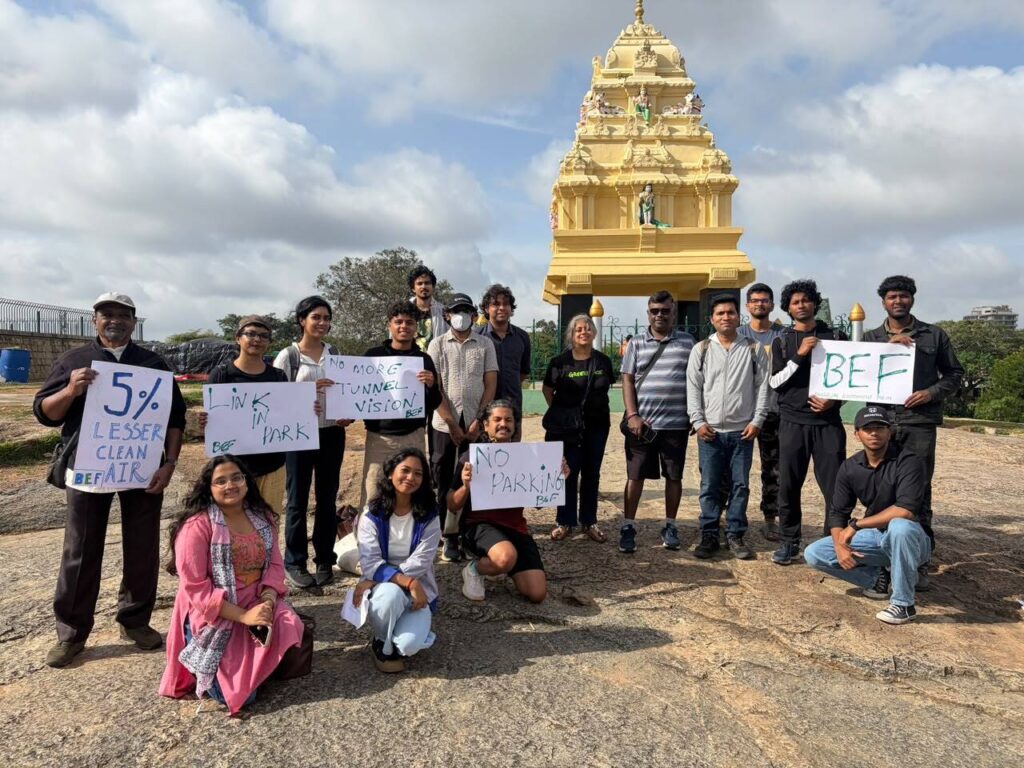
Over 200 citizens, resident groups, environmental organisations and civil society groups have urged the Karnataka government to roll back its decision to amend the Karnataka Government Parks (Preservation) Act, 1975, which would allow portions of parks and gardens to be used for concrete-heavy infrastructure projects. Gathering at Lalbagh Botanical Garden in Bengaluru, the groups showcased a banner saying: NOT 5%. NOT 1 INCH. LEAVE OUR PARKS ALONE.
“Bengaluru is becoming hotter and more climate vulnerable, yet the Karnataka government is making it easier to take away one of the city’s most important forms of natural infrastructure. Parks help cool neighbourhoods, absorb rainwater and provide people with relief from heat and pollution. At a time when the city needs more climate resilience, allowing even portions of these spaces to be diverted is a step in the wrong direction. The government must stop treating public green space as surplus land and recognise it as essential environment safeguard,” said Selomi Garnaik, Climate and Energy campaigner at Greenpeace India.
Demands for conserving green spaces
In a letter submitted to the Chief Minister, the groups demand protection for Bengaluru’s existing parks and green spaces. The key demands are:
- Withdraw the passed amendment to the Government Parks (Preservation) Act that would allow portions of parks and gardens to be alienated for infrastructure projects.
- Ensure that all infrastructure projects first explore alternatives that do not involve the use of existing parks or green spaces.
- Mandate transparent public consultation before any proposal that affects public green space is considered.
- Commission comprehensive environmental, social, health and wellbeing assessments for any proposal that may affect existing parks and green spaces.
Research shows that Bengaluru’s urban green spaces play a critical role in protecting the city from heat. A study of 262 urban green spaces found that parks were, on average, 2.23°C cooler than their surroundings, with their cooling effect extending up to 347 metres beyond their boundaries. In a city facing rising heat and increasing climate risks, the groups say these spaces
are essential to keeping neighbourhoods liveable.
Bengaluru has only 2% of green cover left
Criticising the move, Kathyayini Chamaraj, Executive Trustee at CIVIC said that the legislation was mainly for preserving parks. “You cannot bring an amendment to alienate 5% of the park, which goes against the very objective of the parent Act!”
According to Rajkumar Dugar, Founder at Citizens for Citizens, Bengaluru needs 10 times more parks based on its area and population, than available at present. “The impact on environment, trees to be cut, ecological imbalance, groundwater, cost in terms of redoing the Parks and their compounds, increase in water, air and noise pollution, etc. due to this highly retrograde decision will bring down quality of life of over two crore people living in and around Namma Bengaluru. This decision must be reversed.”
Sandeep Anirudhan, Founder at Conscious Communities called this move “another nail in Bengaluru’s Coffin.” He said, “A healthy urban area requires at least 30% green cover, whereas Bengaluru’s green cover has dropped to nearly 2-3% which is unacceptable. What is tragic is that Bengaluru had nearly 70% green cover just five decades ago. The government’s approach increasingly appears to prioritise real estate and infrastructure interests over environmental safeguards and public interest.”
Read More: Bengaluru: Preference for parks drastically shrinks space available for playgrounds
Leon from Bangalore Environment Forum said that the State government must consult citizens and follow due process through institutions such as the Bengaluru Metropolitan Planning Committee (BMPC), the constitutional body overseeing the GBA and BMLTA. Diluting laws to favour projects, contractors and vested interests is an assault on the Constitution and our democracy.”
The coalition emphasises that urban development should not dismantle the existing ecological and social infrastructure. Parks and urban green spaces must be recognised and protected as essential public infrastructure within the city’s planning and development frameworks.
Read more: Beyond the parks and gardens, Bengaluru’s ‘wasteland’ ecosystems call for protection
The letter has been endorsed many envirinmental and civil society groups including: Greenpeace India, Workers Collective for Climate Justice-South Asia, Citizens For Citizens (C4C), Bangalore Environment Forum, Conscious Communities, Puttenahalli Neighbourhood Lake Improvement Trust, Waste Impact Trust St. Broseph Army, Renaissance Park 3 Apartment Owners Association, Malleswaram Social, Basavanagudi Laughter Club, RR Nagar – I Care Trust, Whitefield Settlers & Residents Association, CIVIC-Bangalore, Paryavarana Trust, Federation of Villa Community Associations of Bangalore, UVDITS, Sarakki Lake Area Improvement Trust, United Conservation Movement, Pay it Forward Foundation, Parisarakkaagi Naavu (People for Environment), ICAR, Emmanuel Heights Committee, Energy and Environment Resource Group Inc., Bengaluru Preja Vedike, Classic Orchards, Evenflow Experiences, Human Rights Defenders Alert India, Metric Stream, Citizens for Sankey, WRI India, Project DEFY, Hebbal Nature Society, Doddanekundi Rising, Sobha Clovelly Apartment Association, Brigade Woods, Samriddhi Trust, Canopy Commons, School of Policy and Governance, Nature’s Craftworks.
Citizens can endorse the joint statement released by the collective against amendment here.
[This article is based on a press release shared by Greenpeace India and has been published here with minimal edits.]