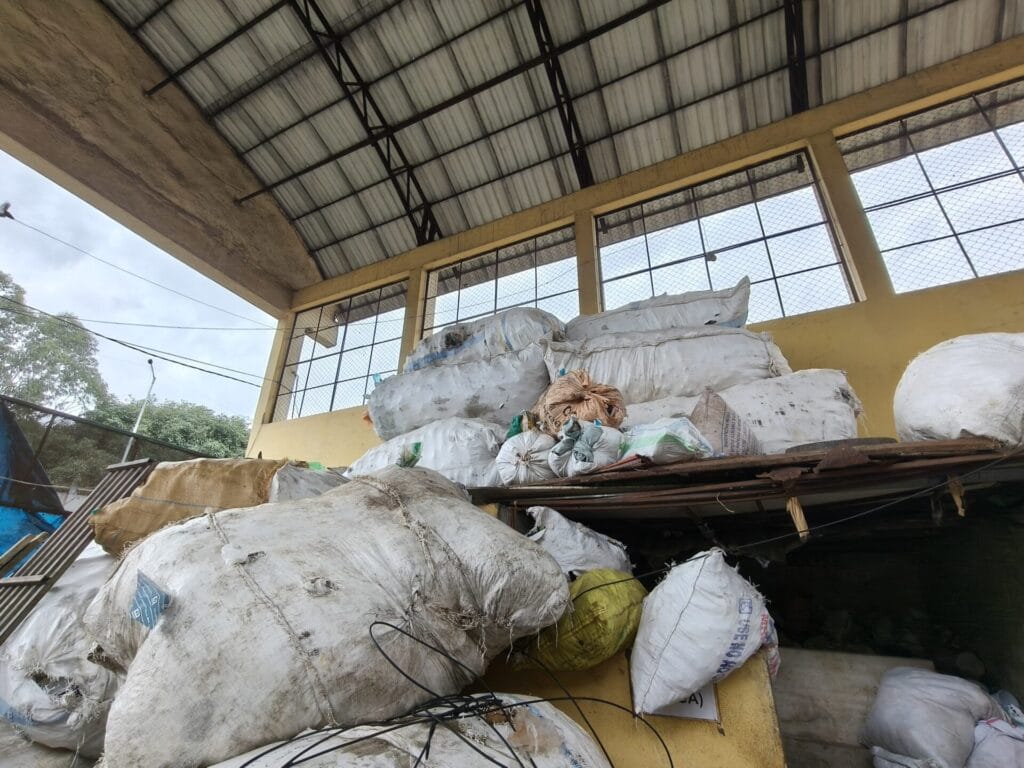
At Bengaluru’s first Dry Waste Collection Centre (DWCC) in Domlur, heaps of waste in segregated piles dominate the landscape. Drivers of collection vehicles and waste pickers work through the piles, segregating waste in challenging conditions.
These centres were established to promote decentralised waste management and improve the livelihood of waste workers. Yet, a decade later, waste pickers continue to struggle without formal employment status, volatile resale prices for recyclable waste, a shortage of quality waste and fragile job security.
Workers at the Domlur DWCC come from various backgrounds. For some, waste picking is a generational occupation — A Krishna, the operator of the DWCC, is a third-generation waste picker.
“Across generations, many workers have been unable to upskill or pursue other livelihoods due to social exclusion and a lack of access to quality education,” he shares. At the same time, many graduates from marginalised communities come to the centre as a last resort, seeking employment because they have either been shut out of the job market or their previous roles offered little respect or dignity, adds Krishna.
Work at the DWCC is highly individualistic. There are no fixed hours, no supervisors, and no rigid structures. This arrangement often appeals to those who feel marginalised in more formal workplaces. Operators we spoke to emphasised that there is no hierarchy in the business, and that the money they earn from reselling dry waste depends on the number of hours each person works.
Despite this autonomy, many waste pickers continue to face a fundamental challenge: the lack of formal recognition and documentation.
Read more: Waste in Bengaluru: What’s creating all those garbage blackspots?
The decentralisation scenario
In 2012–13, under the former Bruhat Bengaluru Mahanagara Palike (BBMP), 198 DWCCs were established, one for every ward. Currently, only 141 remain, and just 119 are operational, which serve 127 of Bengaluru’s wards. Hasiru Dala supports 35 DWCCs, informs Bianca Fernandes, a representative of the NGO that advocates for the rights of waste pickers.
Following the implementation of the Greater Bengaluru Governance Act, the BBMP has been replaced by the Greater Bengaluru Authority (GBA) this month, which now oversees civic administration across the metropolitan region. Under the new system, the fate of these centres is uncertain.
Lack of identity cards and a lapsed MoU
In 2013, waste pickers were issued identity cards by the BBMP, which formally recognised their work and enabled access to welfare schemes such as the Namaste and Safai Karamchari schemes. The Namaste scheme promotes safe, mechanised sanitation through trained workers. The Safai Karamchari scheme supports the socio-economic upliftment of safai karamcharis (sanitation workers), waste pickers, manual scavengers, and their dependents through a range of financial and non-financial initiatives under the National Safai Karmachari Finance and Development Corporation.
Krishna showed us one of these ID cards, which bears the BBMP logo. Hasiru Dala’s social security team works with waste pickers, examines their documents and helps them enrol for schemes for which they may be eligible. For example, the waste picker ID card is sufficient to apply for a ration card.
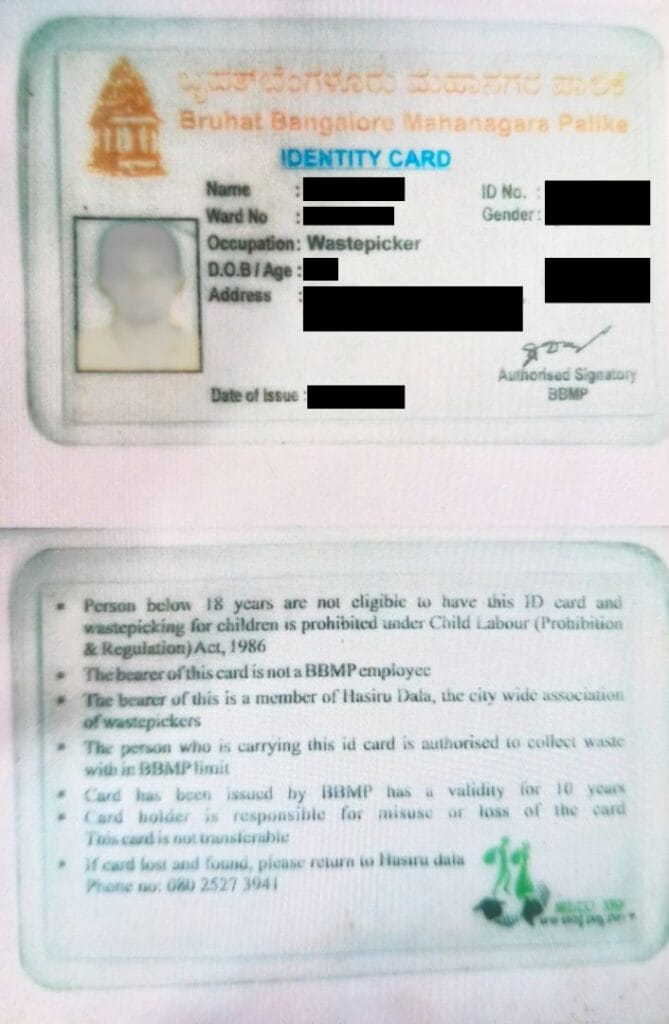
However, the original cards are no longer valid, denying the waste workers much-needed benefits. “These ID cards, issued to waste pickers in 2013, have expired as they are valid only for ten years. In addition, the Memorandums of Understanding (MoUs) signed in 2020 between BBMP and the waste pickers have also lapsed,” says Bianca. These documents were key to recognising their roles as DWCC operators and entrepreneurs, and their simultaneous expiry has added to the workers’ troubles.
No formal recognition for waste pickers
New waste pickers are not able to obtain ID cards, and existing workers are unable to renew theirs. The MoUs, initiated in 2020 and valid for three years, covered every DWCC in Bengaluru. With their expiry, waste pickers are forced to depend on Aadhaar and other IDs to access benefits.
But not everyone has the necessary documentation. Prem, a waste picker working in the Domlur DWCC, lacks a birth certificate and is unable to obtain an Aadhaar card. Moreover, many waste pickers are migrant labour without proper documents and therefore, cannot access the benefits meant for them. This is a gap that the waste picker ID card was designed to fill. “Although talks are ongoing, there is no written confirmation about the renewal of the MoU or the ID cards,” informs Bianca.
But documentation is only part of the challenge. Even when waste pickers are recognised, their livelihoods are threatened by shrinking access to quality waste and unstable earnings.
Waste flow, market volatility and operations
Typically, a driver of a waste collection truck and a DWCC worker visit every area in their allocated region twice a week. K Kumuda, operator of the JP Nagar DWCC estimates her centre can earn up to ₹1.5 lakh from the sale of dry waste in a good month, which must be distributed among all workers according to the hours worked, as recorded in a logbook.
“Every household in Bengaluru produces waste,” says Krishna. “But not all of it reaches us.” This highlights a growing problem in Bengaluru: poor implementation of waste management guidelines and a lack of segregation at source means that DWCCs mostly receive mixed waste. As a result, dry waste, which is critical to waste pickers’ earnings, ends up in landfills.
The BBMP Solid Waste Management Bye-laws, 2020, allow waste pickers to keep the earnings from the sale of dry waste. Plastic bottles have relatively stable prices, but rates of many other recyclable items fluctuate frequently. When waste gets wet, especially during the rains, waste pickers have to undertake a tedious drying process. Despite their efforts, waste pickers are disappointed with the meagre rates they get at recycling centres.
As earnings decrease, so does the work. DWCCs typically engage 20–25 waste pickers; the JP Nagar unit includes 11 women. However, due to falling prices of recyclable waste, mixed waste, and damage from bad weather, many DWCCs are turning waste pickers away. Kumuda notes that only about 30% of incoming waste is of usable quality for decent earnings.
Livelihoods at risk
“Dry waste should reach where it belongs,” Krishna insists. He also urges the government to implement safeguards that protect waste pickers from price volatility in the recycling market. Without such support, Bengaluru’s waste management system, and the livelihoods of thousands who sustain it, remain at risk.
Additionally, Bianca confirms that the BBMP provided initial support in acquiring land and vehicles for the DWCC. However, after the MoU lapsed, the cost of maintenance of the DWCC and vehicles fell on the workers.
Currently, there are no transactions between the waste pickers and the BBMP, and the waste pickers sustain both their operations and livelihoods through the sale of dry waste and various forms of self-financing.
Kumuda says that to cover maintenance and operations costs, the DWCC operators resort to borrowing from informal sources or pledging their gold as collateral. Bianca adds that due to the informality of this sector, people take it upon themselves to sort out any issues they may face. For instance, if a DWCC needs additional infrastructure, such as an extra vehicle, the operators shoulder the responsibility themselves, either by leasing a vehicle or contributing their own for waste collection.
Private players and institutional transition
Despite the critical role DWCCs play, their future is uncertain. A recent transition in waste jurisdiction from the BBMP to the Bengaluru Solid Waste Management Limited (BWSML) has operators, waste pickers and even Hasiru Dala in a state of confusion about the future of waste pickers. The change in Bengaluru’s civic administration adds to the uncertainty.
Until recently, the waste management sector had few competing players. However, many private entities have now realised the commercial potential of dry waste. As a result, app developers and young entrepreneurs have entered this space; examples include ecoSansar and NoKasa. However, not all private players are collaborative and often fail to view waste pickers as partners in their businesses, says Bianca.
As one Hasiru Dala representative observes, waste pickers are unsure whether these changes will offer them opportunities or push them out.
Waste pickers see unity in numbers
In this uncertain landscape, waste pickers have begun to organise. Two years ago, a waste picker union was instituted in Karnataka, and Krishna has taken charge as vice president of the union. It is registered with the State government and has over 2,300 members. It has been involved in an international union of waste pickers, which has over 50 member countries. This has facilitated many conversations about the rights, dignity and recognition of waste pickers on an international platform.
The city depends on waste pickers to keep it clean, yet their work remains precarious, poorly recognised, and unsupported. With ID cards and MoUs expired, volatile recycling prices cutting into earnings, and shifting institutional responsibility creating confusion, waste pickers are being pushed further into informality despite the crucial nature of their work.
This article powerfully exposes the precarious lives of waste pickers in Bengaluru, highlighting systemic failures in recognition and support. The lack of ID cards and expired MoUs are just symptoms of a deeper issue of neglect. Its a stark reminder of the invisible labor that keeps the city clean yet remains undervalued and unsupported.
An authentic exploration of the plight that often goes unnoticed. Kudos to the writers behind this pertinent article!
It’s such a shame how these amazing waste pickers are still fighting for recognition after all this time. They literally keep the city alive and yet have to struggle just to get basic support. Makes you think we’ve got so much more to do to appreciate their work, right?