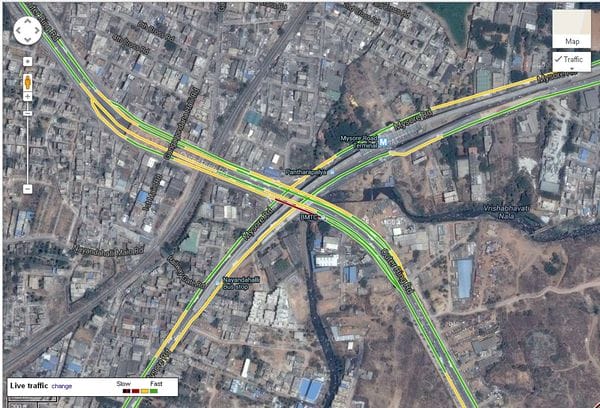
Traffic on Mysore Road. Pic: Google Maps
I am an ordinary citizen of Bengaluru who travels all the way from Rajarajeshwari Nagar to Sarjapur Outer Ring Road for work every day. I almost travel 50 kms each way. On the way, I see that more than 50% of jams are purely because of someone flouting the rules. I thought I must present my thoughts to see whether some problems can be solved.
1. For example, the Rajarejshwari Arch bus stand on the Mysore road is at a traffic trisection, which creates so much of confusion, at all times of the day. Can the police move all such bus stops at least 200 metres away from the signal so that the traffic has a free flow and people don’t get agitated having to wait in signals, when there is actually no traffic load, and it is only an operational issue.
2. The auto stands on both sides of the road at the Rajarajeshwari Arch significantly reduce the road space for the floating traffic. I understand the need of autos and their participating in the traffic but these autos are stationary and chew away one lane on each side of the road. Can we have the auto stands moved to a place where they are accessible and yet allowing the free flow of traffic?
3. The Nayandahalli bus stand in Mysore road (towards Bangalore) is always trouble-stuck just because of the fact we have numerous Cargo vehicles, Tempo Travellers and host of other vehicles just parked waiting for customers or the drivers in their coffee / cigarette / beedi breaks. Compounding to this, one lane already lost by these people, the BMTC buses have no option but to stop in the next lane thereby completely clogging the traffic.
4. Bus stops at all signals, be it in J P Nagar Sarakki Cross, Nayandahalli towards Ring Road, Janata Bazar in Banashankari, or any other place. This is something that needs to be attended to.
5. All flyover exit and entry points are used as bus stops for BMTC and private taxi operators. The worst case is the Private Operators who wait there endlessly for their customers. Mostly the case is true also with buses that are used by private companies to transport staff. I am sure this will need participation from the BMTC and I plan to write a mail to the commissioner of BMTC asking for some attention for the above topics.
6. In the stretch between the Kadirenahalli Underpass to Bannerghatta road junction you will see that at every 100 metres there is a cross road and unmanned traffic intersection which creates so much of confusion. There are indeed provisions at all such roads for people to opt to the right traffic controlled intersection, by letting the flowing traffic move on.
I am sure these small things when implemented can provide really big results and ease your workforce as well.
Kshamisi. Navu irodhu eege. Dhaivittu nanannu badlaisigay prayathne mada bedi. Mysore roadu mess agi irali. Nannagay nanna beedi stoppay uttamma.