Street vending represents a unique form of business in which the vendor’s day begins and ends on the street. Vendors typically toil from dawn until late at night, often for 12 to 14 hours a day, yet many continue to remain economically vulnerable. Poor economic conditions prevailing between 1980 and 2010 forced a large number of individuals to drop out of school, compelling them to take up street vending of various goods as a means of survival.
Today, India is home to nearly 10 million street vendors, accounting for about 15 per cent of urban informal employment. Recognising their contribution to the urban economy and the need to protect their livelihoods, the Government of India enacted the Street Vendors (Protection of Livelihood and Regulation of Street Vending) Act, 2014. The Act seeks to regulate street vending in public areas while safeguarding the rights and livelihoods of vendors.
Who is a street vendor?
A street vendor is a person engaged in the vending of goods, articles, wares, food items, and merchandise of everyday use, or in offering services to the general public in a street, lane, sidewalk, footpath, pavement, public park, or any other public place. Such vending may be carried out from a temporary built-up structure or by moving from place to place using a cart or similar means.
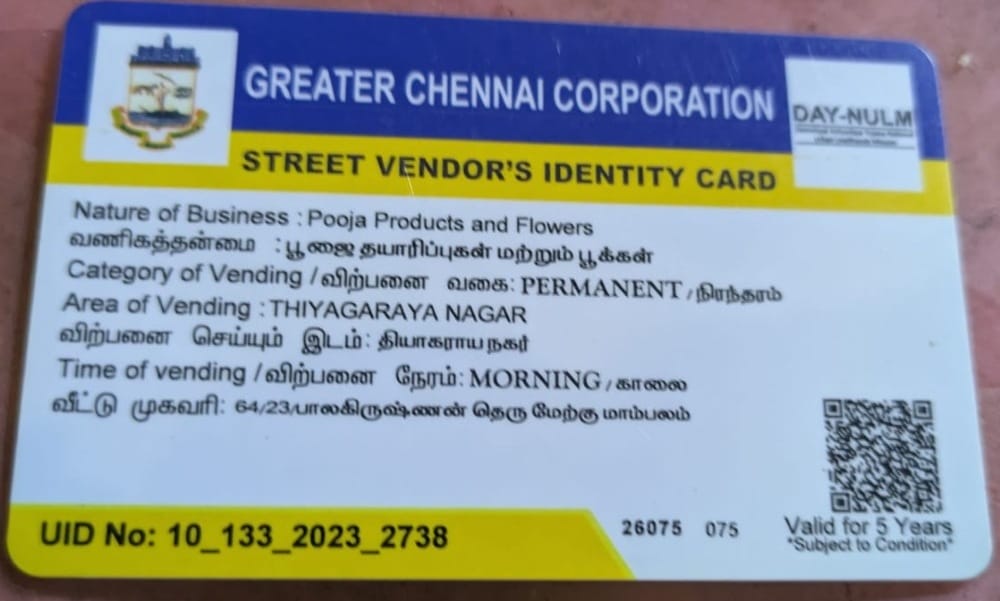
In Tamil Nadu, renewed attention to the issue emerged in 2022 following an incident in T Nagar, Chennai, where the local police forcibly evicted a street vendor. The vendor approached the court, asserting his constitutional right to livelihood. The court ruled in his favour and ordered his reinstatement at the same location. Following this judgment, Town Vending Committees were constituted across all zones in Chennai, and a comprehensive enumeration of street vendors was undertaken. Each vendor was issued an identity card specifying the area and space within which their vending unit is permitted to function.
As per the classification adopted by the Government of Tamil Nadu, street vendors fall into four categories:
- Stationary vendors
- Mobile vendors
- Mobile vendors using motor vehicles
- Other vendors, such as those operating in weekly markets, festival markets, and night bazaars.
they occupy, but vendors demand better facilities and an end
Right to vending and the new GCC order
Although a Government Order mandates licensed vendors to remit fees for occupying public space, compliance had been uneven for several years, and enforcement by the Greater Chennai Corporation (GCC) remained lax.
In December 2025, however, the GCC issued an executive order revising the fee structure and making advance payment of fees mandatory. Failure to remit the prescribed fee would result in the cancellation of the vending licence. The revised fee is as follows:
The full-time, permanent vendors’ fee for space up to 25 square feet will be computed at 1% to 3% of the ‘government guideline value’, with a minimum of ₹750 and a maximum of ₹3,000 per year.
There are 35,588 registered street vendors across Chennai’s 15 zones, though unofficial estimates suggest the number may be close to 200,000. The Greater Chennai Corporation (GCC) is issuing identity cards and collecting annual fees to formalise street vending, giving vendors official recognition while managing public spaces more effectively. In some areas, the process is limited by court-imposed caps and GCC’s own restrictions to ensure orderly use of roads. Chennai currently has 150 vending zones and 188 non-vending zones across its 15 zones. The initiative aims to protect livelihoods while ensuring organised use of the streets.
Read more: How a sustainable approach to hawking in Mumbai can help pedestrians and vendors
The daily grind of street vendors’ families
This writer spoke with over three dozen street vendors in Mambalam, T Nagar, and Mylapore to understand their daily lives and challenges. Sellers of toys, utensils, chappals, fancy items, and other durable goods—products with longer shelf life—usually operate alone. In contrast, vendors of flowers, vegetables, and other perishables face constant pressure to sell their stock the same day, as delays mean direct losses. This urgency often draws the entire family into the business, ensuring quick turnover and immediate recovery of investment.
A typical day begins between 4 am and 5 am. Street vending is often a family enterprise, involving the husband, wife, and in some cases, an adult son or daughter-in-law. The business is largely centred on fruits, vegetables, or flowers.
Men usually travel to wholesale markets early in the morning to procure quantities estimated to last until the end of business hours, typically around 8 pm. Women complete household chores, including cooking, and reach their vending locations by about 7 am. The first two hours of the day are crucial, as the freshness of produce and high customer inflow result in brisk sales. While vendors dealing in fruits and vegetables often enjoy steady business throughout the day, others—particularly those operating near temples—may experience long spells of negligible sales.
The average monthly earnings of street vendors are around ₹40,000, though some report earnings of up to ₹80,000 during certain months. Festival seasons are especially demanding, but vendors approach them with enthusiasm, as occasions such as Pongal, Dussehra, Diwali, and temple festivals significantly boost sales and income. The earnings from these peak periods often sustain families during leaner months. Conversely, the rainy season usually brings a sharp decline in income.
Occupational hazards and the cost of survival
While a section of street vendors has succeeded in providing their children with good education, enabling them to pursue professions outside street vending, many others discontinue the education of their daughters after the 10th standard and induct them into the family business. This remains a matter of serious concern and calls for social and policy interventions to change prevailing mindsets. Although mother–daughter combinations in flower vending keep both fully occupied, such arrangements neither assure social mobility nor guarantee a stable future.
Street vending is fraught with occupational hazards. The profession closely resembles that of a daily wage earner, compelling vendors to work relentlessly for modest and uncertain returns. Those dealing in fruits, vegetables, and flowers must also bear losses arising from spoilage and wastage, as their goods are perishable.
The issuance of identity cards has come as a significant relief to vendors. Before this, they were frequently harassed by enforcement authorities for allegedly unauthorised occupation of public spaces. Their livelihoods were precariously dependent on the discretion of officials. Formal recognition has provided them with a sense of security and dignity.
Nevertheless, the demands of the profession exact a high personal cost. One vendor recounted that for nearly twelve years, she has missed festivals such as Pongal, Deepavali, and Saraswathi Puja, despite living close to her workplace, as early morning business is critical for income. The desire to spend time with her children is consistently overshadowed by financial pressures—a predicament shared by many vendors.
Read more: Smothered by smog: Struggle of vegetable vendors in Delhi’s Keshopur Mandi
What street vendors want from the GCC
- Freedom from harassment: Vendors accept the need to pay fees levied by GCC for occupying public space. However, they expect that payment of fees and possession of identity cards should guarantee freedom from harassment and disruption.
- Protection against eviction drives: Periodic eviction drives by GCC officials often force vendors to shut down temporarily. In some instances, makeshift tables and chairs are confiscated, imposing an additional financial burden on vendors who already live hand-to-mouth.
- Improved street lighting: Night-time vending depends heavily on adequate street lighting. Vendors seek improved illumination, especially in areas where fees are collected.
- Sanitation measures: Mosquitoes and flies pose serious problems during evening and night hours. Vendors want the GCC to implement proper sanitation and pest control measures.
Areas requiring clarification from GCC
If the GCC is indeed keen on the orderly use of the city’s streets, it must address the following issues:
- Auto rickshaw stands occupy roadside and corner spaces and generate a livelihood for drivers. If street vendors are charged for occupying public space, the civic authorities must clarify the rationale for exempting auto stands.
- Two- and four-wheeler repair shops frequently occupy substantial portions of roads, impeding traffic. In some cases, cars are parked continuously on roadside spaces for repair, resulting in permanent occupation of public space.
- Cobblers and beggars also occupy public spaces without apparent regulation. The reasons for excluding them from the ambit of fees for public space occupation merit explanation.
The GCC must adopt a transparent, equitable, and humane approach to ensure the orderly use of city streets. The regulation of public spaces must not come at the cost of the dignity and livelihood of those who depend on it for survival.