The Greater Bengaluru Authority (GBA) released a draft ward delimitation plan that restructures Bengaluru into five municipal zones—Central, South, East, West, and North. This marks a major shift in how the city will be governed, represented, and serviced. The new boundaries will impact every neighbourhood’s access to civic infrastructure, political representation, and administrative coordination.
Oorvani Foundation and Citizen Matters have been tracking this issue for years, and as a part of our flagship programme, Citizen Clinic, we crowdsourced queries and concerns from residents and civic groups. These have been addressed by Vachana V R, Associate Director – Policy, Jana Urban Space and Janaagraha.
Vachana is a public policy professional, and her work spans urban policy research, thought leadership, and systemic policy engagements. She headed the Municipal Law and Policy Program at Janaagraha, where she anchored the Annual Survey of India’s City-Systems (ASICS) report. Vachana has led collaborations with the Comptroller and Auditor General of India and the Principal Accountant General – Karnataka. She has also engaged in projects with the 15th Finance Commission, NITI Aayog, and the Chief Economic Advisor’s office.
Here are the questions and the answers to them:
Confusion regarding boundaries
Q: How will specific boundary and logical disputes be addressed/resolved?
Examples/context:
- Citizens have reported fragmented and illogical ward boundaries. For instance, parts of the HAL region have been added to the newly created Hulimavu ward, despite the considerable distance.
- In some cases, large apartments or layouts are split between wards or even between different corporations, leading to confusion in service delivery.
- The division of existing wards into multiple parts is expected to affect the functioning of Solid Waste Management and Health teams.
A: The State government, through the Urban Development Department and the Directorate of Municipal Administration, retains the authority to issue corrections, modifications, or clarifications to boundary notifications under Section 8 of the Greater Bengaluru Governance (GBG) Act, 2024.
The fragmentation can affect service delivery, especially in the Solid Waste Management and Health divisions, which operate along ward boundaries. The Commissioner of the City Corporation (CC) concerned can issue interim administrative orders in case of fragmentation within a CC. If the jurisdiction overlaps between corporations, then the GBA Commissioner or the Executive Committee of the GBA can intervene.
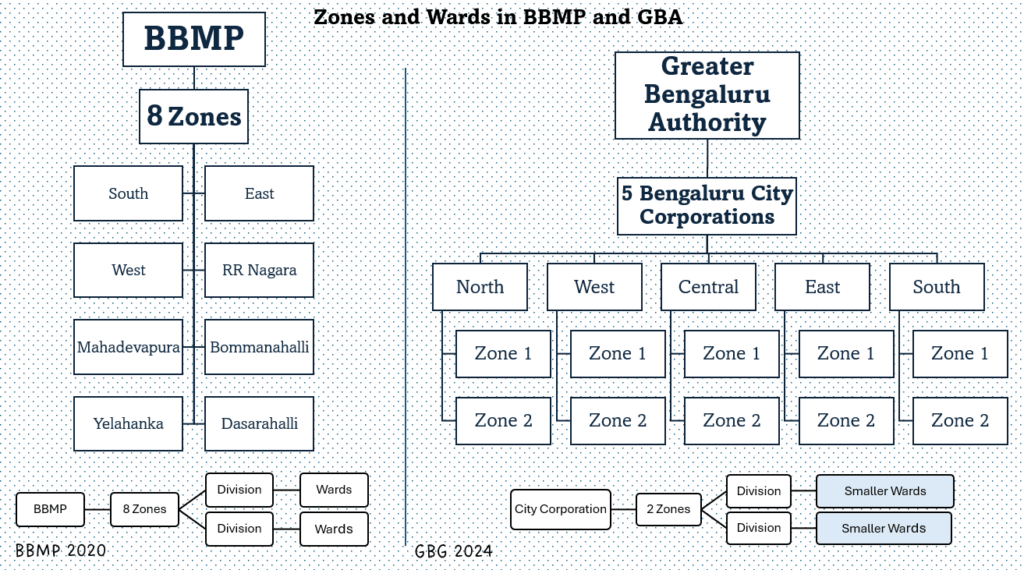
Ambiguity about jurisdiction
Q: How will legal and jurisdictional challenges be resolved?
Example/Context: In Mahadevapura Assembly Constituency, most wards fall under the East Corporation, while a few are under the South Corporation. Earlier, Sarjapur Road served as a clear boundary; now, some apartments on the southern side fall under East Corporation. Citizens are unsure which jurisdiction applies.
A: The CC boundary, as notified, determines jurisdiction for municipal services and taxation. Assembly boundaries remain for legislative representation and do not affect service jurisdiction. Until the transition stabilises, citizens may continue to interact with the existing zonal offices. The GBA’s Executive Committee/Chief Commissioner could also issue directions to resolve jurisdictional overlaps under its coordination mandate.
Read more: Bengaluru local governance: What is changing with the Greater Bengaluru Governance Act 2024?
Levels of communication
Q: What modes and levels of communication can citizens expect about the following?
- Will GBA establish a unified Citizen Portal integrating ward details, official hierarchies, and complaint tracking across all five corporations?
- How will official communication be handled to inform citizens about new ward numbers, corporation boundaries, and service contacts?
- Will the GBA publish GIS-based interactive maps linking old and new ward codes with Assembly segments?
A: The GBG Act explicitly calls for integration and coordination of service delivery but does not prescribe a digital architecture. That said, Section 14 (d) provides that GBA is responsible for the “coordination, execution, and administration of plans, schemes, and major projects,” including the establishment and administration of Geographical Information Systems, Intelligent Transport Systems, and other information and technology-based solutions for coordinating the development of the Greater Bengaluru Area. This opens the door for:
- A Unified Citizen Portal integrating ward boundaries, service hierarchies, and grievance redressal.
- GIS-based mapping tools linking old and new ward codes.

The GBA / UDD official will be better placed to offer information on whether they are planning for implementation. The GBA website provides the current ward and CC details.
Ideally, each CC should issue public notifications and citizen handbooks during the transition.

Transition of existing applications and services
Q: How will ongoing citizen applications (e.g., khata, trade licenses, building permissions) be handled during this transition period?
Example: Residents of Purva Highland Apartment report that their applications are on hold as neither the Kengeri nor Jayanagar divisions are processing them, pending clear jurisdictional guidance.
A: During the transition, pending applications for khata, building plan approvals, and trade licenses are expected to face temporary delays.
The Act does foresee transitions such as assets, liabilities, and rights of bodies being reconstituted. Section 26(2)(i) states that when an area is excluded from the Greater Bengaluru Area, the rights and liabilities of the City Corporation in that area are automatically transferred to the Government. Section 26(2)(ii) says that the State will decide what portion of the City Corporation’s funds and other property shall vest in the Government for the benefit of the inhabitants of such local area, and how the liabilities will be divided.

So, while the Act does provide for the transfer of property, rights, and liabilities when an area is included or excluded under a City Corporation, it does not clearly spell out the procedural details for every type of existing application/service being transferred seamlessly. For citizens, this may necessitate rules, notifications, or orders from the Government or CCs to operationalize the transition of pending applications and services.
Read more: Greater Bengaluru Governance Bill: Where is Brand Bengaluru vision? And the people’s voice?
Financial clarity and uniformity
Q: Will property tax rates, garbage cess, and licensing norms remain uniform across all five corporations, or will they vary? Will a unified property tax code be issued for the entire GBA area, especially considering earlier inconsistencies in the erstwhile BBMP system (e.g., parking area inclusion and zonal disparities)?
A: Currently, property tax rates, cess, and licensing norms are expected to remain uniform across all CCs. The Act empowers the GBA to frame regulations across CCs. Over time, the GBA may recommend harmonised tax codes to prevent inconsistencies.
Coordination among parastatals
Q: Will GBA’s directives be binding on key service agencies such as BWSSB, BESCOM, and BMRCL to ensure functional integration and accountability?
A: This is one of the most significant structural shifts under the GBG Act. The GBA’s directives are binding on all public authorities operating within the Greater Bengaluru Area, including BWSSB, BESCOM, BMTC, and BMRCL. Section 14 (4) empowers the GBA to coordinate, supervise, and direct the functioning of these agencies for integrated planning and project execution. In effect, the GBA can provide policy-level coordination and approval, but functional autonomy of these agencies continues to be governed by their respective Acts.
While the draft maps are now public, many citizens and RWAs have raised concerns about community fragmentation, lack of clarity, and limited consultation. These issues underline the need for greater transparency and clarity in explaining the restructuring process and its implications for everyday governance.