With eyes closed, *Jayalakshmi wades in and weaves through the Great Salt Lake, in the Kovalam-Nemmeli backwaters, her fingers scooping up prawns and fish. From morning to evening, she fills prawns inside a bag punctured with holes at the bottom. For as long as she can remember, the 43-year-old, who belongs to the Irular community in Thiruvidanthai, Chengalpattu, has practised the art of catching prawns and fish, by hand.
“Everything depends on this aaru (the lake). We know exactly where the prawns are, beyond the thorns, snakes and seru(mud or mud flats ”she says. The salt burns her eyes and scarred fingers but is crucial for the breeding of the benthic species that grow in the brackish water.
This lake, a 20 minute-walk from her home, provides Rs 200-500 a day and a meal for her family. Purattasi (mid-September to mid-October season) is the best season and we pick three varieties of prawns, including white and kadambu prawns, and crabs, says Jayalakshmi.
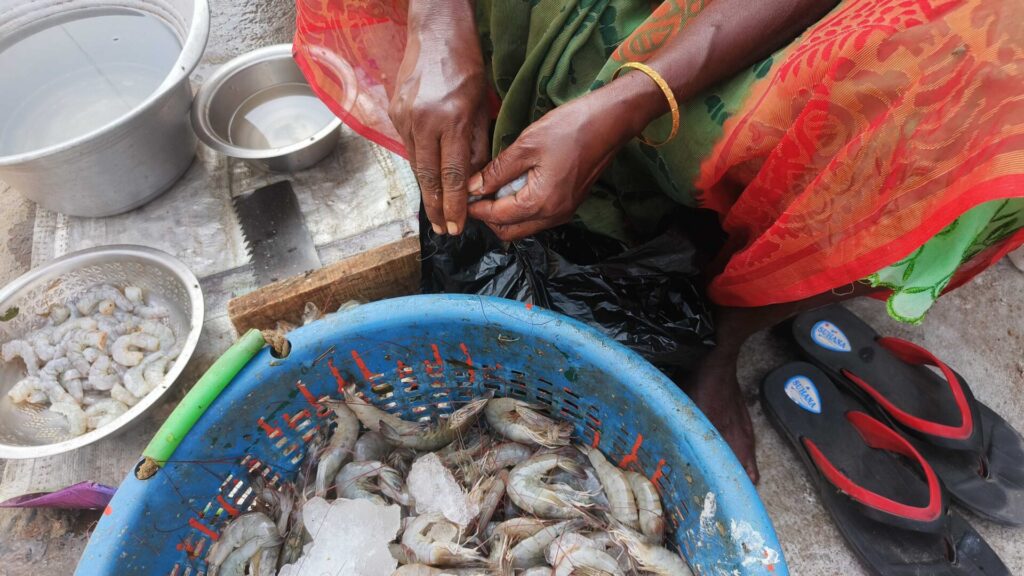
Jayalakshmi is only one among the hundreds of fishers in Kovalam who worry that their livelihoods will be wiped out entirely by the next Purattasi. Just a few kilometres from where her settlement is, Chief Minister MK Stalin laid the foundation stone for Chennai’s sixth reservoir, on January 19, 2026. This new project aims to create a freshwater reservoir in 5000+ acres of coastal wetlands, including marshes, former salt pans and parts of this lake, located between East Coast Road (ECR) and Old Mahabalipuram Road (OMR).
The entire area of this wetland is 8500 acres, according to official documents. “But allowing only freshwater in this wetland will wipe out all organisms here and our livelihoods,” adds Narayanan R, a fisher community member in Kovalam panchayat. Citing this, fisher communities gathered at the backwaters of Vada Nemmeli in February to protest the reservoir project, asking for it to be shelved.
At the receiving end, always!
This is not the first time, however, that Chennai’s water needs have been addressed at the cost of the fisher community. The past few years have seen many fishers moving from the sea to inland lakes and waterbodies, such as the Great Salt Lake. “Over the past 20 years, the catch has come down drastically in the sea,” says Narayanan.
Fishers attribute a lack of catch in the sea to pollution in the sea, the Madras Atomic Power Station in Kalpakkam, and the 150 MLD Nemmeli desalination plant in Suleri-Kattukuppam. While the desalination plant supplies 100 million litres of drinking water per day mainly to the city’s southern suburbs, residents in Suleri Kattukuppam face seawater intrusion, salty groundwater, and coastal erosion.
This desalination plant was later expanded in 2016, affecting sand dunes.“After the plant came, the government began converting seawater to freshwater and let out treated water into the sea. The fish disappeared after that,” says Sasikumar, a member of the Suleri-Kattukuppam Panchayat.
Read more: Nemmeli: Quenching Chennai’s thirst, but at what cost?
Across the 16 coastal hamlets, residents say that government policies have repeatedly failed them. Projects like The Blue Flag Beach, announced in 2021 in Kovalam, restricted traditional fishing practices such as cast and seine netting, drying of fishes, and boat access.
Now with the Mamallan reservoir in the works, these fishing communities are apprehensive of their current source of catch also drying up. At Kovalam fish market, Vijalayakshmi, a vendor, worries that her basket of prawns will no longer be full. As the sole breadwinner of her family of four, she says, “After this, we will be forced to clean up our homes or take up some other livelihood.”
Why the government wants a reservoir
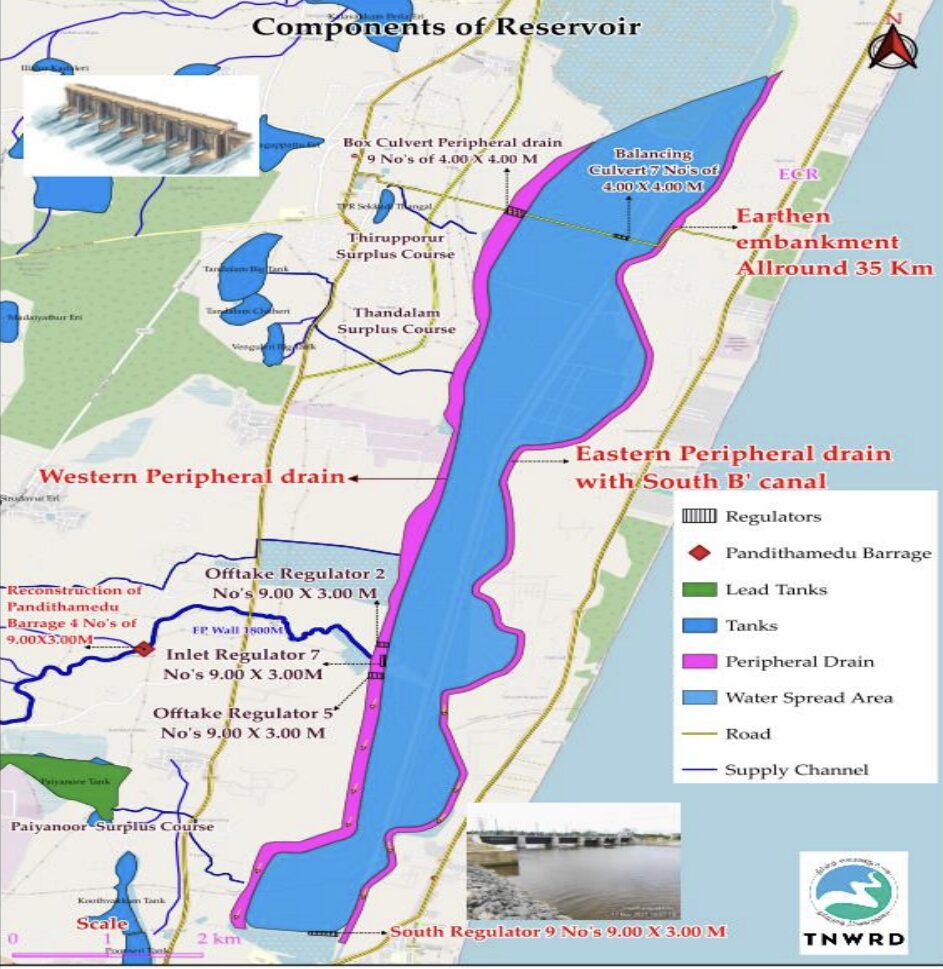
Official documents state Chennai requires 1100 million litres of water per day (MLD), versus the supply of 700 to 800 MLD. The water demand in Chennai is projected to rise by over 2500 MLD in the city, according to the project agenda.
The Mamallan reservoir, at an estimated total cost of ₹471 crore, is envisioned to have a storage capacity of 1.65 TMC of water. The project’s site justification mentions that it will utilise surplus water that drains from 69 upper tanks into the present catchment area, identified to cover 41,408 hectares (ha). A 34-kilometre embankment is to be constructed around this reservoir.
Other claims are:
- This will mitigate floods
- It will meet drinking water requirements of 50,000 inhabitants across 12 villages and peri-urban areas.
- It will mitigate seawater intrusion
Phase I of the project spans 4375 acres of the Kovalam-Nemmeli ecosystem, approximately 65% of which is across Kazhuveli land (marshy land) and 35% Uppangazhi land (salt pans). These lands have been earmarked as Water Resources Department and revenue lands.
Claiming that the formation of coastal reservoirs represents a paradigm shift in water resource development, the EIA states that, “Instead of storing water in mountainous dams, which capture runoff from limited portions of the catchment, coastal reservoirs allow for the storage of water in estuaries, capturing excess floodwaters from the entire catchment area.”
So where is the problem?
The problem arises when one looks at the impact on the larger fishing ecosystem. The coastal wetland which is around 8000+ acres, and contains several prawn and fish breeding grounds. The Kovalam-Nemmeli backwater system is a critical coastal wetland. The wetland and the sea is separated by a narrow dune-studded space which houses over 16 fishing villages.
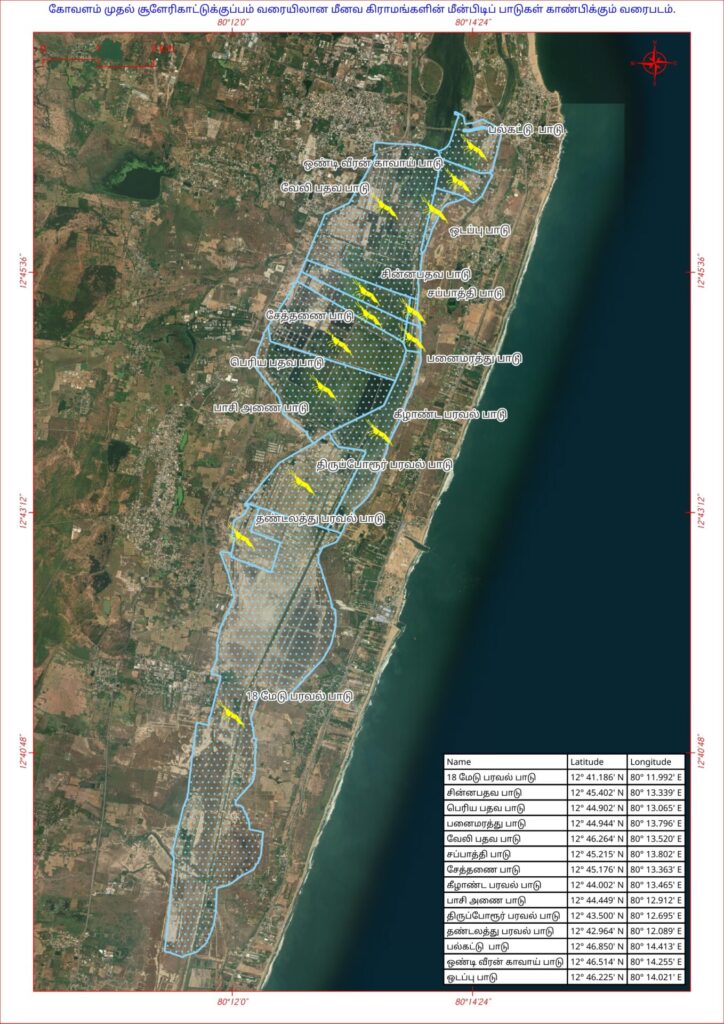
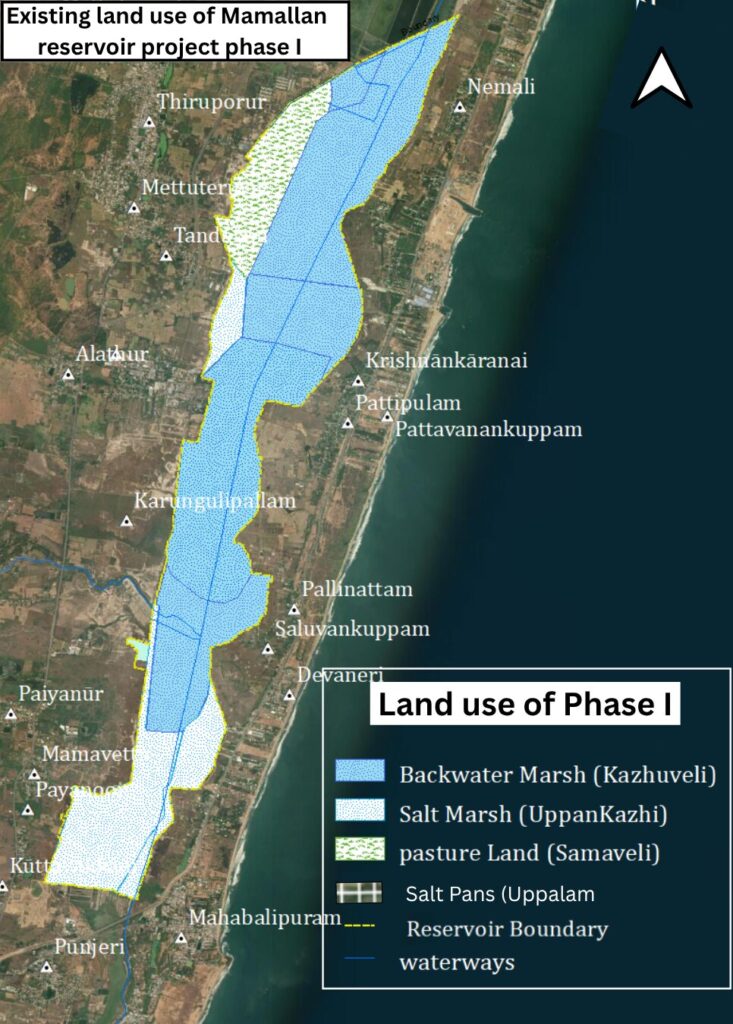
“It has two connections with the sea – the Kovalam estuary on the northern side and Kokilamedu on the southern side. There is a daily exchange of seawater with the estuaries, which floods the wetlands, based on the height and strength of the tide,” explains Nityanand Jayaraman, an environmental activist.
Dotted with mangroves, shallow water pools and salt marsh vegetation, the area contains nurseries for both the prawn and fish. “Many fish here lead a double life – they come and go back to the sea. They come to the estuary because unlike the open waters, it provides shelter,” adds Nityanand.
Marine biologist T D Babu further points out that the lagoon is a habitat of many marine molluscs (bivalves, gastropods, crustaceans) and fish. Humans cannot create or replicate such habitats artificially anywhere else.
“Many marine species migrate to this lagoon to breed and feed, and this serves as nursery grounds for their young ones. For fishers, especially for ladies and senior citizens, it provides a potential inland fishing ground at no cost (no fishing boats required). Moreover, this serves as a dining area for both resident and migratory birds which visit here in lakhs from Europe and Russia. ” he adds.
“There is a complex network at play here, where the fish and prawn species lay eggs, grow and slowly move out to the estuaries. They then go to the sea and grow. For instance, prawns grow from a few centimeters to much larger. The salinity, rain, and pH levels are crucial,” says Suresh A, a traditional fisherperson.
“The estuary is expected to have high salinity and the tidal wetlands are expected to have brackish water. Every place has its own ideal for the vegetation and the animals that thrive in that kind of a neighbourhood,” says Nityanand. If this becomes a fully freshwater regime, the species gets affected too. Salinity levels change across the estuarine levels but any sudden fall in salinity, change in pH and specific density can cause heavy kills to species according to a manual for brackish water culture.
It may be noted that the Rapid Environmental Impact Assessment (REIA) for the reservoir was conducted over three months, whereas experts say salinity changes throughout the year, and needs to be studied over two monsoons at the least. They add that this wetland also serves as a natural buffer against flooding, erosion and storm surges, which will be affected once the reservoir comes up.
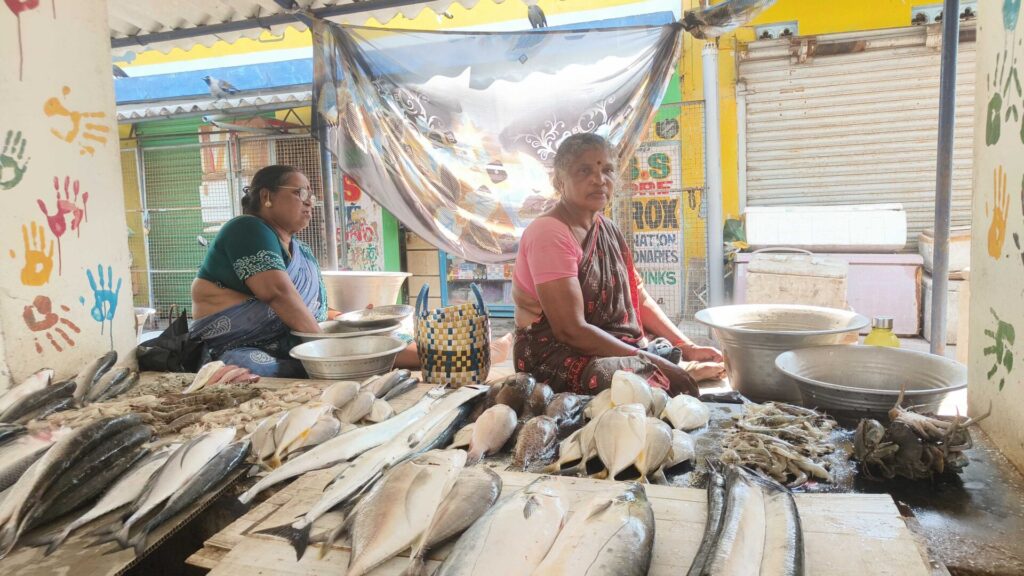
During peak season, such as November to December, this ecosystem and the aaru yields at least 10 kilos of prawns and brings in anywhere between Rs 2000-4000 as profit, for a day to fisherpersons. Other times, it is still dependable – yielding at least an income of Rs 500 a day.
As Malar, a fish vendor in Kovalam market, says, “Idhu namba poorviga sothu, nammaku nelam illa, valai mattum dhaan (This is our ancestral wealth. We don’t have anything, just our nets)”. Fifty-seven-year-old Malar is among the 100 women in the market that make ends meet by selling and cutting fish, prawns and crabs, earning anywhere between Rs 500 to Rs 1000 a day.
This is seconded by Kavipriya’s family in Kovalam. During the pandemic, as work dried up, this estuary came to the rescue. With no money for a boat, she said, her husband went fishing with a few nets and this propelled them through tough times. Three months of fishing at the lake during the peak monsoon season, between September to December, could yield an income of anywhere between Rs 1-3 lakh. “We pay off our debts, pay school fees, make new purchases and even save up during this time,” says Kavipriya.
Netmakers, vendors and salt pan workers will also be hit by this move, say fisherfolk. According to the EIA, 47% of the population in the district work on agriculture, specifically groundnuts, paddy, gingelly and other crops. This could be affected by potential salinity intrusion by the project, say experts. Around 35% of the land in the project area is estimated to be Uppangazhi land (salt pans), where few communities continue to toil to make salt. It may be noted Tamil Nadu and Gujarat are major contributors to India’s average annual salt production of 300 Lakh tonnes.
Loss of indigenous knowledge and practices
Some fishers have reported that in some areas, branches have already been laid to obstruct the path to the lake. Construction work for the dam in other spots also commenced in other places in February this year.
But all 20 persons we interviewed around the region reported that there had been no public consultation about the issue. Near Thiruporur farmlands, two women said they had no idea about this project at all.
This coastal stretch is also a rich storehouse of indigenous knowledge, where skills, beliefs, norms, practices and behaviour patterns have been handed down through generations.
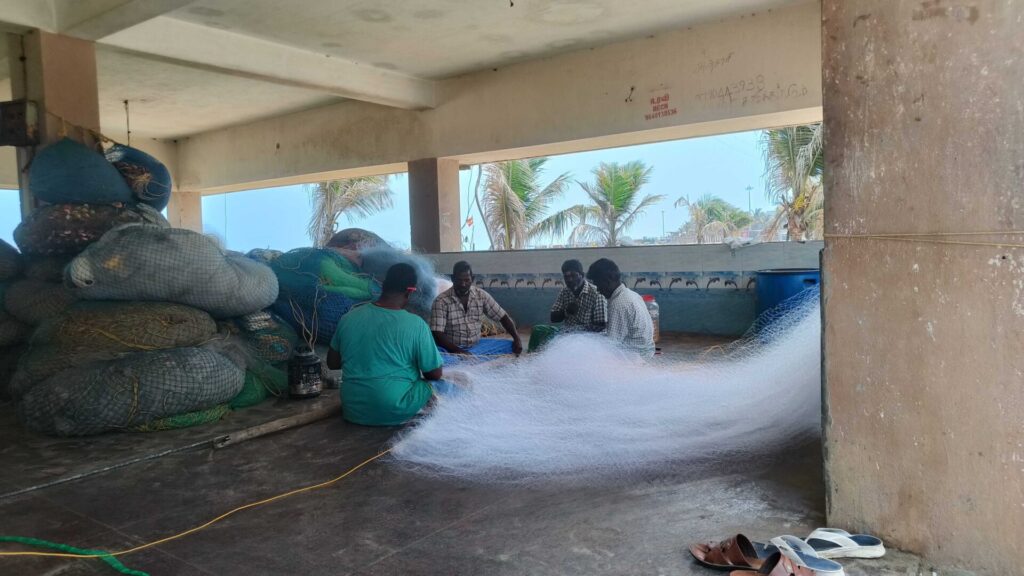
At Kovalamkuppam, Dhesingh, a community leader, shows Citizen Matters, several nets – “Oru meenu ku oru vala, oru season. (One net for one type of species, one season).”
Traditional fishermen head out to sea in groups of four to six, and return with kilos of catch, from red snapper, crabs, seerfish and many others. Armed with needles, they know the art of mending every type of net. This indigenous knowledge stands to be lost in the face of the project.
At Suleri-Kattukuppam today, the community’s boats, baits and nets lie unused. Around 300 families here depend on the Great Salt Lake, and the air is tense. “Our forefathers were fishing, and this has been passed on through generations. Our fishing villages have been around for over 300 years,” says J Palani, a fisher and resident.
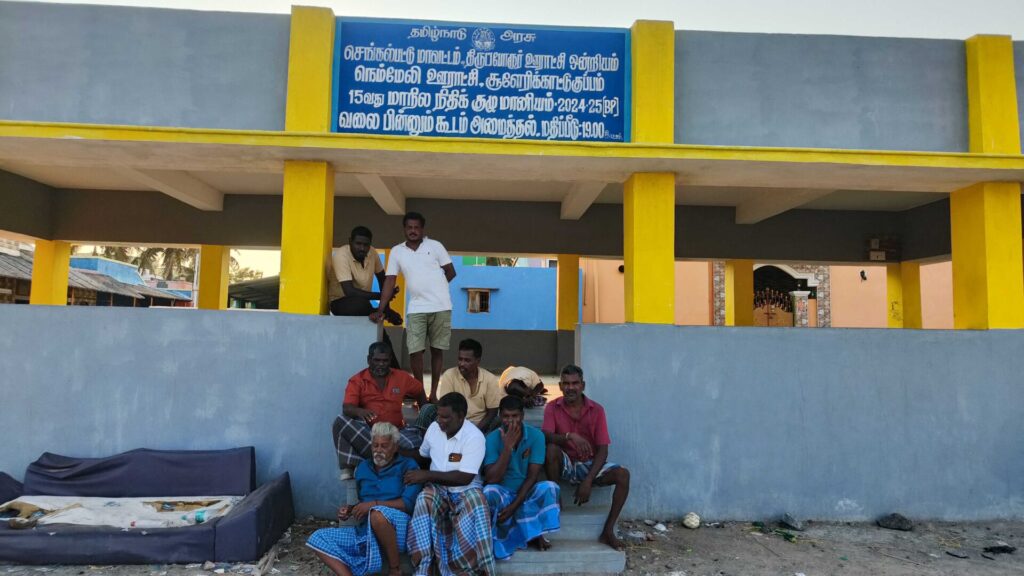
“In January, February and March, boats would go with big nets and come back with nethilli (anchovies) as it was the season. In monsoon, it was prawn, and now both have reduced drastically, in the past few years,” says a member of the NGO SEA Organisation, requesting anonymity.
Unregulated focus on tourism has also affected the environment adversely, the member adds. There are over 100+ hotels and restaurants, the member estimates, and over 27 five-star-hotel buildings close to the shore. Previously, hotels have been fined for unauthorised constructions near the High Tide Line.
“We didn’t ask the government for anything, They don’t think of us as people. They tell us [projects like this] may raze one town, but hundreds of people will benefit from it,” Rajamuthu, a former panchayat head. But he warns – the sea cannot be controlled, it will find some way in.
What residents and experts recommend:
- Drop the Mamallan Reservoir plan and provide policy to protect traditional fisher livelihoods.
- Declare this area as Mamallan Lagoon.
- Halt increasing urbanisation in this area.
*Names changed