As the lunch bell rings at Greater Chennai Corporation’s (GCC) Chennai High School in Adyar, students line up eagerly for their midday meal. Seated in groups, they chat happily while enjoying vegetables grown in their school’s terrace garden, which they helped plant and nurture. Once lunch is over, every student deposits food waste into a dedicated bin.
This seemingly small act is part of a much larger system. The food waste, along with kitchen scraps, is fed into a biogas plant located within the school campus. The biogas generated powers the school kitchen, while the resulting slurry is used as fertiliser for the terrace garden and composting leaves. This closed-loop system has already diverted around 1,800 kilograms of food waste from landfills over the past six months.
Chennai High School in Kamaraj Avenue, Adyar, is not just setting an example in managing its food waste; it is equipping the next generation with hands-on knowledge of sustainability. But this transformation did not happen overnight. It is the result of six years of consistent community engagement and thoughtful planning.
Read more: Kasturba Nagar programme led by residents’ group turns waste into soil
How the journey began
The initiative began in 2019, when the Greater Chennai Corporation (GCC) partnered with the Residents of Kasturba Nagar Association (ROKA) for a weekend collection drive for e-waste and textile waste. “We collected over 750 kilograms in just three days,” says Janani Venkitesh of ROKA. As the campaign grew, the school campus became the drop-off point, with students volunteering. This marked the beginning of ROKA’s partnership with the school.
During the COVID-19 lockdown, ROKA volunteers provided breakfast to conservancy workers at the school, consciously avoiding plastic and disposables. This deepened their engagement with the school.
In 2020, ROKA began addressing the growing issue of food waste. “We noticed large quantities being sent out. So we started composting using the existing well rings,” says P Saranya, another ROKA volunteer.
The launch of the government’s breakfast scheme increased the amount of liquid food waste, like sambar and kuzhambu. “This kind of waste is difficult to compost. It smells and attracts rodents. A biogas plant was a more practical solution,” Saranya explains. The well rings are now used for composting leaf litter.
Building the system
With funding of ₹5.5 lakh from the Environmentalist Foundation of India and Avris Environment Technologies (a company that provides food waste treatment solutions), a 75-kilogram capacity biogas plant was installed in December 2024. Avris supplied the system and handles its maintenance.
At the same time, the Chennai Resilience Centre (CRC) set up a terrace garden under the Urban Thottam programme. Now, vegetables from the garden go to the school kitchen, where meals are prepared for 275 students.
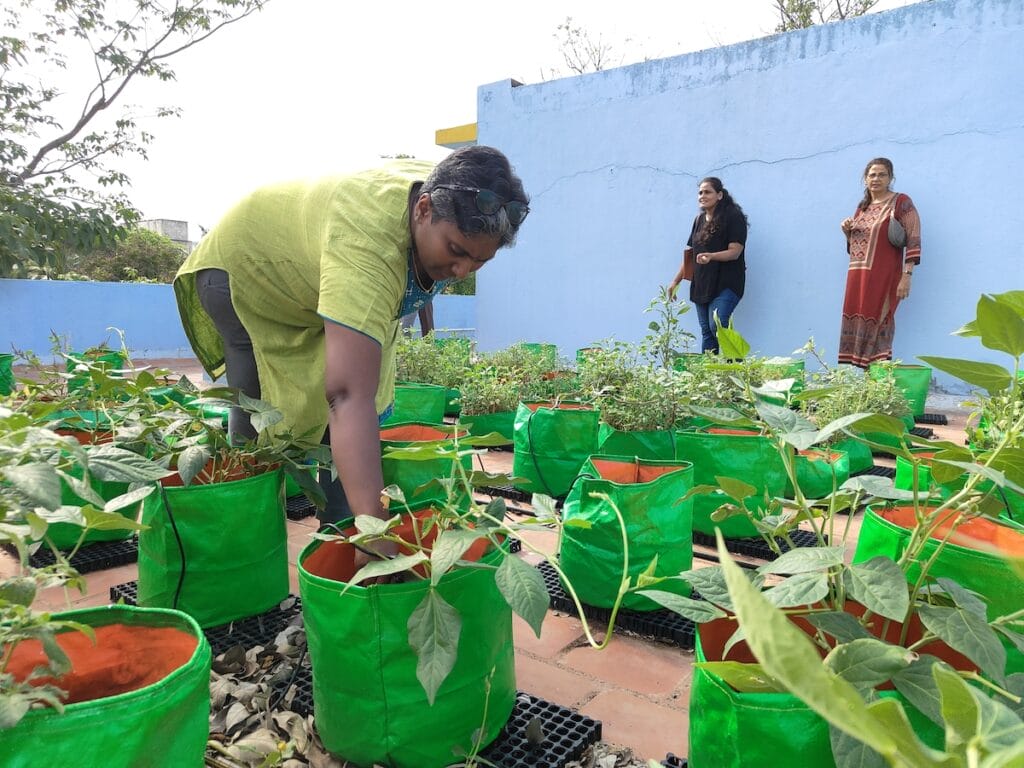
CRC also installed sensors to study temperature changes in classrooms beneath the terrace garden.
Read more: It’s SIMPLE: How a community in Chennai is striving to become zero-waste
How the biogas system works
Each day, food waste is mixed with water and added to a sink with a crusher, which even breaks down meat bones. The crushed waste goes through an inlet barrel into a digester.
“When we add 75 Kgs of food waste along with 75 litres of water, the system processes 150 litres of slurry within 24 hours,” Saranya explains. This slurry, when diluted, becomes a nutrient-rich fertiliser used in the school garden.
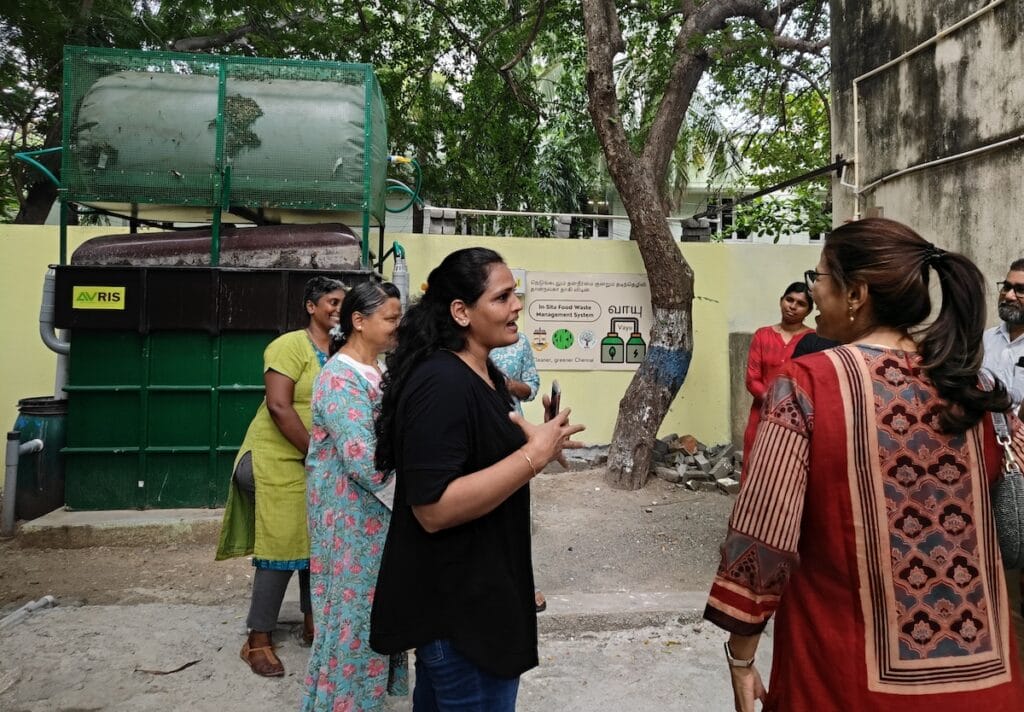
The biogas generated is stored in a balloon fitted on top of the system and piped directly into the kitchen. “Since regular burners cannot use biogas, we have installed a dedicated burner,” says Janani. Other than manually feeding the waste into the crusher, the system is fully automated.
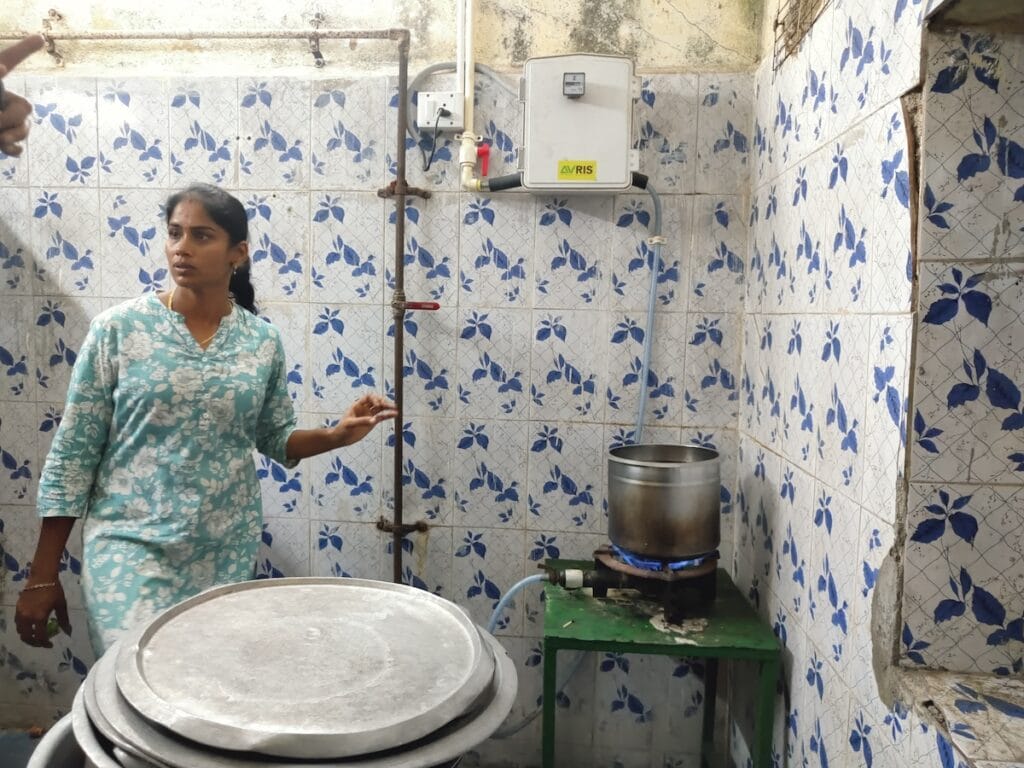
A metre tracks usage hours, and a logbook records waste input and gas output. To keep the system active during school breaks, cow dung slurry is added regularly.
Measurable impact
Between December 2024 and mid-July 2025, the school processed 1,800 kg of food waste. The biogas-powered stove ran for approximately 200 hours, averaging 2 to 2.5 hours each day.
This has allowed the school to save the equivalent of three commercial LPG cylinders (19 Kgs each) or six domestic cylinders (9.5 Kgs each). “Biogas has a lower calorific value than LPG. You need 2 Kgs of biogas to replace 1 kg of LPG,” Saranya explains.
The system is not only reducing waste and costs, but also transforming how students learn. Vijayalakshmi M, the school’s science teacher, believes that the terrace garden and biogas plant have brought science lessons to life for her students. “Once or twice a week, I take students to the garden during science periods or through the eco-club. It helps them understand root systems, drip irrigation, and plant growth practically.”
Students help with weeding, watering, and harvesting, while also learning how waste is composted or turned into biogas. “Having a real system on campus shows them how waste becomes energy. It is far more effective than blackboards or smart classes. I always prefer practical learning.”
The impact has extended beyond school. “Among 55 students in one batch, at least 20 have started growing plants at home,” she says with pride.
Challenges along the way
While the system is largely sustainable, it has not been without difficulties. One of the key limitations is the mild flame produced by the uncompressed biogas. “We use a booster pump to increase the flame, but compressing the gas like LPG would make the process costlier and more complex,” explains Saranya.
Initially, the kitchen staff were hesitant, as cooking with a mild flame takes longer. “We addressed this by asking them to use the biogas burner for supplementary tasks like boiling eggs or chickpeas. Over time, they adapted,” Janani says.
Maintenance posed another challenge. “As residents, we lack the technical expertise to maintain the biogas system. Fortunately, the team from Avris has been highly responsive, which has made ongoing operations manageable,” Saranya notes.
Under the current agreement, Avris will handle maintenance for the first year. After that, an annual maintenance contract will be essential to keep the system running smoothly.
Plans for expansion
Saranya believes this model can be applied in other locations that produce large amounts of food waste, such as marriage halls, cloud kitchens, and restaurants. “It doesn’t require much space. All it needs is an initial investment and a mindset to follow through,” she says.
Encouraged by their success, ROKA plans to replicate the project in another GCC school in Thiruvanmiyur. This school has even greater potential, with a larger kitchen that provides breakfast to 20 schools, lunch for 700 students, and meals for three anganwadis in the area.
A model worth replicating
Chennai High School in Adyar has quietly become a beacon of sustainability. By connecting food production, energy generation, and waste management, it demonstrates that practical, local solutions can lead to meaningful change. Most importantly, by involving students at every step, the school is sowing the seeds for a more environmentally conscious generation.