The Lok Sabha Elections (General Elections) 2024 are coming up in a matter of months. Elections are crucial in a democracy like India, as it allows citizens to choose the leaders, who will govern the country for the next five years. How we vote has a direct bearing on the formation of the government at the Centre, and therefore, it is important for all eligible voters to exercise their franchise.
If you are gearing up to vote in the parliamentary polls in April-May, it is essential to ensure that your name is the electoral rolls. Have you registered as a voter? Are your records all in order?
Some states have released their final electoral rolls, while others are yet to do it. According to the Election Commission of India portal, the voter list will be updated till the last date of filing of nominations by the candidates.
If you have not yet registered, or you want to make changes/corrections to your name or address, here’s how you can do it.
What is voter registration?
It is a process in which an individual’s name is added to the list of eligible voters. This is done by making a successful application to register one’s name in the rolls. To be eligible to vote in the upcoming elections, a person has to be,
- A citizen of India
- 18 years of age and above.
In India, voter registration can be done through the voters’ service portal, https://voters.eci.gov.in/. First-time voters have to use Form 6 to make the application.
What is the process for a new registration?
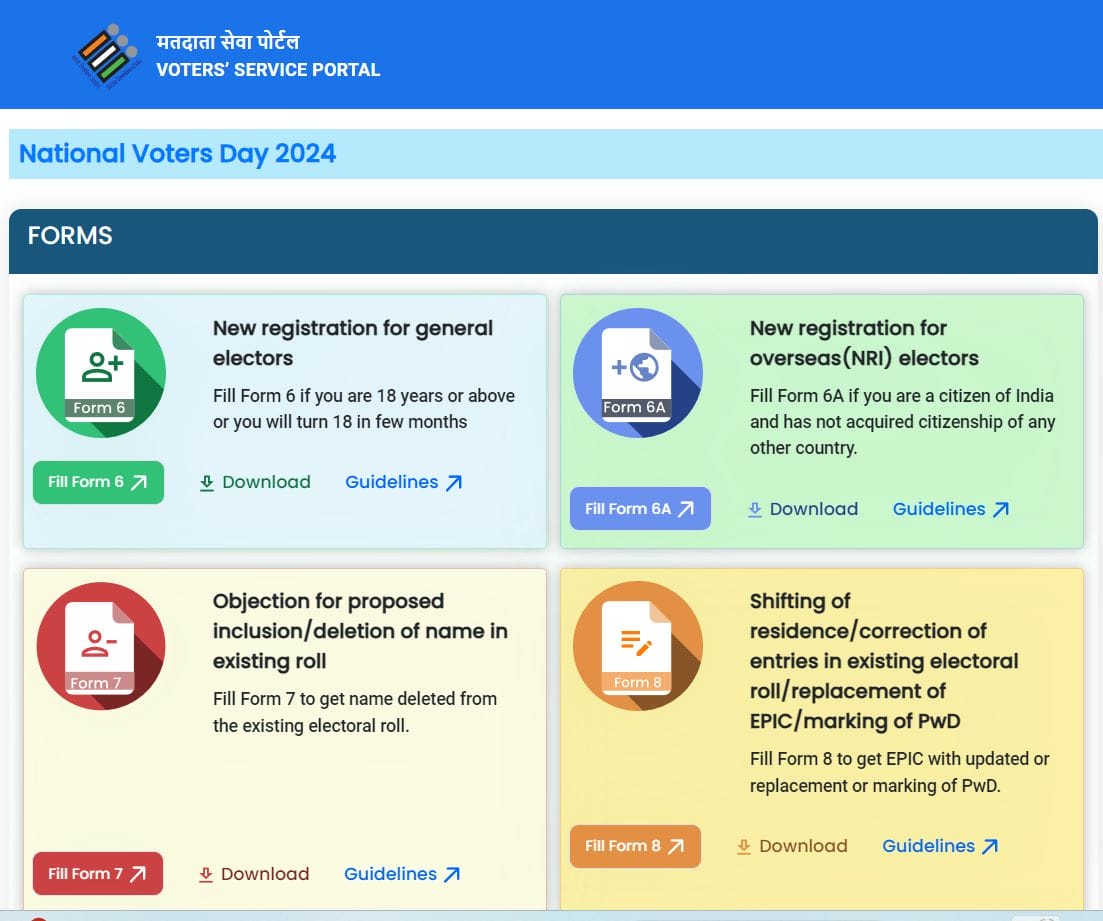
This is how you can register:
- Go to the website, download and print the form, enter all the necessary details such as name, relative’s name, address and so on and provide identity and address proof. Don’t forget to attach your passport size colour photo. This can be handed over or posted to the nearest Electoral Registration Office (ERO). You can search for your constituency and the ERO through the same portal.
- You can also register online through the voter services portal or the Voter Helpline mobile app. Just fill the necessary details online and upload a passport size photo of yourself along with documents for address and identity proof.
- The same form can be used if you want to shift your name from one constituency to another.
- Non-Resident Indians have to register by filling Form 6A.
- Objections/deletions to the existing roll can be made through Form 7
- Form 8 is for corrections to the entries/shifting of residence within the constituency.
Documents for identity proof include Aadhar card, passport, PAN card or driving licence. For address proof, ration card, electricity bill, Aadhar card or passport can be uploaded.
In case you want to make corrections to your name or address, the same documents as mentioned above can be attached (or uploaded online) while submitting the required form. For change in address within the same constituency, there is no need to produce any documents.
Read more: Explainer: Should we worry about linking Aadhaar and our voter ID?
Tracking your application
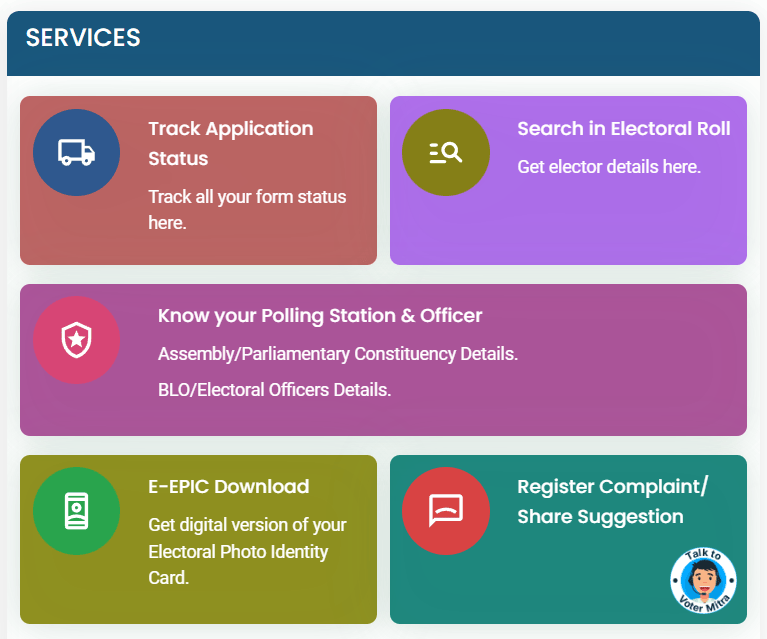
You can track your application status by logging in to the voters’ service portal. Once your application is successful, you will be allotted the nearest polling booth. You can search for your polling station through the website.
You will be issued an Electoral Photo Identity Card (EPIC) that is posted to your residential address. You can also download a digital version of the EPIC through the portal by logging in and entering your EPIC number that is issued after receipt of application. Carry it with you to the polling booth on election day.
If you have successfully registered but not received your voter card, carry your Aadhaar card or Passport as identity proof.
Checking your name in the electoral rolls
Sometimes, people may go to the polling booth on election day, only to find that their names are missing from the electoral rolls. That’s why it is a good idea to check your name in the existing rolls, much before the day of voting.
Log on to https://electoralsearch.eci.gov.in/ and enter details such as name, address, relative’s name, age, gender, district and constituency. If you are already registered, your name along with your allotted polling booth and EPIC number will be displayed. If not, you will have to complete the registration process.
According to the Election Commission of India (ECI) portal, the voter list is continuously updated till the last date of filing of nominations by the candidate.
All details about voting and registration are available on the ECI website — https://www.eci.gov.in/.
Persons with Disabilities can register to vote through the Saksham app. Citizens can clear any doubts about voting and registration by dialling the helpline — 1950.