Mumbai’s urban population is estimated at 12 million as per the available data. As the city continues to expand, more buildings crop up, and migration continues to increase. Increasing migration for better work opportunities has caused a spurt in commercial establishments.
The city is connected by an extensive rail transportation system, with trains carrying 2.6 times more passengers than their capacity. Deaths and accidents are a daily occurrence in crowded trains as people have no option but to hang on the footboard of the train to reach their workplace. Traffic in Mumbai is unmanageable.
Roads, including highways, freeways, smaller lanes and by lanes across the Mumbai Metropolitan Region (MMR) are used by passengers to commute by car, bus, autos, cabs and two-wheelers. In addition, parts of the city are connected by the metro rail, with three lines operational today and eight under construction.
Read more: Last mile connectivity still a problem for Mumbaikars
Traffic in Mumbai at its worst
Despite many developments, Mumbai is still the country’s most congested city, standing at a 50% congestion level. This essentially means that passengers take 50% longer to travel when the roads are heavily congested as compared to baseline congestion levels. A distance of four kilometres from Andheri East to West takes commuters at least an hour on peak traffic days as per many social media complaints about roads and traffic in Mumbai on Twitter.
Read more: Will congestion pricing help Mumbaikars add an hour and a half to their day?
Given this background, it is of utmost importance for citizens to discuss why Mumbai’s roads are always congested and how they can be decongested. At Citizen Matters, we are initiating a panel discussion on the condition of roads as the monsoons recede and examining them as contributors to traffic woes.
Stuck on roads: The causes and fix to traffic in Mumbai
Citizen Matters’s Space · Where live audio conversations happen
The panel will be conducted on Twitter Spaces on Tuesday, 13th September 2022 from 7:30-8:30 pm. We will be joined by Jeet Mashru, Roads Of Mumbai, a platform focusing on the city’s roads, Reshma Doshi, MNCDF, a citizen welfare forum and Dhawal Ashar, an expert on planning and transport at World Resources Institute, India.
Some of the questions the discussion will address are –
- What are the political and economic factors underlying perpetually congested roads?
- What do the authorities do to address the road infrastructure deficit?
- Will building newer metro lines decongest our roads?
- What can be done to improve the existing public transport infrastructure like the BEST network and rail network to reduce traffic in Mumbai?
Our Speakers
Dhawal Ashar
A Senior Manager with the Integrated Transport team at the World Resources Institute, India’s Ross Centre for Sustainable Cities and Transport program. His work integrates transport engineering and urban design to improve safety and sustainability in cities. He is a founder member and trustee of the Equal Streets Movement – a sustained community movement towards the provision of better and safer cycling infrastructure in Mumbai. This is an open streets movement inspired by Ciclovía en Bogota.
Dhawal has over 12 years of experience working as a transportation planner and engineer.
Dhawal tweets at @ashardhawal
Jeet Mashru
Jeet is an award winning documentary producer and also writes for Hindustan Times. He’s actively involved in resolving civic issues across Mumbai Region from past 7 years, he’s a Co-convener of MNCDF Bombay and will be representing one of their affiliate pages Roads Of Mumbai.
Roads of Mumbai is a blog and Twitter platform documenting issues regarding traffic, roads, infrastructure, road safety and commute through articles, memes and photo threads.
Jeet tweets @mashrujeet
Reshma Doshi
Reshma Doshi is a Digital Media Analytics professional. She is an activist who works for citizen welfare and is the co-convener of Mumbai North Central District Forum – a Citizen Welfare Forum (MNCDF).
MNCDF is a popular citizen welfare forum working on community governance, public policy, legal aid concerning civic issues.
Reshma tweets at @resh1978
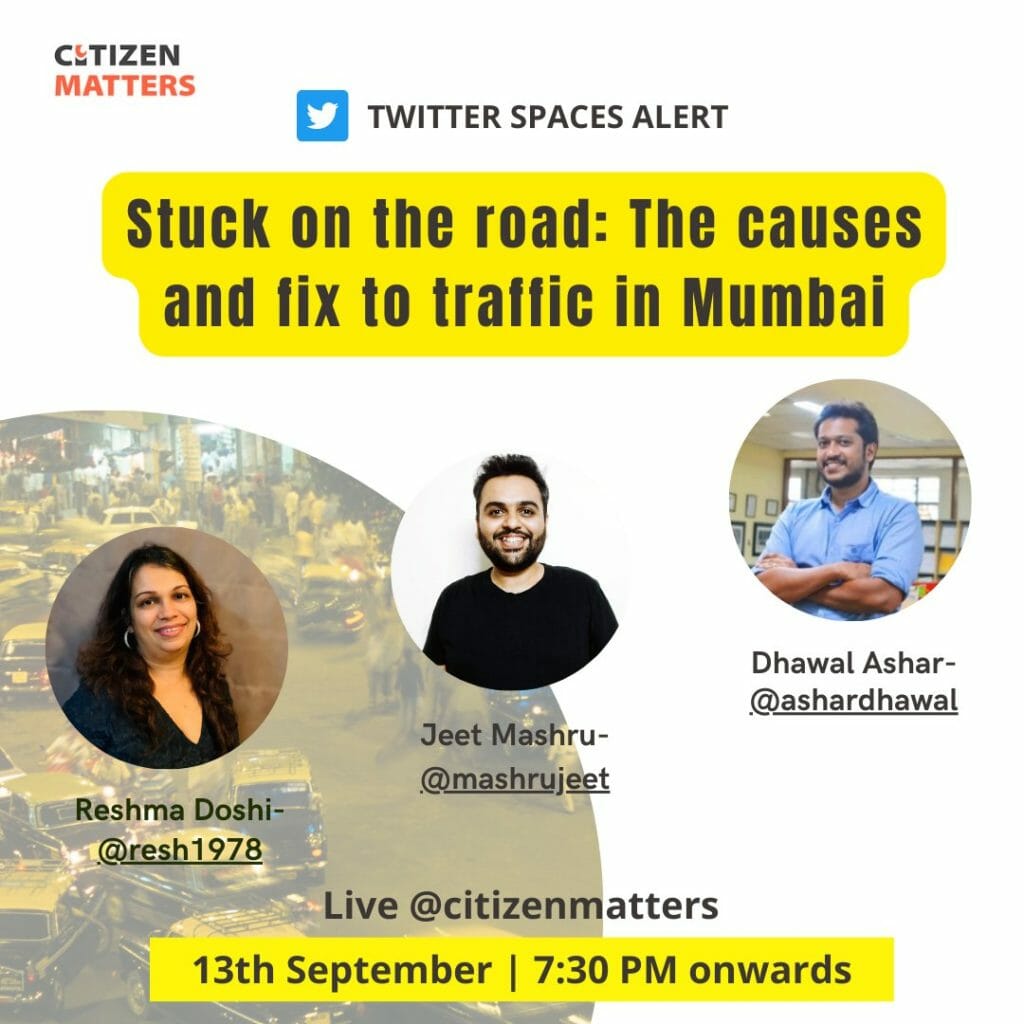
You can join in the conversation on our Twitter account.