“We, the women of India hereby commit to building a nationwide movement cutting across region, religion, language, caste and ideology to demand political power for women. All for one and one for all.”
This pledge taken on December 8th by about 150 women assembled at Hotel Chalukya in Bengaluru resonated in the hearts of many more invisible people who were not in the room, including women political aspirants and people who want to see more women out there ruling the country and the states.
The nonpartisan, crowd-funded collective of people, India Women’s Caucus, aimed at improving representation of women in politics launched a logo that had a formal name: Shakti – Political Power to Women.
The meeting also passed the following resolutions:
- To build a non-partisan national movement to demand political power for women
- To launch Shakti in Delhi in February 2019 and kick-start state caucuses
- To exert public pressure on political parties for 50% tickets to women for the 2019 Lok Sabha elections
- To promote women candidates during the 2019 Lok Sabha elections
- To demand passage of Women’s Representation Assurance policy in the winter session of Lok Sabha (2018), derived from the Women’s Reservation Bill discussions.
Beyond the meeting: Call Your MP Campaign
As a first step towards persuading the political powers to start thinking about representation of women in politics seriously, Shakti has also organised a call-a-thon on December 27, 2018, to urge Members of Parliament to support the Women’s Reservation Bill that has not been tabled in Parliament for last 4.5 years.
Calling upon the people’s representatives to put forward their views on issues that matter to people is popular in countries like the USA. But in India, this is the first time such a nationwide campaign is being organised. On the said day, people will call their respective representatives in Parliament, urging them to facilitate discussions around the Bill and support its passage.
Volunteers from 18 states, ranging from Jammu & Kashmir, Rajasthan, Chandigarh, Haryana to Maharashtra, Karnataka, Telangana, Andhra Pradesh, Tamil Nadu and Kerala have joined this campaign. Civil society groups, students, women’s groups, farmers, domestic workers, women from corporate sector and many others will be picking their phones and calling their MPs.
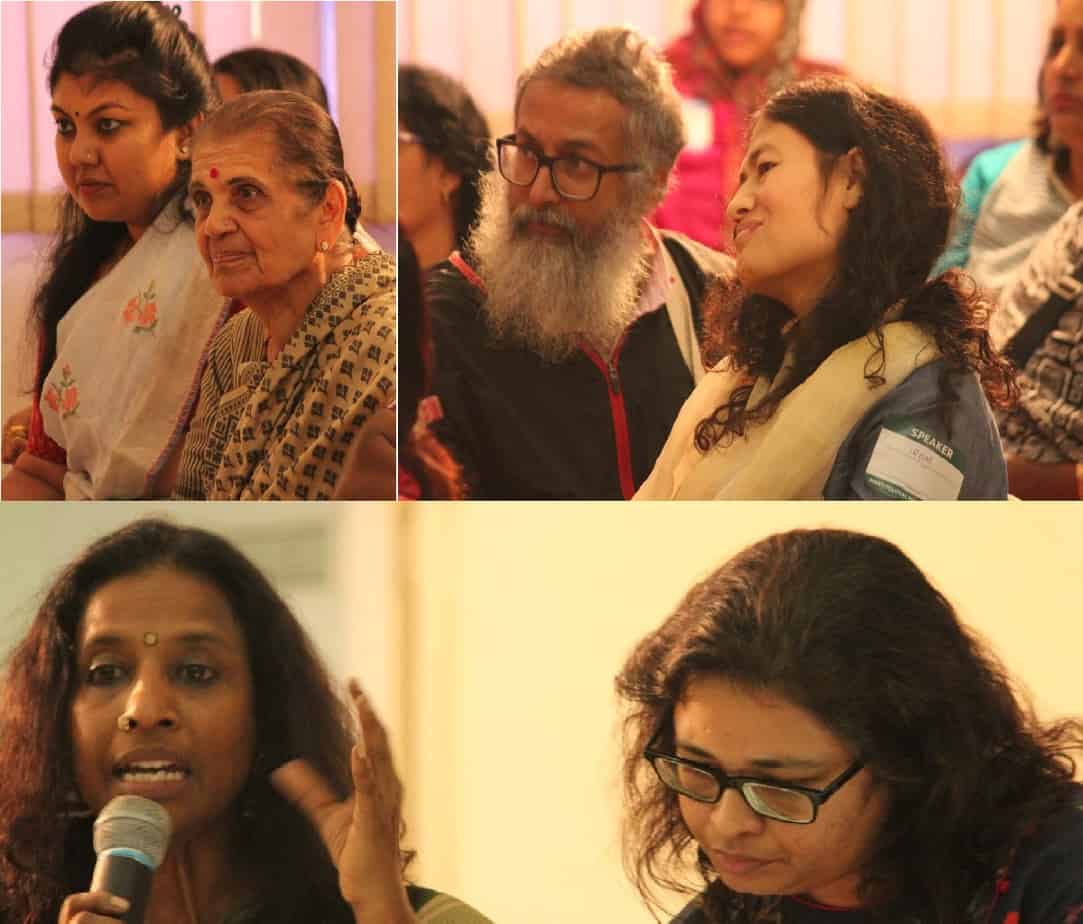
Clockwise from top left: Soumya Reddy, Jayanagar MLA, Leeladevi R Prasad, ex-minister, Irom Sharmila, Rajashri Nagarkar, Tara Krishna Swamy. Pic: Srinivas Alavilli
The event that launched the campaign
The day-long event on December 8th held in Bengaluru hosted women politicians, political aspirants, mediapersons and political researchers, who discussed the way forward for participation of women in the 2019 General Elections and beyond.
The attendees included Irom Sharmila, an anti-AFSPA activist and founder of the political party Peoples’ Resurgence and Justice Alliance and Leeladevi R. Prasad, former minister and Rajya Sabha MP from Karnataka, who entered politics as a corporator from Bengaluru in the 1950s.
Many women who have been active in the political space, including INC leader Sushmita Dev, BJP Spokesperson Malavika Avinash, PA Devi, cultural activist from Telangana, C Motamma, Vice President of Karnataka Pradesh Congress Committee, Bader Sayeed, senior advocate and former AIADMK MLA and others participated in the discussions.
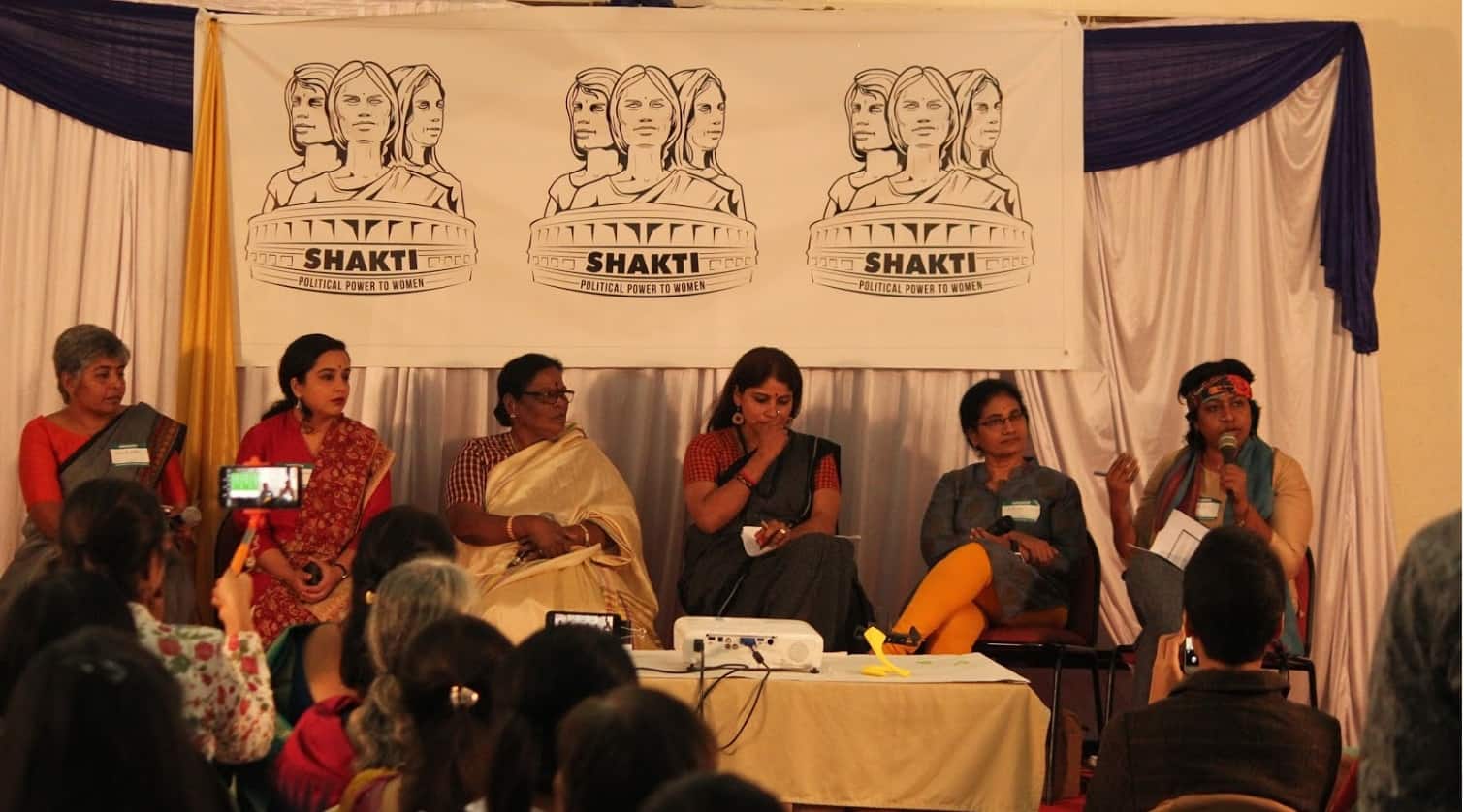
Kavitha Reddy (INC activist), Surabhi Hodigere (political campaign planner), C Motamma (KPCC Vice President), Vasanthi Hariprakash (moderator), PA Devi (cultural activist) and Shahina KK (journalist), in a panel discussion. Pic: Srinivas Alavilli
Myths on women and politics busted
In the keynote address of Srilatha Batliwala, author, activist and Director of Knowledge Building and Feminist Leadership at CREA talked about the political structures that keep women out, and suggested ways to break through them: Recognise the existing of hidden power dynamics; mobilise other women to confront these dynamics; collectively build parallel processes like nari gram sabhas, nari adalats and nonpartisan groups and resist playing by the rules set by men.
Tara Krishnaswamy, the co-founder of Shakti, spoke about myths on women’s participation in politics, showcasing data from over years. There are only 9% of MLAs and 11% of MPs in India who are women, though women are actually interested and are active in politics, said Tara. She quoted Bhim Raskar of Resource and Support Centre For Development (RSCD) campaigning for women in Panchayats, whose research shows that women tend to focus on health, education and sanitation, while men tend to go for infrastructural works.
She quoted a study by the United Nations involving 4000 assembly constituencies in India between 1992 and 2012, which found that economic indicators in the constituencies that had women as MLAs were 15% points more than those that had no women MLAs. “To say that women don’t know how to foster economic growth is complete.. ” said Tara, without completing the sentence.
Winnability is the most common factor that is argued by political parties that do not want to field women. But in 2014, 7.8% of the candidates were women, 9.6% of the winners were women. 92% of the candidates were men, and 6% of men actually won the election. Even the Election Commission data shows that women are more winnable than men, Tara said.
Why are there so few women in politics?:
The heated debate on the topic explored many facets of the exclusion. Women are limited to local bodies, and not given seats in the larger legislative bodies responsible for lawmaking. Women in politics have to keep fighting as grassroot workers. When someone wants to contest, the money and ecosystem around her, especially the male leader backing her matters to the parties. All these factors emerged as the reasons facilitating exclusion of women.
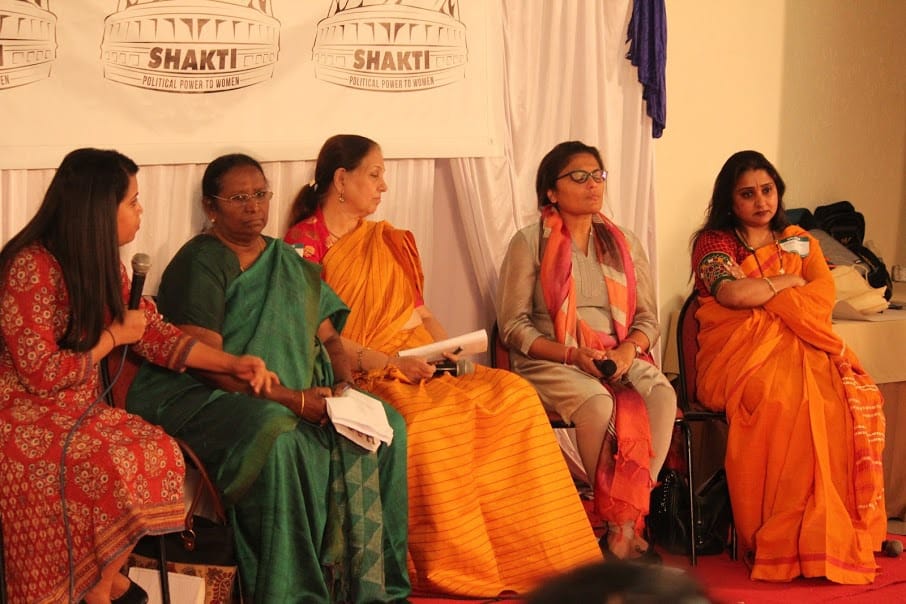
Dhanya Rajendran (moderator), Bader Sayeed, (former AIADMK MLA)
Ruth Manorama, (JD(S) LS candidate), Sushmita Dev (INC MP), Malavika Avinash (BJP Spokesperson) in a panel discussion. Pic: Srinivas Alavilli
Most parties respond positively to women’s reservation
There have been many positive responses to Shakti’s campaign, across India. Participants from National Congress Party (NCP) in the December launch programme went back with a letter from Shakti in their hands, which was submitted to the party chiefs. The Shakti team also sent a letter to MK Stalin from Dravida Munnetra Kazhagam (DMK) in Tamilnadu and is in the process of reaching out to all parties.
Tara Krishnaswamy, who leads the campaign, says that Indian National Congress (INC) President Rahul Gandhi has written to Congress-ruled states including Punjab asking them to pass a resolution in favour of the bill. Andhra Pradesh, Odisha and recently Punjab have already passed the resolution.
“We also have excellent response from the BJD and other parties across India. Shakti as a public pressure group wants to make sure it does not stay confined to the resolution but that there is actually some action that takes place on the ground. Our campaign will act towards putting pressure on them,” she says.
The next step for Shakti after the Call Your MP (CYMP) campaign is to spread formally to more states including an official national launch in Delhi. The group operates through a FB group, has a Twitter profile and a WhatsApp group. There is also a change.org petition that asks people to support the campaign.
Full disclosure: The author volunteers for Karnataka branch of India Women’s Caucus, and was active in helping put together the above event.