24 TMC Cauvery water for city
The Bangalore Water Supply and Sewerage Board (BWSSB) is drawing up a Detailed Project Report (DPR) to use additional 6 tmcft Cauvery water for the drinking water needs of Bengaluru.
The government has issued an order to the BWSSB to use 24 TMC of Cauvery water annually for the City and its surrounding areas. After meeting the legal team in the national capital, Deputy Chief Minister D K Shivakumar, in charge of Water Resources Department, said that the city can use 24 TMC, according to the Supreme Court’s order in 2018. Currently, it is using only 18 TMC of water.
Regarding Tamil Nadu’s objections over the sharing of waters, he asked why Karnataka should give up its rights.
Source: The Hindu, Indian Express, moneycontrol.com
Read more: KC Valley Project: Monitoring lapses, data gaps raise doubts over treated water quality
Preparing for heavy rains
On November 6th, the city faced its wettest November day since November 3, 2015 – when it received 95.3 mm of rain. Deputy CM DK Shivakumar paid a surprise visit to the war room of Bruhat Bengaluru Mahanagara Palike’s (BBMP) head office at Hudson Circle at midnight and reviewed the situation.
The north-east monsoons brought in heavy rains, which made the BBMP administrator Rakesh Singh send a directive to zonal commissioners to appoint an engineer for disaster management in each ward. He would bear responsibility for repairing potholes, pavements and reduce solid waste management. Works by Metro, Bangalore Electricity Supply Company Limited (BESCOM) and BWSSB were also advised to expedite work.
The Bangalore Development Authority (BDA) was told to open the sluice gates of Varthur and Bellandur lakes, in view of Mahadevapura zone receiving excessive rainfall. BBMP chief commissioner Tushar Giri Nath instructed officials to be prepared to prevent rain damage. He said that shoulder drains should be cleaned so that water flows smoothly to the drains, silt should be removed and excessive water from flooded areas should be removed with pumps.
The Indian Meteorological Department (IMD) put the city on Yellow alert on November 8th. In the northern parts of the city, there was moderate rainfall and overflowing water from Hebbal and Chowdeshwari lakes, leading to knee-deep flooding in many parts in the evening, disrupting airport-bound traffic. Nearly 50 homes in Sahakar Nagar were flooded. The low-lying area saw a backflow of rainwater. Parts of Kodigehalli were also inundated.
Source: Economic Times, Indian Express, Deccan Herald
For a safer Deepavali
During the Deepavali celebrations between November 12th and 14th, safety measures were issued by a circular from the Department of Fire and Emergency Services. It said that firecrackers can be sold and stored only in open spaces decided by government officials and at temporary shops allowed by the local authorities.
The department asked officials to check the shops and storages and inform the authorities about non-green crackers. Crackers were asked to be sold only during the day. On-duty personnel were asked to be alert, while fire engines were to be properly maintained.
During emergency calls, action was to be initiated immediately. Other measures included proper ventilation, use of fire retardant items, proper entry and exit at the front and back of shops/storage areas and no smoking or cooking inside the premises.
It was in 2018 that the Council of Scientific and Industrial Research-National Environmental Engineering Research Institute (CSIR-NEERI) introduced the green crackers, which were not only eco-friendly, but 15-20% cheaper. They also generated 30% less noise.
Source: Deccan Herald, The Hindu
New stamp to honour Raman
A new stamp with a face value of Rs 5 was released on November 7th by the Governor, Thawar Chand Gehlot, at the Raman Research Institute, commemorating its platinum jubilee. The stamp was designed by Avijit Dutta, showing a portrait of eminent physicist Sir CV Raman over the main building of the Institute.
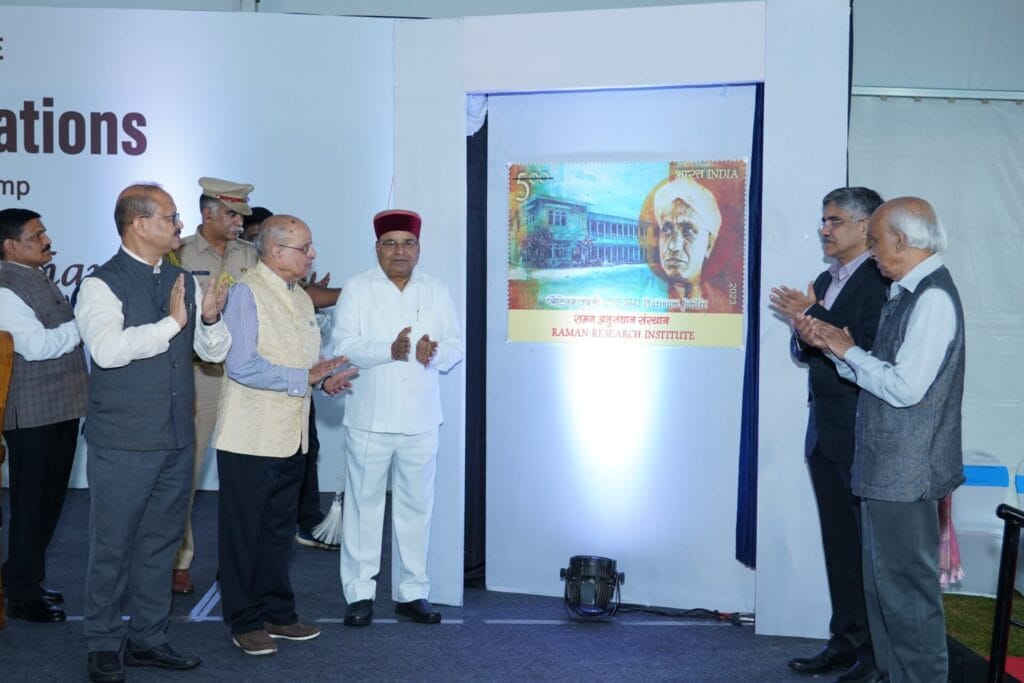
The Governor paid tributes to Sir CV Raman, mentioning various global awards he had won, such as the Nobel Prize and the Lenin Peace Prize.
Source: Indian Express, The Times of India
Read more: This clinic in Bengaluru offers free health services to the urban poor
Public health partnerships
To strengthen public health systems, the state health department and Centre for Cellular and Molecular Platforms (C-CAMP), under the initiative of the biotechnology department of the Ministry of Science, Technology and Earth Sciences, co-hosted a roundtable on November 8th, to explore partnerships, funding and indigenous innovations.
Health Minister Dinesh Gundu Rao asserted that the aim is to make Karnataka a model state for healthcare that can be replicated by other states, through like-minded collaborations. He hoped that the public-private partnership would enable them to mobilise funds, upgrade healthcare facilities and explore innovative technologies and modern practices. He underlined the significance of affordability, accessibility, quality and scale. Partners like C-CAMP can address challenges in maternal and child health, non-communicable diseases, tuberculosis and eye health, he added.
The roadmap for the next three to five years will help to deploy innovative, indigenous health solutions and facilitate partnerships among the government, C-CAMP, CSR and philanthropic organisations.
Source: Indian Express, biovoicenews.com
[Compiled by Revathi Siva Kumar]