No BWSSB Cauvery supply for 110 villages
Residents of 110 villages in the city’s periphery said that although they paid the charges in 2019, they have still not received Cauvery water connections from the BWSSB (Bangalore Water Supply and Sewerage Board). Three years ago, their roads were in a bad shape as the BWSSB had cut them to fix water pipes, but they had been told that the roadwork would be speedily restored if they took water connections. Residents complained that they had paid up to Rs 50,000, yet they were not told about any developments, nor can they see GLR (Ground Level Reservoirs) or access to STPs (Sewage Treatment Plant). Today, they pay about Rs 2,000 a month for a tanker of water.
Meanwhile, BWSSB officials said that they can fulfil the water requirements only after completing Cauvery Stage V project. They denied that they have collected money from areas where they are not supplying water, explaining that they are supplying twice a week to 51 out of 110 villages.
Source: Deccan Herald
Water adalats planned in city
The BWSSB will hold water adalats in various parts of the city on Thursday between 9.30 am and 11 am. Grievances related to water billing, delay in converting domestic to non-domestic connections, sanctioning water supply and sanitary connections will be settled at the event. Participants can include consumers from the following BWSSB subdivisions — (South-2)-2, (South-2)-1, (Southwest-2)-3, (Southwest -2)-2, (Southeast-1)-3, (East-2)-3, (Northwest-1)-2, (North-1)-2, and (North-1)-1. Call 1916 for further details.
Source: Deccan Herald
Also Read: BWSSB’s workforce woefully inadequate, says Chairman Tushar Girinath
Revenue inspectors to act on flex ban
The BBMP (Bruhat Bengaluru Mahanagara Palike) has authorised revenue inspectors to take steps for acting on the ban on flexes and posters, including filing police complaints and fining printers who prepare the flexes. Action will also be taken against people whose names are published on the flex – either the person or the firm that has printed it. Ward marshals have been asked to take the responsibility of enabling the protection of the revenue inspectors during the flex-removal drive.
However, thousands of flexes and buntings had sprouted between Yelahanka Junction to Doddaballapur, to celebrate CM Bommai’s completion of a year. Only later, when the event was cancelled, the flexes were removed.
Source: Deccan Herald, Bangalore Mirror
BBMP engineers told to visit construction sites
The BBMP sent a circular on July 21, specifying that it is mandatory for the town planning department and ward engineers to visit sites when a property owner fixes the BPL (Building Plinth Line). After a court order, spot inspection is compulsory and the officers and engineers have to upload the BPL along with GPS coordinates and photographs on the BBMP website.
Revenue officers also have the powers to identify illegal buildings, even as they are involved in assessing the property tax slab. A provision on BBMP’s internal portal says that it can share the plan sanction with revenue officers, revenue inspectors and assessors.
The BBMP’s guidelines specify that officers who do not inspect or upload the data would face penal action as per Section 252 of the BBMP Act, 2020, and also get suspended and face departmental enquiry.
Meanwhile, two engineers were suspended by the BBMP on July 22nd, after allegations that freshly asphalted roads had peeled off just before Prime Minister Narendra Modi’s visit on June 20. Though Rs 23 crore had been spent to redevelop and repair 14 kms of roads, they wore out within 15 days.
Source: Deccan Herald, The Hindu, The News Minute
Also Read: Study: BESCOM transformers poorly maintained, can disrupt power supply
1,900 transformers to become single-pole
Over the last three months, Bescom has converted 881 traditional transformers into special single-pole structures to free footpaths. It aims to convert another 1,900 transformers in the next two years. Each will be placed high above the ground, so that the impact of a blast or explosion would be significantly reduced, said a senior official.
Of about 59,000 transformers in the city, only a few are problematic and had been identified for the project. In 2017, Bescom had converted 3,194 transformers, but the expensive, capital intensive task could be taken up again only three months ago. Sources said that the task gets no subsidy, but is funded by Bescom and the expenditure is approved by the KERC (Karnataka Electricity Regulatory Commission). Converting one transformer costs Rs 5.15 lakh.
Source: Deccan Herald
BTP-Google partner to ease traffic on Bengaluru roads
BTP (Bangalore Traffic Police) is partnering with Google to optimise traffic signal configuration and reduce waiting time for commuters. Through Artificial Intelligence, Google will examine driving trends from its maps and draw up a revised plan. The project aims to reduce waiting time at pilot signals by 20% per commuter, 400 hours per day per intersection, and 73,000 hours per year at the pilot intersections. It will also bring down congestion, fuel consumption, road rage, and greenhouse gas emissions.
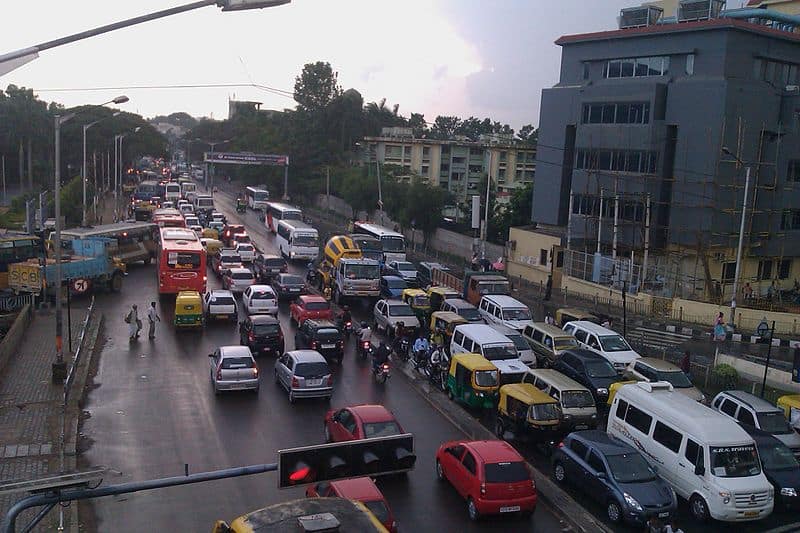
The plan can be extended to other intersections in order to benefit one crore vehicles, said B R Ravikanthe Gowda, Joint Commissioner of Police (Traffic). He added that the the project can include live updates on road closures, incidents, and other data, so that commuters can use alternative routes through Google maps. It would enable citizens to avoid congestion zones as they would have accurate information on road closures and related incidents.
This is the first time in the country that a police department is directly joining hands with Google.
Source: The Hindu, Geospatial World, Hindustan Times
Lake Hosakerahalli becomes black spot
Seven acres of the Hosakerehalli lake have been encroached – six acres by a private body and 0.26 acres by the government, says the BBMP. Spread over 59.36 acres, it receives sewage from a stormwater drain and has also turned into a black spot, in spite of clean-up and awareness activities. Lake restoration funds are not being well used. BBMP special commissioner (estates) V Ram Prasath Manohar said the civic body was awaiting funds to rejuvenate the local body.
Activist Ram Kumar B K said that activists would probably move court by the end of the year to get the lake fenced and clear encroachments, including borewells dug on the lake bed.
Source: The Indian Express
[Compiled by Revathi Siva Kumar]