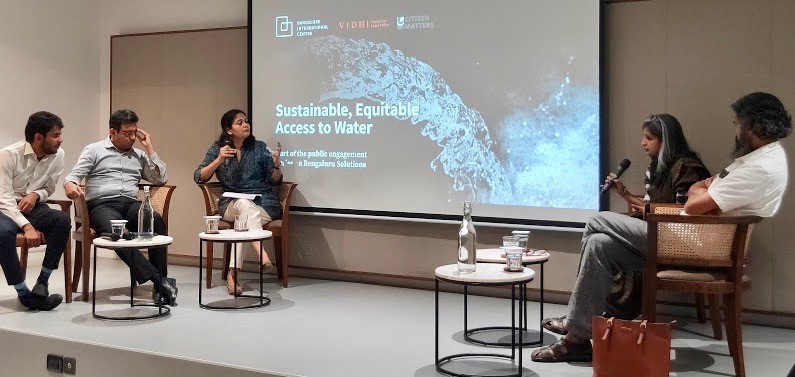
“It is a lack of (institutional) capacity which is leading to public woes on water. We are not in a position to give you quality services because of two things – one, manpower, and two, finances,” said BWSSB Chairman Tushar Girinath, speaking at a panel discussion on ‘Sustainable, Equitable Access to Water’.
Girinath explained that BWSSB has been experiencing a severe workforce crunch, its staff numbers woefully inadequate for carrying out the Board’s mandate effectively. Comparing BWSSB’s workforce with that of Delhi Jal Board, he noted that the latter employed 33,000 people (including regular and outsourced employees) for a population of 2.5 crore, whereas BWSSB’s workforce was just 4000 for about half that population. This figure need to be augmented urgently, he said.
Vidhi Centre for Legal Policy and Citizen Matters, in collaboration with the Bangalore International Centre (BIC), had organised the panel discussion on 24th October, as part of the Bengaluru Solutions Series. This was the third instalment of the series. The panel discussion was on providing Bengaluru residents sufficient water at an affordable price, in the context of the city’s dire water crisis.
Other panelists at the discussion were Vishwanath Srikantaiah, urban planner and Trustee – Biome Environmental Trust, independent researcher Bhargavi S Rao, and Shashank Atreya, Research Fellow at Vidhi. The panel was moderated by Meera K, Founder, Citizen Matters.
Addressing a packed room, V Ravichander of BIC welcomed the panelists. Meera introduced the panelists, and asked them about a long-term vision for managing water in Bengaluru sustainably and equitably.
Girinath called for the management of groundwater to be under the authority of BWSSB. He said institutional coordination was lacking with respect to groundwater, and that permissions were granted for borewells without subsequent monitoring. He said that all borewells should be monitored and metered, with a limit set on how much water can be drawn from it. And that a proper tariff structure should be introduced to regulate groundwater extraction.
Girinath admitted that BWSSB’s record on sewage treatment was abysmal and needed drastic improvement.
Vishwanath Srikantaiah said that when water was treated as a middle or higher class issue, the focus was on resource availability (whether Bengaluru will run out of water) or pollution. Whereas lower income communities in the city are more concerned about accessibility to water itself, since they are often left out of the supply network and have difficulty sourcing water. He said that nearly half of Bengalureans – close to five million people – don’t have access to water.
Vishwanath said that a large number of recharge wells can be built in the city by engaging traditional well-digger communities. This would create employment, along with the infrastructure for sustainable water management.
Discussing legal and institutional challenges around water management, Shashank Atreya pointed out that almost seven different authorities have a mandate over lakes and other water bodies in the city. And each authority is responsible for a different facet of management – one for flora and fauna, another for preventing encroachments, yet another for managing lakes, and so on.
Besides, due to the lack of information on water at the ward level, citizens are unable to participate and engage with the government in water management, Atreya said. He said that an integrated agency was needed to manage the city’s local water resources along with water supply and distribution.
Focusing on citizen participation and implementation of the 73rd and 74th Constitutional Amendments on decentralised governance, Bhargavi Rao talked about raising awareness on water management at the ward committee level.
Watch the full discussion here:
During the Q&A session, the audience raised several questions on managing private water tankers in the city, on BWSSB’s poor record of sewage treatment, and on manual scavenging and deaths of sanitation workers in Bengaluru.
The conversation concluded with Bhargavi commenting on how access to water has grave impacts on public health. She also pointed out that gender, class, caste and religion impact one’s access to water, and need to be accounted for in discussing access. She emphasised the need to teach both children and adults where water for everyday use is sourced from, so as to inculcate an understanding of water ecology.
On the contrary all public utilities, including BWSSB, are OVERSTAFFED!
A visit to any of their offices will show this to be the case.
Instead of making excuses the boss-men of these utilities should learn to use the manpower EFFECTIVELY and efficiently as does the private sector