Temperature is dipping down to 16 degrees. Gone are the days when the sun scorched at 40 degrees – 22 degree is the hottest part of the day now. The weather almost makes it feel like old-time Bangalore.
Gloomy sky. Drizzles throughout the day and night. Heavy downpour by the time you leave office. Water logs, traffic jams. This is the typical rainy season in Bengaluru, though rains gave us a miss during the South West monsoon in May – June.
This November, the incessant rain that soaked Bengalureans has broken the all-time record. As on November 19th morning, the city received 256.4 mm rains. The last time Bengaluru city received such a high rainfall in the month of November was in 1916 – 252.2 mm for the entire month.
Here is the daily rainfall data as calculated by India Meteorological Department.
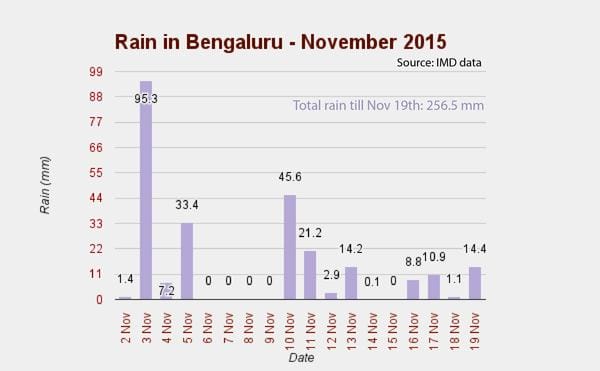
The city has received 1,200 mm of rain this year. The total rainfall in October and November this year is 303 mm.
More rains in coming few days!
For people who were hoping to see some sunshine this weekend, there is more bad news in the offing. Meteorological Department expects the rain to continue till this weekend. The rain which watered down Deepavali celebrations is likely to ruin your weekend plans too. Courtesy, a new depression in Arabian Sea.
According to Indian Meteorological Department, the rain that lashed the city during the past 10 days was due to the depression that was developed in Bay of Bengal. While the intensity of depression on Bay of Bengal has reduced, another depression has formed in Arabian Sea, close to Lakshadweep.
Rajashekhar, Assistant Meteorologist at the office of Indian Meteorological Department, Bengaluru told Citizen Matters that incessant rain is the result of the forming of two depressions back to back, without a break. Low pressure has formed in Lakshadweep which will result in depression due to which Bengaluru city is likely to receive rainfall for at least next 2-3 days.
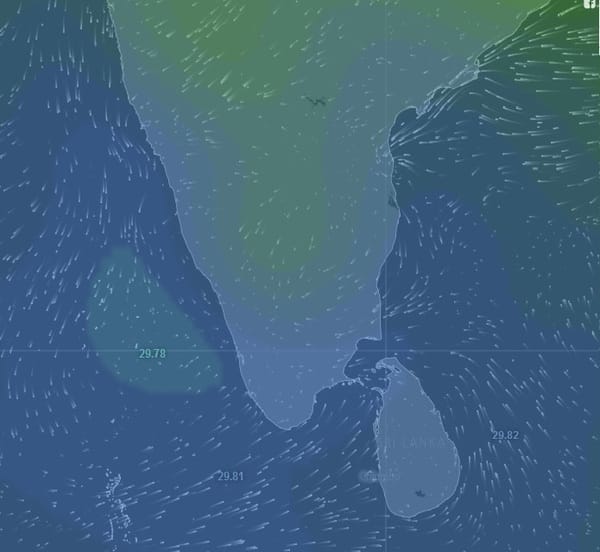
New depression forming near Lakshwadweep, in Arabian Sea. Souce: Windyty.com
The city which witnessed low temperature in the last few days might see a slight change in temperature after the rain stops. “The temperature may not rise too high, but it might increase up to 25 degree,” Rajashekhar informed.
Weather forecast for Bengaluru
This graphic created by meteoblue.com, in Windyty.com gives an idea of the temperature and rainfall in the week to come, at Highgrounds, Bengaluru. It has a tool that can be dragged over any location you want, to get forecast for that particular area.
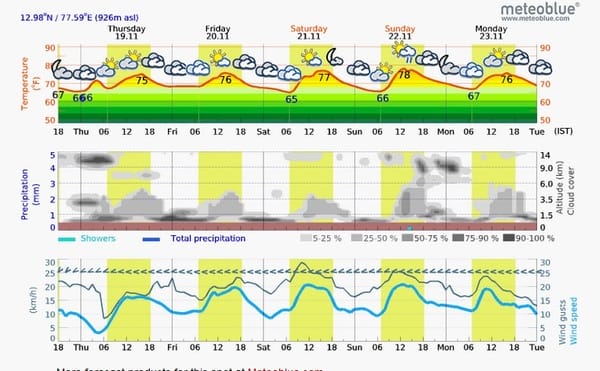
You can also check the weather section of timeanddate.com to see what Bengaluru weather will look like hour by hour, for next one week. The website says that the temperature of Bengaluru is likely to remain below 30 degree for next one week, sky will remain cloudy and some rains can be expected.
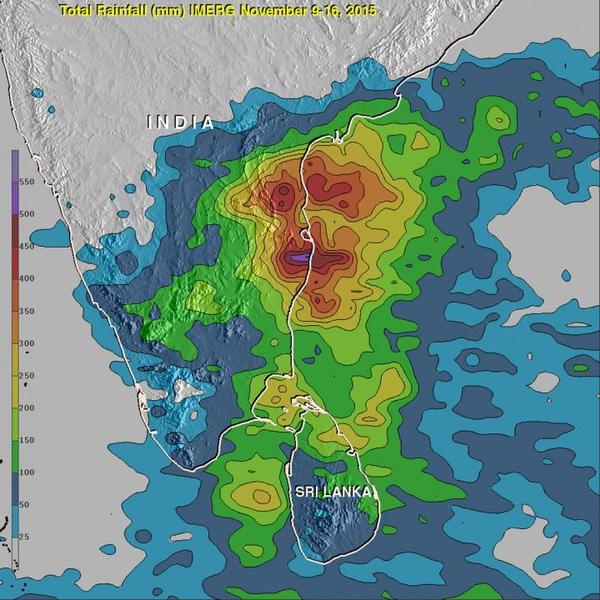
NASA’s Integrated Multi-satellite Retrievals for GPM (IMERG) combines all data from 12 satellites into a global map of rainfall at half hourly intervals. The rainfall accumulation analysis above was computed from data generated by IMERG during the past week from November 9-16, 2015. Source: http://pmm.nasa.gov/extreme-weather/indias-deadly-flooding-rains-measured-imerg
With inputs from News Desk
Related Articles
Musings of a Bangalorean on a rainy evening…
Why is it cloudy and raining in Bangalore – now?
Rainfall in Bangalore over the last century: Has it really changed?