While the Special Intensive Revision (SIR) is currently on in Karnataka, people have been confused about voter roll updates. Following the initial chaos over filling out enumeration forms, the Election Commission of India (ECI) extended the deadline for the process.
To assist residents who lack any of the 11 standard documents specified by the Election Commission of India (ECI), the State government announced fast-track issuance of Permanent Residential Certificates (PRCs). The list of documents to prove one’s citizenship in the Claims and Objections phase of the SIR process includes birth certificate, passport, matriculation certificate, forest rights certificate, or caste certificate. However, many questions remain about what a PRC is, how to get one, whether it will be accepted by the ECI, and how it differs from a standard Residential Certificate (RC).
The draft roll will be published on August 17. Electors can file claims and objections till September 16. Meanwhile, ahead of enumeration, the State government directed Panchayat Development Officers (PDO) to issue residential certificates. However, a residential certificate cannot be used for the SIR verification.
What citizens must know
- The verification process requires proving your citizenship, not merely your current address.
- Residential Certificate indicates where you currently live and can easily be obtained using a rental agreement. It does not establish long-term stay or eligibility.
- Permanent Residential Certificate demands proof of long-term continuous residence in the State, serving as a valid document recognised by the ECI during the Claims and Objections phase.
The election commission has also clarified this.
| Permanent Residential Certificate | Residential Certificate |
| Proof of one’s residence in the state for a longer term | Proof of one’s residence in the state |
| Issued by a tahsildar or higher authority | Issued by a PDO |
| Requires proof of residence for more than 10 years including birth certificate (in the state), 10 years of education in the state, ownership or possession of property, etc. | Aadhaar, ration card, electricity or water bills, or a rental agreement that establishes a person’s current address can be proofs to obtain RC |
| Can be used as a document to prove eligibility in the SIR process | Can not be used as a document to prove eligibility in the SIR process |
How to get a PRC
On June 29, the Revenue department, issued comprehensive guidelines for issuance of PRC. Citizens can apply through Seva Sindhu or Nadakacheri online portal and for offline applications, they can visit Grama One, Karnataka One, Bangalore One, Common Service Centres (CSCs) or Bapuji Seva Kendras.
To apply via Nadakacheri portal
- Open the portal using this link
- Click on Online application – new application
- Enter your mobile number and OTP
- Navigate to New Request – Residence Certificate – Permanent Residence Certificate
- In the next page, download the self-affidavit form, fill and keep it ready
- As you proceed, you will be directed to E-KYC process to verify your Aadhar using OTP via registered mobile number
- Once KYC verification is done, fill in the details required, including personal details (address, parents and contact details)
- Click next and select applicable eligibility criteria for obtaining a PRC
- Upload the self-affidavit and other documents to support your eligibility
- Click submit and e-sign using Aadhaar and linked mobile number
You can further track the application and once it is approved, you can download it online, collect it from the revenue office or can get it to your address via speed post by paying ₹41.
To apply via Seva Sindhu Portal
- Visit the portal using this link
- Under Department and Services find Revenue department and choose Residence certificate
- Click on Apply Online and register as a new user using Aadhar number
- Verify mobile number and email id and you can login
- Fill in your personal details including address, parents details and mobile number
- In the next step, choose the number of years you have lived in the referred address
- Upload all the supporting documents
- Pay fee and submit
- You will be directed to the e-sign process
Once submitted, you can track your application online using the reference number. You can find the detailed application process here.
Read more: SIR for Karnataka voters: All you need to know about enumeration
Offline application
To apply offline visit nearby citizen service centres with documents to support one or more eligibility requirements listed below and you can fill the application. The picture below lists down the documents that can be used as a proof to get the PRC. The government has also set up 49,320 facilitation centres in ward and booth levels, noted a Deccan Herald article.
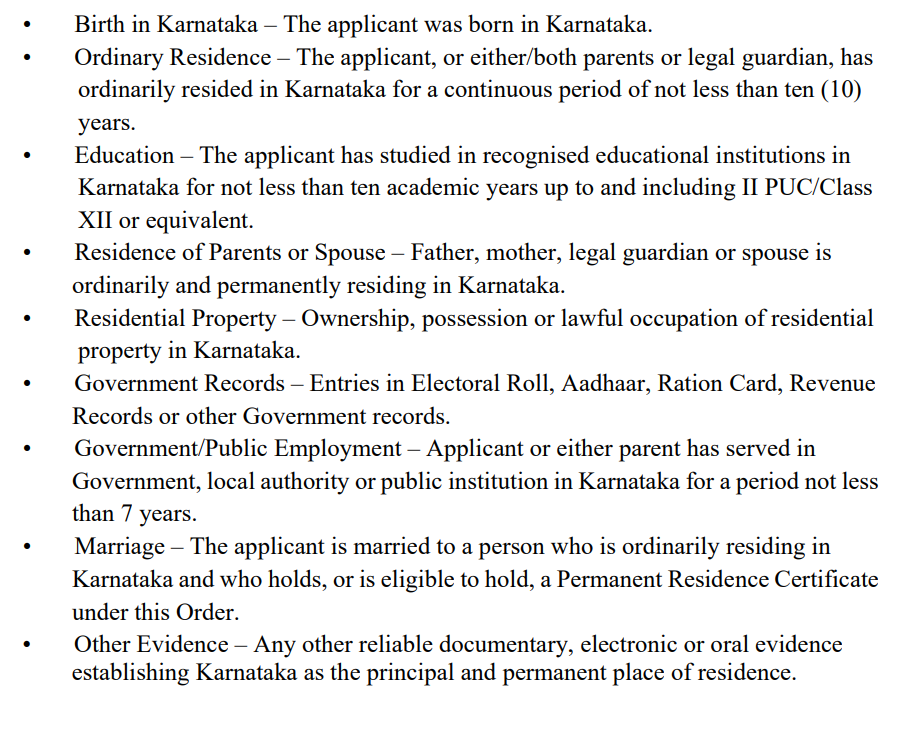
The Karnataka government has shortened the processing time for PRCs from two weeks to 10 days. Once the draft electoral roll is published on August 17, the Election Commission of India (ECI) will verify voter details. If the enumeration form lacks sufficient proof and voters do not have the 11 prescribed documents, applying for a PRC can help.
How does PRC help
Aishwarya Ravikumar, National Organising Secretary, People’s Union for Civil Liberties (PUCL), says many people do not have the documents prescribed by the ECI. “Poverty is the reason why many people do not have documentary proof,” Aishwarya says. These are informal sector workers like sanitation workers, street vendors or domestic workers who are not protected by any formal structure. They only have ration card and Aadhaar cards. “Aadhaar was made mandatory for everything, so they’ve got those done. But the 11 documents listed for verification in the SIR process don’t include anything that a common person may possess.”
People usually preserve documents such as electricity, water and gas bills. Some also keep their children’s school certificates. In such cases, a Permanent Residential Certificate (PRC) could serve as a useful supporting document.
In this regard, a coalition of civil society organisations like People’s Union for Civil Liberties (PUCL), All India Central Council of Trade Unions (AICCTU), Slum Janara Sanghatane and Domestic Worker’s Rights Union has launched My Vote, My Rights to assist vulnerable communities with the SIR process.
What happens when you do not meet the criteria?
According to the Karnataka government’s guidelines, if documentary evidence is insufficient, local enquiry and other reliable evidence may be relied upon after recording reasons. PRC will be issued by the Tahsildar or Deputy Tahsildar, while the Assistant Commissioner will be the appellate authority and Deputy Commissioner has been designated the revisional authority. As the issued guidelines are not comprehensive, applicants cannot be termed ineligible based on it. The officials concerned have been given the authority to undertake local enquiries to determine a voter’s permanent residence in the State.
Citizen Matters tried to reach out to Tahsildars from different taluks in Bengaluru Urban district to understand how the process is being undertaken on ground. Most of them did not respond. A Grade-2 Tahsildar told Citizen Matters that the procedure for applying for and issuing a Permanent Residence Certificate (PRC) is not yet clear. The official said they would share further information after gathering the necessary details. This article will be updated as more information becomes available.
Read more: Karnataka SIR 2026: Top FAQs and community concerns addressed
Challenges persist
However, the process to get PRC is also challenging as it requires extensive documents. “In some cases, finding proofs to get a PRC could also be challenging. People who migrate often from one house to another, especially in urban areas, are finding it difficult to establish that they’ve been in one place, then you have nomadic and semi-nomadic tribes. Although a lot of them have settled down and at least one member of the family will be able to have some documents. But 10 years is not easy for these categories of people,” says Aishwarya.
Shivasundar echoes the same. “The document meant to help people without proof requires much of the same proof to obtain. It is very difficult for ordinary citizens,” he says.
Among poor religious minorities and working-class families in urban areas, many may not possess SC, ST or OBC certificates. Some may never have attended school, while others may not have birth certificates. These are documents required to get a PRC.
“Being left out of the SIR process is going to be inevitable for many people and civil society organisations do not have the resources or the manpower to reach out to every person. So the exclusions from SIR is simply because of the lack of proactive effort from the government,” Aishwarya adds.
“While it is welcome that they are fast tracking this process, it needs to go to the ground. There needs to be help desks to help people apply for PRC and put together the evidence.” she says.
Helpline numbers
Seva Sindhu or Karnataka One portal: 08024410574 or email at sevasindhu@karnataka.gov.in
For Nadakacheri portal, contact your respective district consultants. Find their contacts here.
CEO Karnataka Voter helpline: 1950 / 180042551950
Do you want to get information on local events in Bengaluru, Mumbai and Chennai, news updates, links to explainers, data and more? Join our WhatsApp broadcast channel, Citizen Matters – Civic updates for the Active Citizen.