Rabindra Sarobar, affectionately known as the “Lungs of South Kolkata,” is at a critical turning point. As a designated site under the National Plan for Conservation of Aquatic Ecosystems (NPCA), Kolkata’s living ecosystem requires dedicated protection. Authorities are not supposed to use the lake as a commercial revenue generator for municipal expenses.
However, the Kolkata Metropolitan Development Authority (KMDA), as the custodian of the lake, has failed to safeguard this beautiful green oasis in the heart of the city. Many Public Interest Litigation (PIL) matters remain pending before the Kolkata High Court and the National Green Tribunal (NGT). Yet, KMDA continuously delays taking necessary action, citing a shortage of funds.
Violations of various directives
Despite directives from the NGT and the Supreme Court to preserve this concrete-free, eco-sensitive zone, environmentalists and the Save Rabindra Sarobar Forum (SRSF) have documented widespread violations and neglect:
- Failure in aquatic management: KMDA has failed to desilt the lake, ignoring recommendations from various entities including the NGT-appointed expert committee.
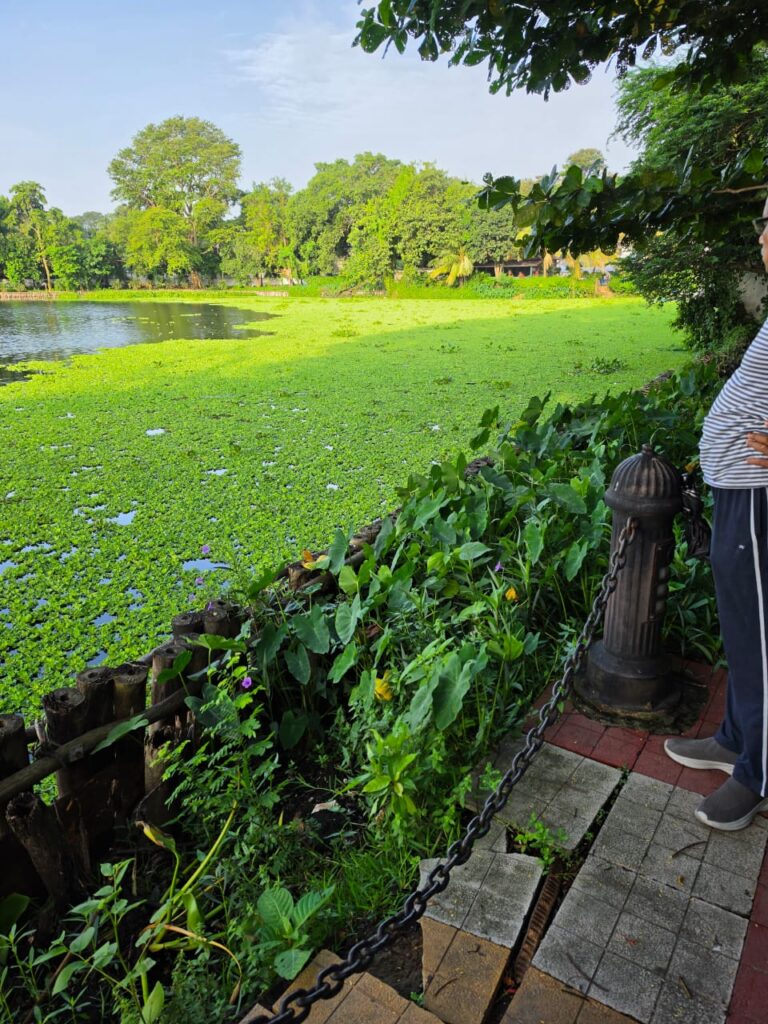
- Ecological degradation: The lake has been under severe urban strain, including heavy algae overgrowth, high fecal coliform levels, and a decline in migratory bird counts, down by over 60% over the last decade.
- Direct environmental violations: SRSF has highlighted illegal construction within clubs lining the shore and untreated sewage discharge flowing into the lake. There is unauthorised pumping of lake water for club use, garbage dumping within 50 metres of the water’s edge, petrol/diesel vehicles entering the national lake campus, and inadequate security.
The revenue vs. allocation gap
True environmental accountability lies in proper financial management. Every rupee generated within the boundaries of an NPCA site should, logically and ethically, be reinvested into its ecological preservation.
Read more: Why these Kolkata morning walkers have reserved their Sunday mornings for protest!
Currently, KMDA gets substantial revenue from commercial entities and clubs lining the lakeshore through uniform rent agreements based on built-up and open-space square footage:
- Rowing clubs (3): ~₹40 lakh
- Swimming clubs (3): ~₹22 lakh
- Nazrul Manch Auditorium: Minimum ₹50 lakh
- Other entities (cricket, archery clubs, etc.): ~₹10 lakh
- Total annual earning: At least ₹1.22 crore
Despite generating over ₹1.22 crore annually, how this money is spent is not clear. Instead of operating under a dedicated, ring-fenced “Sarobar Conservation Fund,” these revenues are utilised for general administrative or cross-sectoral municipal pools. The lake’s immediate biological needs, such as desiltation, water quality management, and biodiversity protection, are left waiting for separate budgetary allocations or sporadic government grants.
To compound the issue, the authorities are levying a ₹10 entry fee for general visitors and requiring ID cards with nominal monthly fees for regular morning/evening walkers, birdwatchers, and club members (around 10,000 people visit the lake daily). Squeezing revenue from citizens and environmentalists while revenue from commercial/club leases remains unaccounted for highlights a fundamental flaw in administrative priorities.
What the Save Rabindra Sarobar Forum is demanding
Environmental and financial audits are necessary before pushing for legal protections for the lake:
- Biodiversity Heritage Site (BHS) Status: Under Section 37 of the Biological Diversity Act, 2002, BHS status would legally restrict the state government from altering land-use patterns, regulate high-decibel events and concrete encroachment, and empower local citizen forums to co-manage the ecosystem.
- Ramsar Convention recognition: Integrating the lake into this international treaty framework would bind the government to global accountability standards and a strict “wise use” management plan to halt pollution, stop domestic greywater seepage, and restore native fish and avian biodiversity.
Because Rabindra Sarobar is a public property and a non-profit conservation space, citizens have every right to complete transparency regarding how public funds are earned and spent to maintain ecological balance.
So, here’s what needs to be done
- Conduct an independent financial audit: Carry out an audit of the Rabindra Sarobar Head of Account to check fund allocation and track revenue earned against money spent on true ecological conservation (bioremediation, dissolved oxygen monitoring, tree protection) versus basic civil works.
- Establish a Sarobar Conservation Fund: Set up a dedicated account to ensure 100% of commercial earnings generated within the Sarobar campus are reinvested into its maintenance.
- Execute desiltation and scientific water management: Implement NGT expert committee recommendations to desilt the lake and preserve its ecology.
- Enforce mandates to stop pollution: Halt all illegal club constructions, untreated sewage discharge, and garbage dumping within the lake premises.
- Secure BHS and Ramsar site tag: Complete the environmental audit baseline data to secure BHS and Ramsar Site status for the lake, to legally protect for the lake.