80 kilometres south of Chennai stands the Madras Atomic Power Station (MAPS) — one of two big nuclear power plants in Tamil Nadu — and its affiliate organizations. These organizations employ around 15,000 permanent employees, who mostly live with their families in the Kalpakkam and Anupuram townships, located approximately 5 kms from the nuclear plant. The distance is said to mitigate health risks from radiation. But they are not the only human resources of the plant.
More than 4000 workers, hundreds of them migrants to the state, are employed on a contract basis every year in construction, housekeeping, catering, hygiene and maintenance of the nuclear plant and its expanding projects. While they build, clean, cook and maintain the sprawling complex that Tamil Nadu proudly showcases as one of its most critical power installations, these migrant contract workers live a parallel life. A life largely defined by uncertainty, health hazards and an almost complete absence of leisure.
55-year old Suresh hails from Orissa and has been working in MAPS as a contract worker. “We live much closer to the power station. We do not receive accommodation facilities like the permanent employees do. And the villages closer to the power plant are where we find cheap enough accommodation on rent.”
These rented “houses” they live in are merely old, unmaintained buildings or even make-shift shafts made of metal sheets that provide very little protection against the inclemencies of weather. Three to five migrants live in each of these houses and share the rent, which varies between Rs 4000 and Rs 8000 per month. These houses are also much smaller than the ones that permanent employees are provided.
Read more: “Cities must give a lot more to informal workers they engage”
Reality of contract workers
While some locals also work as contract workers, Suresh notes that migrants form the majority, a large number coming from UP and Bihar.
“It benefits the organisation (to hire migrant workers on contract),” he says, “since locals usually demand higher pay for the same work, while we migrants are desperate for jobs.”
Contract workers typically have basic educational qualifications—9th, 10th, 12th standard, or a Diploma—and are categorised into four groups: unskilled, semi-skilled, skilled, and highly skilled, with daily wages of ₹700, ₹800, ₹900, and ₹1200 respectively. Most are hired for two to six months, but some, like Suresh, work on annual or bi-annual contracts for long-term or permanent roles outsourced at much lower pay.
Regarding benefits, Suresh simply states, “No work, No pay.” Contract workers do not receive paid leaves, bonuses or gratuity — benefits enjoyed by the plant’s permanent employees. “I’ve worked here for 19 years,” he says, “but I don’t get the benefits of permanent staff, even those with just one to two years of service. My contract is renewed annually or bi-annually, but there’s always a risk it might not be.”
Suresh and others face constant pressure to stay in their contractor’s good books, often taking on extra work and responsibility. “I live with anxiety in the last few months of every contract,” he admits.
Far from home: The physical and emotional distance
Imran, 29, a migrant worker from Bihar, works on construction for a new power project. “The last time I saw my family was a year and a half ago. I long to go home, especially during festivals,” he said. But with short-term contracts, holidays are few and far between. “I spend them without my wife, daughters, mother, and brothers.”
Both Imran and Suresh said that with families far away, festivals feel meaningless, leaving them feeling more alone and dejected. But then, even a short trip home would cost the workers a week’s wage. “We’re paid only if we work that day. Losing a week is impossible. Contractors can terminate us anytime,” says Imran.
He finds some comfort in video calls. “A few years ago, I didn’t have a smartphone. Now I can see my family. But how is that enough? I work every day for them, yet I don’t live with them. My eldest daughter won a trophy at her school’s sports day last month, and it hurt that I wasn’t there.”
“I try not to think about it because I have no choice,” says Imran. The fear that his children will grow up not missing him, because he has been absent too often, continues to haunt him.
Leisure: An unattainable dream?
What makes the daily drudgery of their lives worse is the absence of any avenues for recreation. Permanent employees living in Kalpakkam or Anupuram have access to sporting arenas, swimming pools, libraries, parks and other cultural events. Chennai and other neighbouring cities are just a quick drive away, where there is ample scope for recreation.
“They might earn anywhere between Rs 50,000 to several lakhs. But we cannot afford to plan an impromptu trip to the city like that. We have to save for emergencies. What if my parents fall sick and I have to make an unplanned trip home?” asks Imran. Every rupee Imran and his friends spend on leisure is thus carefully considered. “It’s exhausting,” he admits.
Weekdays blur together: up at 6 am, cook rice, roti, dal, veggies, maybe chicken or fish, pack lunch, work ten hours, return exhausted, eat, sleep. No TVs in their rooms. Not all have mobile data.
“Now, most of us have a basic smartphone,” Imran says. “It keeps us connected to our families and makes it easier to send money home.” Most nights, he and his roommate watch cricket highlights on YouTube until they fall asleep.
Sundays are simple. Expenses have to be kept to a bare minimum, since over half their monthly salary has to be sent back home for rent, bills, food, medicine, and their children’s education.
Mornings start slow: laundry, a late breakfast. “After a week of hard labour, we take it easy,” Imran says. At 30, he’s the oldest in his shared room, and feels responsible for his younger roommates, aged 22–24. Here, coworkers become family, sharing moments of joy and sorrow. “It makes even small chores feel lighter,” Imran shares, “whenever I receive pictures from my family on Whatsapp, these are the people that I immediately show them to.”
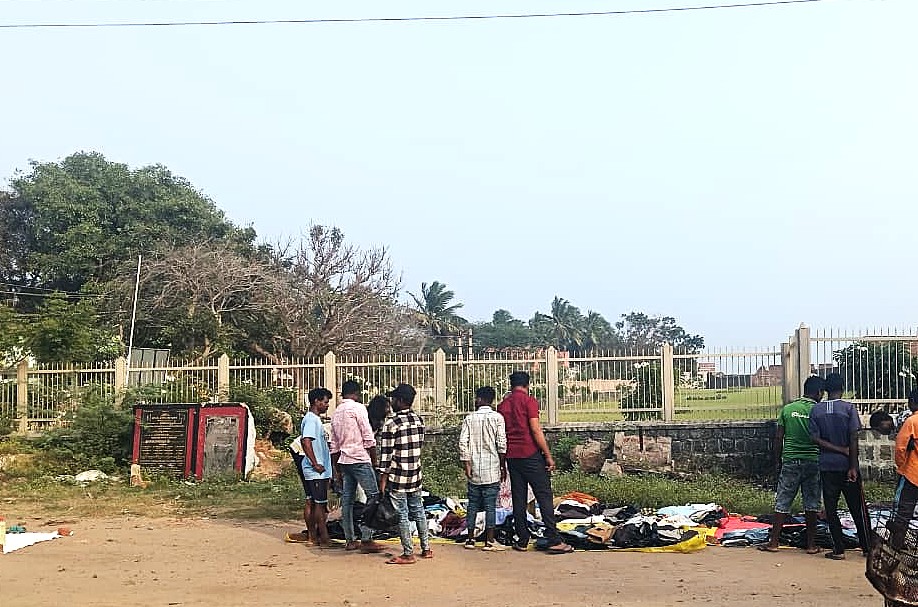
Sunday evenings are for recreation. Which only means that they walk 3–5 km to the shops outside the employee township — pani puri, kachori, samosa, tea. No one owns a cycle or bike; they might move for work in months. Imran’s group plays cricket on barren grounds set aside for new projects. “Every Sunday,” he says proudly. “No proper field, but we manage. Then, chai and samosa.”
Second-hand clothes vendors set up shop nearby, selling T-shirts, shorts, and track pants for ₹50–100, essential for many of these workers whose clothes wear out fast given the jobs they handle. Some visit the ruins of the Sadras Dutch Fort or Pudhupattinam beach, enjoying the breeze with raw mango or sundal.
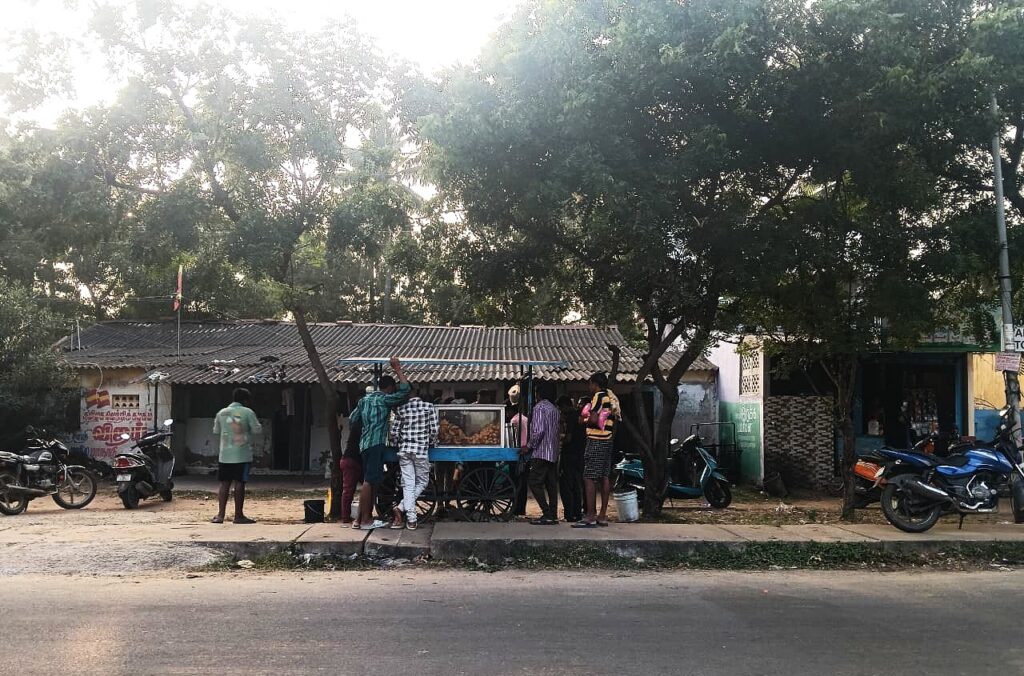
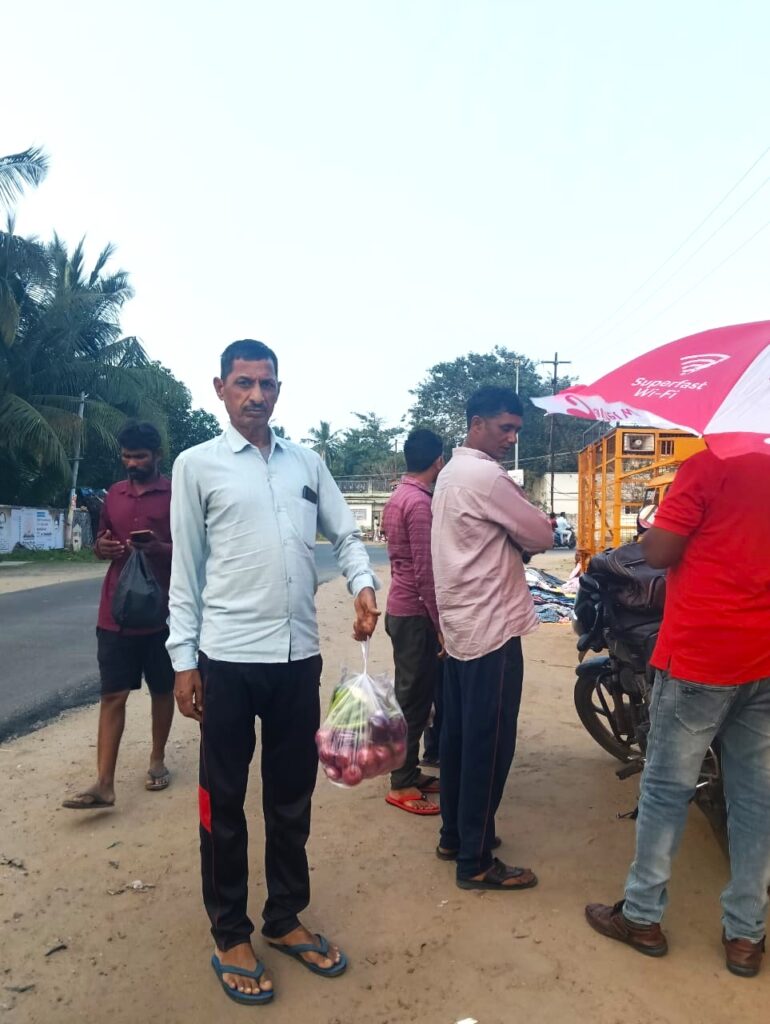
But as the sun sets, the weight of the coming week returns. On the walk back, they stop at grocery stores and fish markets, bulk-buying supplies to last a week for their shared home.
Until next Sunday, when their world of leisure begins and ends within these few kilometres.
This is truly eye opening. People who are giving their blood, sweat and tears to see their family do better, deserve to be treated with basic human dignity. It is surprising to see that people are not even given the bare minimum courtesy of shelter, raise in payment and a trip to visit home which should be a right to people in this day and age.
Really appreciate the writer of this article, Amudhini M V, for bringing this to light.
A powerful article that shows how migrant workers contribute significantly but still lack basic rights. Authorities should focus more on their welfare and safety.