As commercial development along Old Mahabalipuram Road (OMR) has surged, reliable public transport has become essential. Yet, daily commuters, labourers, office workers, college and school students, and Resident Welfare Association (RWA) staff continue to grapple with limited access to Metropolitan Transport Corporation (MTC) buses. For many, reaching bus stops on the main road is a daunting task, especially since interior localities remain underserved and private operators like share autos rarely venture into these areas.
The absence of adequate bus stops and the restricted MTC service forces residents into long, difficult journeys. The worst-affected by this lack of last-mile connectivity are service-sector workers, as they often cannot afford the high costs of daily travel, leaving them with few viable options for mobility.
As residents were struggling, the Federation of OMR Residents Associations (FOMRRA) initiated a campaign for enhanced last-mile connectivity for residents and commuters. We wanted the government to integrate metro and bus stops with residential areas within OMR to improve public transport access for residents and domestic workers. Our efforts have paid off as our study of the transport issue has resulted in the launch of mini buses and EV buses on some routes on OMR.
But first, what’s the existing scenario of MTC buses for OMR?
State Highway 49A (SH-49A), also known as Old Mahabalipuram Road (OMR) or Rajiv Gandhi IT Expressway, is a major route connecting Chennai to Mahabalipuram in the Chengalpattu District. Spanning nearly 50 km, it starts at Madhya Kailash Temple in Southeast Chennai and ends at East Coast Road near Mahabalipuram. OMR is a key corridor known for its IT parks, residential complexes, and commercial centres.
Read more: MTC’s failure to revamp bus services affects Chennaiites
Its strategic role as an economic and residential hub has created a competitive environment among businesses, real estate developers, and service providers, driven by ongoing infrastructure and urban development across sectors such as tourism, hospitality, IT, education, real estate, retail, and transportation.
However, of the 730 MTC bus routes, only 45 serve OMR, representing 6.2% of total routes. Many OMR residents in urban apartments rely on personal vehicles for both professional and personal travel.
OMR task force for transport solutions
The “Special Ops – MTC” WhatsApp group volunteers under FOMRRA made significant efforts to map missing routes, analyse bus frequency, and turn commuter concerns into clear suggestions. This significantly helped us petition the transport authorities for better facilities. The dedicated Bus Connectivity volunteers collected valuable information on the needs of public transport users and turned basic information into strong support for the thousands of OMR residents who rely on MTC services every day.
Data-driven insights from the survey
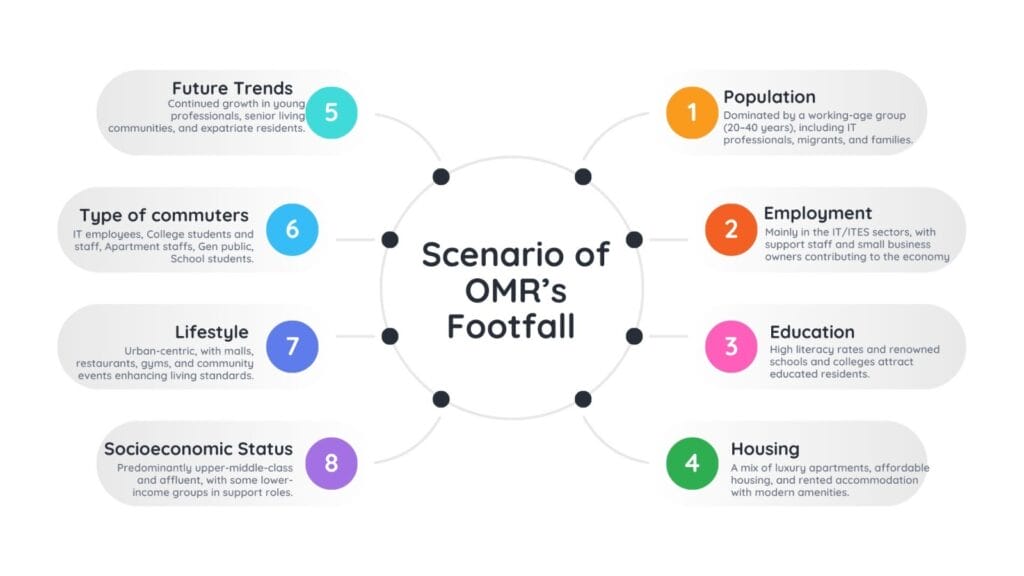
A survey was conducted among OMR apartment RWAs to assess the availability and accessibility of MTC buses and identify ways to improve last-mile connectivity. Residents from Semmencheri, Shollinganallur, Siruseri, Egattur, Thalambur, Kelambakkam, Thoraipakkam, Navalur, Kazhipattur, Padur, and Pudupakkam participated, sharing their concerns and suggestions.
The findings indicated that the OMR corridor is not receiving sufficient transit services. Survey responses showed that bus stops are up to three kilometres from residential areas. People living farther from the main road face greater challenges accessing public transport because bus stops are too far apart. The survey also revealed the need for additional new bus stops at existing routes.
Lack of MTC buses from OMR to key destinations in Chennai
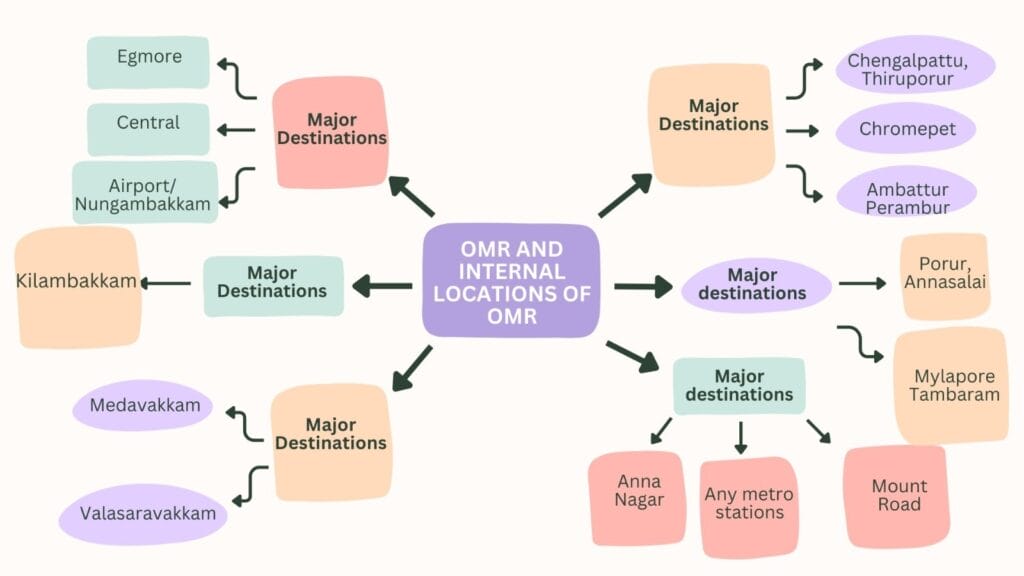
Residents reported that there are no direct MTC bus services from OMR to several key destinations. For example, travelling from Kelambakkam to Thiruporur or Sengamalam often means paying extra for auto or cab services just to reach the main OMR road. Important destinations without direct bus connectivity include Mylapore, Central, Egmore, Porur, Nungambakkam, Kilambakkam, Mount Road, Tambaram, Chengalpattu, Ambattur, Chromepet, Medavakkam, Valasaravakkam, Anna Salai, Perambur, Pallavaram, Metro stations, and Anna Nagar.
Lack of small bus services across OMR and interior areas
For a long time, small bus services were not operated along the entire OMR corridor or in its interior areas. These services were only run as far as SRP Tools and Taramani. Even with significant IT sector growth from Taramani to Siruseri and the development of new residential and commercial spaces, short-distance bus services were not introduced to these regions. Some residents report a lack of nearby MTC bus stops, requiring them to rely exclusively on autos and cabs. Some residents say it is hard to reach OMR from places like Shollinganallur, Siruseri Sipcot, Elcot Avenue, Thalambur, Semmencheri, and the Pallavaram-Thoraipakkam road. They also spend more time changing buses to reach their destinations.
OMR Mobility 2026: A 10-point integrated transport roadmap
FOMRRA proposed the following solutions to support OMR residents, office workers, daily labourers, and students who rely on public transport:
1. Increase the number of MTC buses.
2. Add more bus stops along OMR.
3. Introduce a new bus service to key destinations.
4. Launch MTC small bus services along OMR.
5. Update existing bus stops with route information.
6. Improve traffic signboards in OMR.
7. Raise awareness about MTC digital services.
8. Deploy electric low-floor buses to promote a clean and sustainable environment.
9. Expand bus bays where needed.
10. Enhance last-mile connectivity for interior parts of OMR.
Following the study, which we presented to the MTC authorities, small bus services have been introduced along the OMR between major destinations. EV bus services and low-floor buses were introduced to support clean transport, and new bus services to the Airport were added. In August 2025, Deputy Chief Minister Udhayanidhi Stalin launched 135 new buses and inaugurated the upgraded Perumbakkam electric bus depot. The ₹233 crore project added 55 air-conditioned electric buses and 80 deluxe buses to the fleet.
What we want the government to do
Government authorities must take these steps to help move the FOMRRA proposed solutions forward faster than usual:
- Add more MTC buses during peak hours to improve service along the IT corridor.
- Establish the new bus stops as demanded in the report.
- Enlarge the current bus bays to reduce traffic jams.
- Put up route maps and bilingual information boards at all OMR bus stops.