Sanitation workers’ protest: How the privatisation push deepens inequality for Chennai’s marginalised

In Part 1 of this video, we break down how the outsourcing of waste management impacts thousands of sanitation workers across Chennai.

In August this year, over 2,000 sanitation workers from Central and North Chennai staged a peaceful protest against the Greater Chennai Corporation’s (GCC) decision to privatise waste management services in Zones 5 and 6. Their demonstration was met with force and allegations of police brutality, just one day before Independence Day.
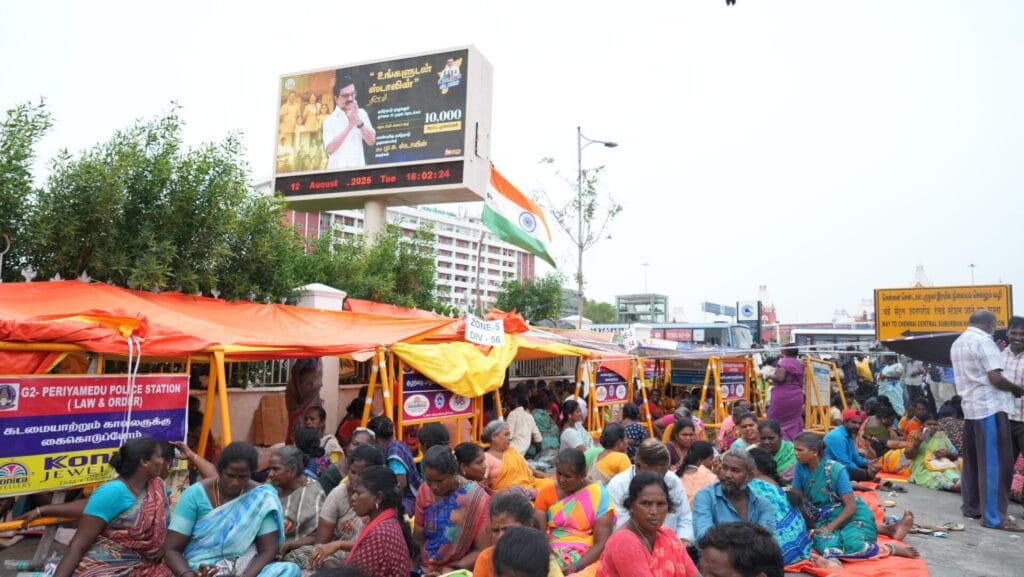
Sanitary workers protest against privitisation of waste management in zones 5 and 6 in Chennai.
Sanitary workers protest against the privatisation of waste management in zones 5 and 6 in Chennai. Pic courtesy: Sakthivel/Vyasai Thozhargal

Over the years, GCC has outsourced solid waste management to private firms in 13 out of its 15 zones. The latest was in June this year, which approved the handover of Zones 5 and 6 to Delhi MSW Solutions, part of the Ramky Group. This move has left long-serving sanitation workers in a state of uncertainty.


Read more: The plight of conservancy workers in singara Chennai


Impact of privatisation of waste management on workers

Previously employed under the National Urban Livelihoods Mission (NULM), these workers are now being offered only contractual positions with the private company, that too with a significant pay cut.

The DMK had made a poll promise to regularise the jobs of sanitary workers working for over a decade. However, the state government has made no attempts to address their concerns.

While officials claim privatisation will bring better benefits, many workers argue the opposite. Advocate Kannan of the Uzhaippor Urimai Iyakkam points out that regularisation, not privatisation, is key to ensuring job security and dignity of the workers and their future generations.

The move to privatisation has raised many such concerns. In Part 1 of a video on this issue, we have broken down how the privatisation of waste management will affect thousands of sanitary workers in Chennai. 

For the workers, who are already marginalised because of caste and social stigma, privatisation brings more discrimination through pay cuts and loss of already precarious livelihoods.

But the story doesn’t end there. Privatisation also raises questions of accountability and public money. In Part 2, we will look at what this means for Chennai’s taxpayers.

Also read:

Leave a Reply

Your email address will not be published. Required fields are marked *

Similar Story

Reimagining Deonar: How Mumbai’s toxic dump can become a green lung space

Instead of relocating residents into housing near the Mumbai landfill, restoration efforts could consider creating a buffer zone that the city needs.

Mahesh* owns a small paan and beedi shop near 90 Feet Road. His family has lived in Mumbai’s Dharavi for 50 years. Over the years, they added additional storeys above their home, a common practice in Mumbai's slums. The rent from these upper floors helps Mahesh care for his ageing parents. Redevelopment would cost him both his shop premises and this vital supplementary income. The Maharashtra Coastal Zone Management Authority (MCZMA) has given the go-ahead for the bioremediation of solid waste at the Deonar dumping yard to free the plot for housing “ineligible” residents (those lacking documentation) of the Dharavi…

Similar Story

HSR residents drive sacred swap, reduce religious waste dumping

A Bengaluru community effort gives respectful farewell to temple waste, protecting the environment and promoting waste awareness.

Across Bengaluru, it is common to see abandoned photos and idols of deities left under sacred trees, near parks, or outside temples. Does this sight disturb you? It bothered us deeply to see these divine symbols—once the centre of our homes—left to become soiled, discoloured, and neglected. What is even more distressing is that most of these items eventually end up in landfills. We felt that this needed to change. Such items deserve a respectful farewell, and the needless waste of valuable resources must come to an end. So, what's the solution? The journey Our journey began with a pilot…