Democracy is more than just the right to vote or stand for office; it’s about empowering citizens to influence the policies and decisions that shape their daily lives. For a government to be truly responsive, citizen engagement must be at the core of the law-making process. In this system, policies should be crafted not only for the people but with the people, reflecting their concerns and aspirations.
Public consultations are vital in strengthening democracy by ensuring policies reflect the needs of those they impact. In February 2021, the Brihanmumbai Municipal Corporation (BMC) incorporated feedback from Mumbaikars during the city’s annual health budget deliberation. This led to increased healthcare spending, prioritising the upgrade of hospital infrastructure and the construction of more medical colleges—directly addressing key concerns raised by the community.
Citizen participation needed for change
The importance of public participation, particularly during the pre-legislative or public consultation phase, cannot be overstated. It allows citizens to directly influence laws by sharing concerns, insights, and solutions based on their experiences. This involvement helps create more informed, inclusive policies and fosters a sense of ownership and accountability among the public.
An example of effective public consultation is the Transgender Persons (Protection of Rights) Rules, 2020, where young citizens shared feedback on the draft rules. Within two months, 52% of their feedback was incorporated, addressing potential implementation challenges.
Such consultations empower citizens to engage in the lawmaking process, fostering a sense of democracy beyond just voting. While it’s often said that governments don’t listen, experiences show that they do respond when constructive inputs are provided at the right stage in the lawmaking process.
Read more: Lack of public consultation is a hindrance to holistic lake development in Bengaluru
In India, the Pre-Legislative Consultation Policy (PLCP) of 2014 outlines the framework for conducting public consultations on central legislation and policies. However, since the PLCP is a policy rather than a law, it serves as a guideline for central ministries and departments rather than a binding mandate. As a result, its implementation depends on the willingness of policymakers to adopt and follow its provisions.
Nevertheless, some regulatory bodies in India began involving the public in consultations as early as 2002. While these consultations initially had limited scope, the practice has gained significant traction over the years. Digital platforms have enhanced the accessibility and inclusiveness of consultations, enabling a wider range of citizens to participate. This shift has led to the development of broader outreach programmes, promoting more inclusive and transparent policymaking.
Public consultations lead to inclusive policy making
Recognising the efforts of government departments that engage in consultation practices is essential to fostering a culture of transparent and inclusive governance. In 2024, the Civic Innovation Foundation (Civis), a non-profit working in the realm of governance and public consultation, hosted its inaugural awards ceremony—the Civis’ Inaugural Public Consultation Awards 2024.
This event marked the tenth anniversary of the Pre-Legislative Consultation Policy (PLCP), celebrating the progress made in public consultation practices. By highlighting these efforts, Civis reinforced the importance of collaboration between the government and citizens. Such recognition not only strengthens the legitimacy of policies but also encourages further innovation in the consultation process. It motivates government departments to continue refining their efforts and adopting more inclusive practices.
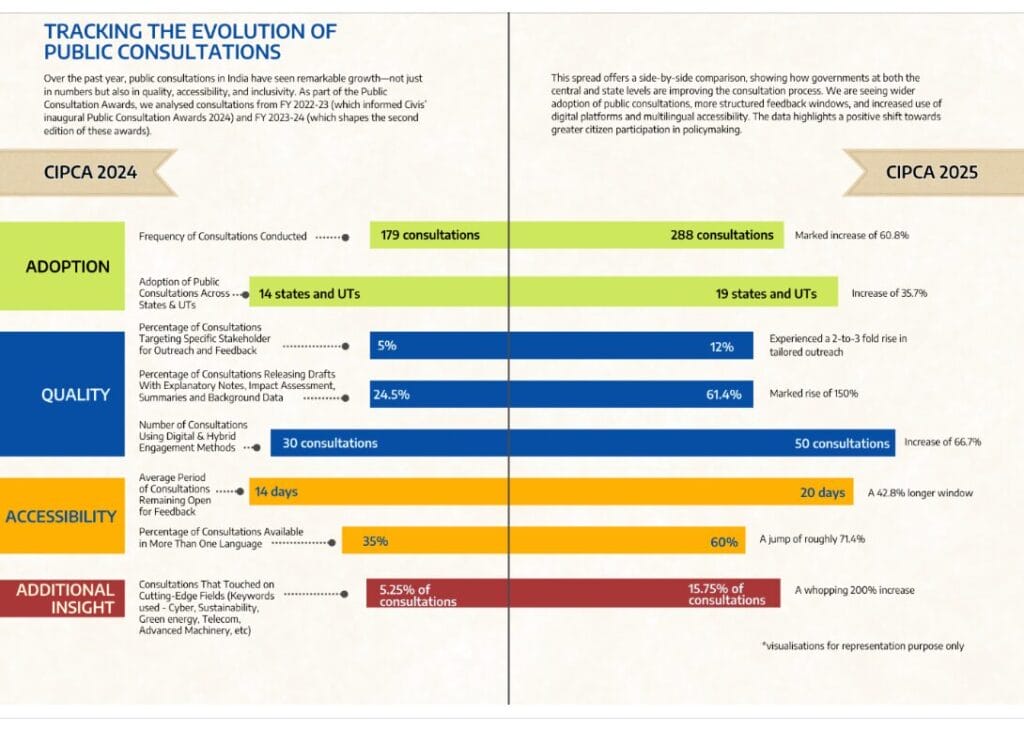
Since its enactment, the Pre-Legislative Consultation Policy has significantly boosted public involvement in the law-making process, marking India’s shift toward a more deliberative democracy. As of 2024, the number of laws and policies being subject to public consultations has grown by 2112.5% since 2014. Further, the Civis’ Public Consultation Awards, 2025 states that over the past year, the sphere of public consultation has not only seen an increase in numbers but also in quality, inclusivity and accessibility.
Recording responses from the public
Knowing that their feedback can directly influence policy decisions motivates citizens to engage in consultations. Best practices such as these help broaden participation:
- Extending feedback periods (often 60 days or more)
- Publishing drafts in multiple languages
For instance, the Insolvency and Bankruptcy Board of India (IBBI) released detailed reports summarising feedback and responses, ensuring transparency. Similarly, the Securities and Exchange Board of India (SEBI) mapped stakeholder responses to proposals, clearly showing how public input shaped their decision-making process.
Public consultations are crucial for fostering transparent, inclusive, and responsive governance. By actively involving citizens in the lawmaking process, governments can create policies that truly reflect the needs and aspirations of the people they serve.