In Part 1 of this series, I narrated how our citizen group surveyed 439 streetlights in Vasanth Nagar this June-July, and identified defective and missing lights. Using our data, we convinced BBMP to take action. BBMP has already fixed nearly half the defective streetlights here, and is expected to complete the rest in another fortnight.
Given the condition of streetlights in many parts of Bengaluru, you may want to replicate the survey in your neighbourhood too. During the survey, you can map streetlights either on a Google Map online, or list the details manually in an Excel sheet. I prefer the manual method for now, since officials, corporators, contractors and their staff understand this data better.
Here is a step-by-step guide on conducting the survey, presenting the data to officials, and following up with them for results.
- First, form a team of citizens who are passionate about taking up such civic projects.
- Crop a suitable map of your locality out of Google Maps.
- Study it carefully. Divide your neighbourhood along major roads, into smaller portions. Name each portion (say, Zone1, Z2, Z3 etc).

Here’s how we divided Vasanth Nagar into four ‘zones’ for our survey
- Make sure you have the name of each street/road. If a road doesn’t have a name at all, find its commonly-used name from residents nearby. This would help contractors identify the road easily during repair works later.
- Take a particular zone, and plan a route so as to cover every single street in it. Be careful about the border roads around each zone. Include both sides of a border road within the same zone, and ensure it is not included in the adjacent zone.
- Note down all relevant data for each streetlight:
- Type of light (mainly Sodium/LED)
- Whether it’s working or not. Remember, sometimes streetlights work intermittently, so observe carefully
- Whether it’s covered by any tree branch, creating shadows on the streets. Sometimes streetlights are completely hidden by branches
- Whether there is a major gap between two adjacent streetlights. If a new streetlight is required, check if a pole is already available there or not
- Exact location of the streetlight
All data can be collected just after dusk, once the streetlights are on.
- Enter all data into an Excel sheet zone-wise, and summarise the data for each zone. The Excel sheet prepared during our survey.
- Once the Excel sheet is completed, convert it to PDF and send a copy to the official email IDs of the Assistant Engineer and Executive Engineer (Electrical) of your ward; hand over hard copies to them as well. Mark copies to your ward corporator.
- Follow up with them to get as much work done as possible – repair of dead streetlights, pruning of branches, installing new streetlights where spare poles are available, and finally, installing both new poles and streetlights where required.
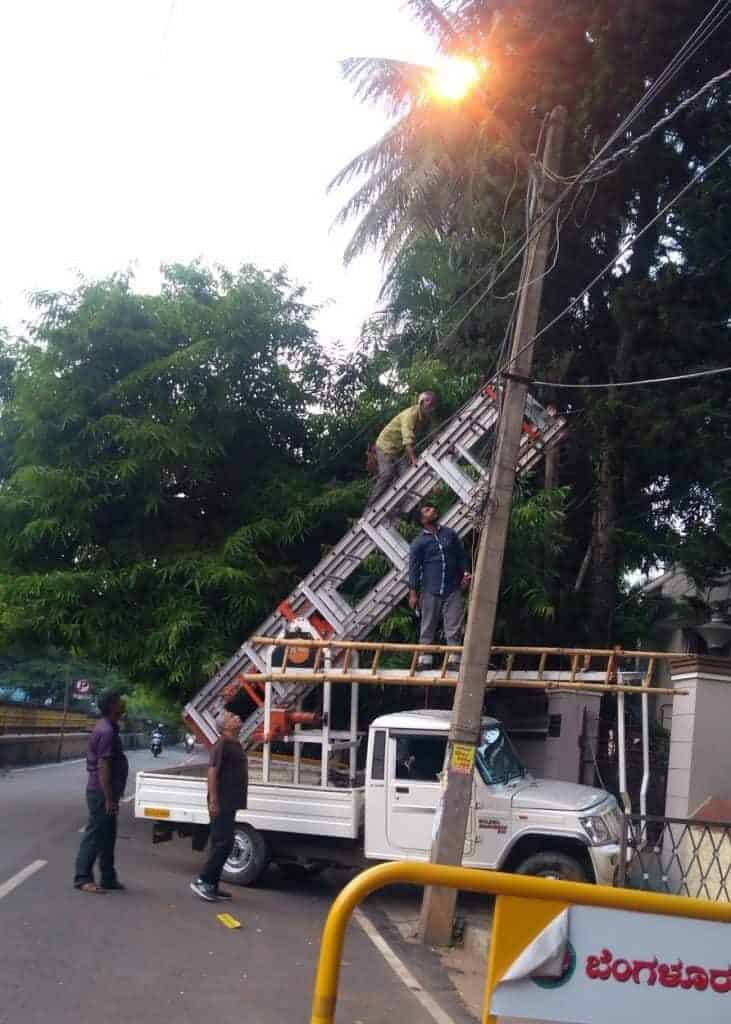
Contractor’s staff repairing a streetlight in Vasanth Nagar. Pic: Rajkumar Dugar
- At least one of your team members should coordinate with the contractor’s staff, and be with them while they do these works. This would help you communicate better with the staff on the exact problem with each streetlight. The staff may also need your help, for example, to get a local resident to move his vehicle parked below the streetlight. You should also take pictures of the work being done on each streetlight, and update your report as the work gets done.
- The key to success is to stay positive and collaborate with the concerned persons, rather than taking the negative approach of complaining. Help them do their job. Be with the contractor’s staff when they work. Maybe share a coffee or lunch with them, since they are deviating from their routine and going a little out of their way for you.
- Think about how you can improve upon this system, implement it and share your experience with other citizens. This in turn would help them learn, implement and improve upon what you have done.
Dear Mr Dugar,
I am from Richards Town and represent the RTRA.In 2009, we had published a street light survey very similar to the one you have done.This helped in converting most of the lights from tube lights to sodium vapor. In 2017, we then went a step further, changing the lights ~ 90% to LED.