The Karnataka state budgets for 2025–26 present an ambitious blueprint for Bengaluru. With allocations that rival national infrastructure plans — ₹40,000 crore for tunnel corridors, ₹8,916 crore for a double-decker flyover, and ₹27,000 crore for the newly coined “Bengaluru Business Corridor” the government appears determined to transform the city’s landscape. But this grand investment raises a deeper question: Is this a vision for a people-centred city or simply an infrastructure-centric spectacle?
What emerges is a familiar story, not unique to Bengaluru but emblematic of urban development across India. Faced with growing chaos, the instinct is to “throw concrete at the problem.” Yet, as residents continue to grapple with gridlocked roads, water insecurity, and governance failure, it is increasingly clear that money alone cannot solve what are fundamentally political, ecological, and institutional crises.
Read more: Karnataka budget focuses on roads and buildings, not on people
The infrastructure obsession
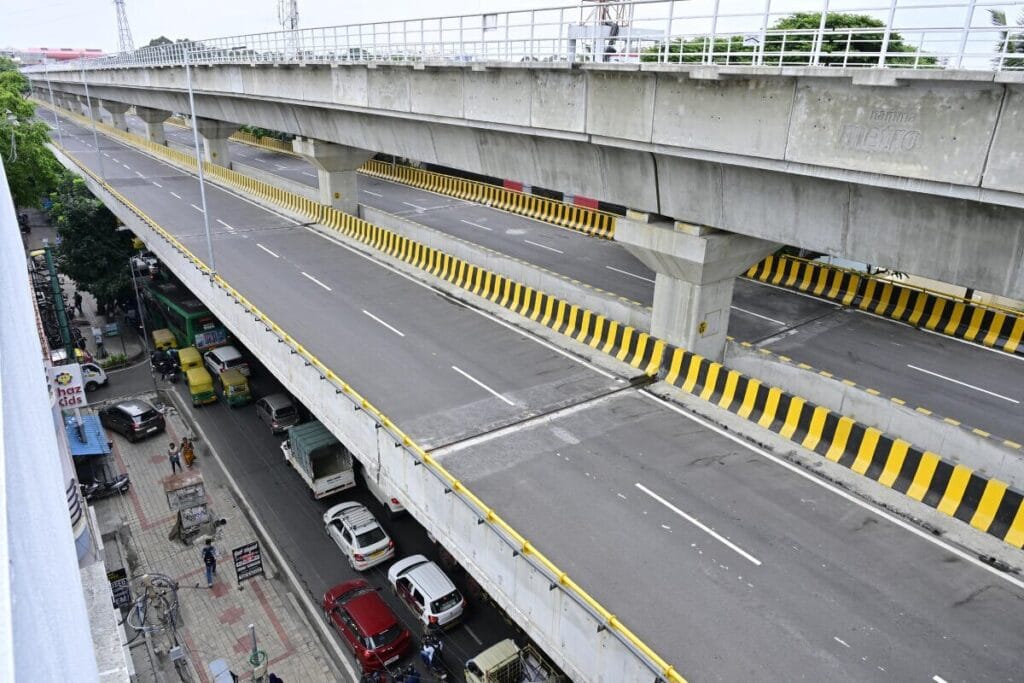
The state’s budget approach to Bengaluru reflects a single-minded preoccupation with physical infrastructure. New roads, flyovers and expressways dominate the narrative. These projects signify more than capital expenditure, they signal a development logic that equates mobility with flyovers, and urban modernity with speed.
But this “mobility equals progress” equation is deeply flawed. While transport networks are vital, the budget gives little indication that these massive investments are part of a coherent urban vision. There is no integrated land use-transport strategy. There is no corresponding investment in pedestrian infrastructure, last-mile connectivity, or public bus systems that serve the majority. The question remains, are we building a city for cars or people?
This vision caters to a narrow slice of Bengaluru’s population, the car-owning elite while ignoring the everyday struggles of millions who walk, cycle, or depend on BMTC buses. Moreover, infrastructure-induced growth often leads to displacement, gentrification, and further ecological strain, particularly in peripheral areas. Without robust equity safeguards or a sustainability framework, these mega-projects risk deepening the divides they purport to bridge.
Read more: Opinion: God did not create any of Bengaluru’s problems!
Water: Addressing symptoms, not causes
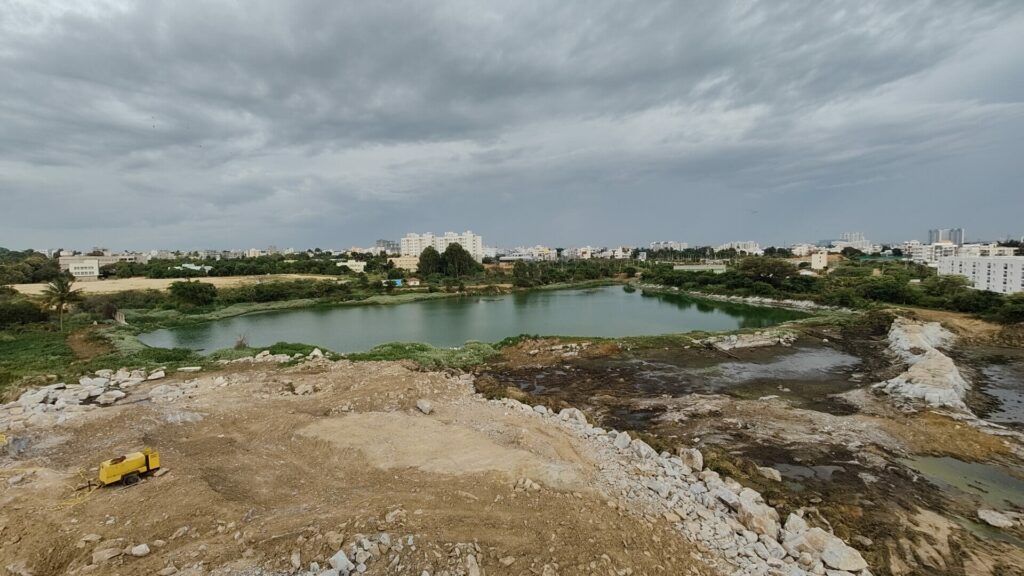
Bengaluru’s water crisis, manifesting as both drought and deluge, is a textbook case of ecological amnesia. The budget allocates ₹3,000 crore to stormwater drains and sewage treatment plants (STPs), ostensibly to control urban flooding. However, this engineering-heavy response ignores the root causes — the destruction of the city’s lakes, wetlands, and recharge zones.
Once known as a “city of lakes,” Bengaluru has lost over 79% of its water bodies and 88% of its forests due to relentless urban sprawl in the last 50 years according to a study by IISc. These ecosystems served as natural sponges, absorbing rainwater and replenishing aquifers. Their erasure has turned rainfall into a hazard rather than a resource.
The budget offers ₹234 crore for rejuvenating Bellandur and Varthur lakes, and ₹35 crore for 14 other lakes under “Green Bengaluru.” But these projects tend to focus on aesthetic enhancement, jogging tracks, fences, and lighting, rather than ecological restoration or community stewardship. They are lakes as lifestyle parks, not as living ecosystems.
Equally troubling is the continued reliance on long-distance water sourcing. The preparation of a DPR for Kaveri Stage-VI indicates that Bengaluru still prioritises capital-intensive water supply projects over demand-side management. Despite calls from environmentalists and urban planners, there is little investment in decentralised rainwater harvesting, greywater reuse, or protection of groundwater commons, particularly in low-income and peri-urban areas, which suffer most from water inequity.
Governance deficit
Perhaps the most critical and least addressed issue in the budgetary discussions is governance. Bengaluru has had no elected municipal council since 2020. Decisions that affect 14 million residents are being taken by bureaucrats, not by accountable local representatives. In this context, the creation of a new Special Purpose Vehicle (SPV) to implement major urban works is not just a technocratic tool, it is a democratic bypass.
The proliferation of SPVs, parastatal bodies, and departmentally run projects has resulted in a fragmented city governed by more than 10 agencies, including Bruhat Bengaluru Mahanagara Palike (BBMP), Bangalore Development Authority (BDA), Bangalore Water Supply and Sewerage Board (BWSSB), Bengaluru Metro Rail Corporation Limited (BMRCL) and Bangalore Electricity Supply Company Limited (BESCOM), each with overlapping mandates and little inter-agency coordination. The result is administrative chaos, citizen confusion, and poor service delivery.
What does this prolonged delay mean? It means that there is no roadmap for reviving ward committees, empowering area sabhas, or holding BBMP elections. This deliberate silence on local democracy undermines the very foundation of participatory urban governance. Citizens are left without forums to express grievances, propose alternatives, or hold planners accountable.
Special Purpose Vehicles (SPV): Bengaluru’s boon or bane?
- In 2014, the State government established the Bengaluru Suburban Rail Company Limited (BSRCL) as an SPV for the Suburban Rail project. In 2018, the then CM H D Kumaraswamy announced a new SPV under K-RIDE to expedite the project.
- There is always a tense engagement between municipal authorities and the development authority. Add into the mix a special purpose vehicle (SPV) like BMRCL and it creates utter chaos.
- In 2018, an SPV headed by a full-time CEO to implement the Smart Cities Mission called BenSCL (Bengaluru Smart City Limited) was created.
- In 2019, state government gave its consent to register the SPV named B-RIDE (Bangalore Integrated Rail Infrastructure Development Enterprises Limited) that would implement the suburban rail project worth ₹22,242 crore.
While SPVs are meant to streamline project implementation by bypassing bureaucratic hurdles, their proliferation in Bengaluru has often resulted in overlapping jurisdictions, lack of coordination, and governance challenges. The key question remains—are these entities accelerating urban development or adding to the chaos?
Charting a people-centric path
Bengaluru today stands at the intersection of multiple urban tensions between economic growth and environmental limits. Between elite enclaves and informal peripheries and between a city imagined from above and one lived from below. The budget, in many ways, crystallises these contradictions. It lacks the vision and humility required to build a just, resilient, and democratic Bengaluru. Infrastructure is necessary but it must serve broader goals of inclusion, sustainability, and citizen empowerment. Here’s what a credible alternative could look like:
- Reclaim urban democracy: Hold long-delayed BBMP elections. Empower ward committees with resources and decision-making authority. Institutionalise participatory budgeting and local planning.
- Design for people, not cars: Shift focus from flyovers to sidewalks. Expand and modernise the BMTC network. Build safe cycling lanes. Integrate metro, buses, and last-mile options into a seamless mobility network.
- Revive urban ecology: Move from lake beautification to watershed restoration. Incentivise household and community-level water harvesting. Restore stormwater flows through decentralised systems.
- Institutional coordination: Establish a metropolitan governance framework that brings together disparate agencies under a common platform for planning and accountability.
- Address informality: Recognise and support informal settlements and livelihoods through inclusive zoning, basic services provision, and tenure security, rather than treating them as ‘encroachments’ to be removed.
- Focus on equity and livability: Ensure that budget priorities reflect the needs of low-income communities, women, the elderly, and persons with disabilities. Invest in public health, education, and affordable housing with the same intensity as flyovers and metros.
From concrete to common sense
Bengaluru’s current trajectory of infrastructure-led, elite-oriented, and ecologically blind development is not inevitable. It is a political choice. The state budget offers an opportunity to rethink that choice not by abandoning infrastructure, but by embedding it within a broader vision of urban justice.
Building a future-ready Bengaluru will require more than tunnels and corridors. It will demand imagination, accountability, and a renewed contract between the city and its citizens. In other words, we don’t just need better roads we need better politics.
The well presented article raises important and critical issues that are responsible for ad hoc project announcements minus the governance framework. The 74th Constitutional Amendment of 1992 prescribes Urban Local Self Governance for cities, which ensures mechanism for City Planning, preparation of City Plans, participatory governance through Council elections, Ward Committees etc. All of which are currently missing. Citizens must unite and protest non implementation of a Constitutional provision.