Bangalore International Centre in collaboration with Citizen Matters and Vidhi Centre for Legal Policy, had organised ‘Right to breathe- Fixing Bengaluru’s Air’, a discussion under Bengaluru Solution Series, on January 11th. This was the second installment of the Bengaluru Solution Series.
The panel for the discussion comprised of Randeep D, Indian Administrative Officer and Special Commissioner – Solid Waste Management, BBMP, Anjali Saini, a member of Whitefield Rising, Pawan Mulukutla, Bosch India and Shashank Atreya, a Research Fellow at Vidhi Centre for Legal Policy. The panel was moderated by Meera K, Founder, Citizen Matters.
The quality of Bengaluru’s air is fast declining and the attention around this issue has been fairly limited. The panel discussion attempted to create a platform for public engagement with experts. The discussion began with V Ravichandar introducing the Bengaluru Solution Series and briefly providing the background on the issue of air pollution in the city. He stressed on the need to have data-led policy making to combat air pollution and the urgent need improve the technological intervention in such matters.
This was followed by a short presentation by Researcher Aishwarya Sudhir on the findings of her report on Bengaluru’s Air. She pointed out that the situation in Bengaluru is alarming especially the impact from vehicular pollution.
The panel began by Randeep speaking about the initiatives that BBMP has taken to prevent burning of garbage in the city. His comments immediately attracted questions from several active citizens, who were keen to understand the reasons behind the shortcomings of BBMP’s solid waste management policy. In response to many questions Randeep suggested that solid waste management in Bengaluru is a constantly evolving challenge, it can only be addressed by citizens taking ownership of their waste and partnering with local agencies to treat their waste.
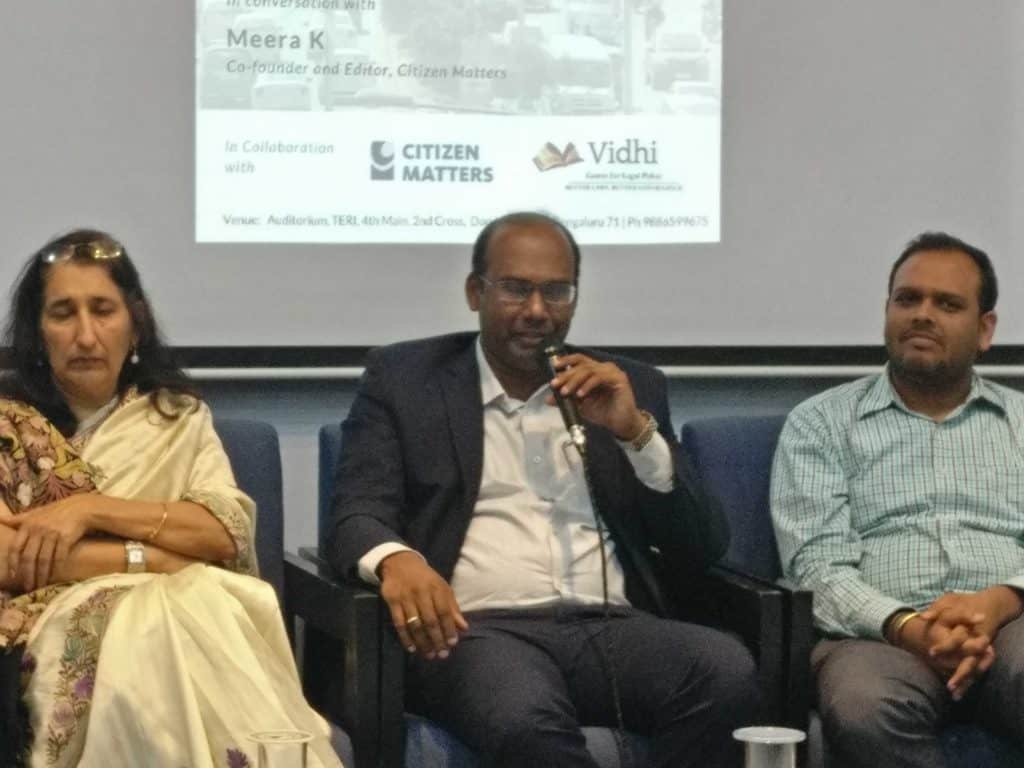
Pic: Shree D N
With the focus shifting to citizen participation, Anjali Saini spoke about her experience of initiating changes through resident welfare associations and collaborating with local Government. She felt that since the government is short-staffed it must rethink its operations and maintenance procedure to improve efficiency. Shashank Atreya suggested that BBMP can perform its role better if Karnataka State Pollution Control Board can improve its capacity. The board currently faces 60% staff crunch. He also stressed on identifying solutions soon within the Government and not invite the High Court to intervene.
The discussion then shifted to addressing vehicular pollution, Pawan Mulukutla spoke about the need to have a holistic urban transportation policy with public transportation becoming the primary mode of travel. Shashank Atreya spoke about the issues faced in phasing out 2-stroke autos in Karnataka and the need for decisions on transportation to not be taken in silos. Subsequent to a brief discussion on urban transport, the panel were again drawn into the issue of waste management, with Randeep briefly commenting on the initiatives taken by BBMP on tackling construction and demolition waste (“C&D waste”). He informed the audience that currently BBMP is empowered to file a criminal complaint against builders responsible for not clearing C&D waste.
Watch the full discussion here:
When the discussion moved to the question and answer session, there were several questions in the area of the legal changes required to improve quality of air, gathering more and improvised data and ways to ensure better decision making. At the end, Gautham from Reap Benefit, an organization involved in environment-related projects, spoke about how children learning and trying to solve the issues was a way forward. Bangalore International Centre which has emerged as the intellectual hub of Bengaluru, witnessed a full house for this discussion.