Much has been written, in social media circles, against the expensive, potentially ugly steel bridge that is going to come at a cost of Rs 1800 Cr (estimated) to the public exchequer of the state of Karnataka. There are additional costs of course, trees, precious, full grown trees that have to be chopped off. Aesthetics.
A steel structure… don’t get me wrong, I am an engineer, I love steel…is going to snake through town from Chalukya circle to Hebbal flyover. Beautiful heritage buildings and land. Compelling arguments have been made by many people along these lines, and they are right. What I want to expand on are the arguments (none of them my original thoughts) that appeal most to me.
The first question anyone should ask is – what is the problem being solved? With the Steel Bridge or an alternative solution. Apparently, it is to make it easier to get to the airport (for somebody, not clear who). So the thing to do is to go look at some data. Since traffic count data is not accessible easily, google maps with traffic turned is the best substitute. What does a typical weekday traffic map tell us? Both morning and evening rush hour show a terrible bottleneck between the elevated expressway and the mid point of Hebbal flyover.
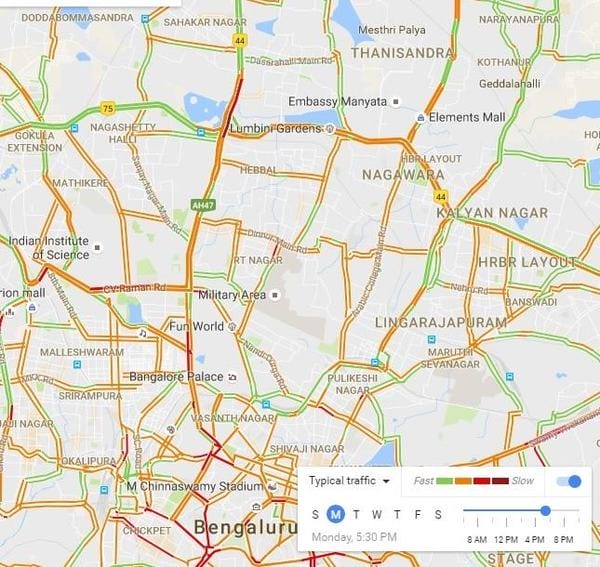
Traffic map on Bellary Road. Courtesy: Google maps
That indicates that Hebbal flyover is a choke point for traffic entering into the core city area inside the ring road. The morning map also shows bad traffic coming into the city from a little before Sanjay Nagar main road past Mekhri circle all the way down including along palace grounds. This pattern varies a bit for different days of the week, but the image is representative. Rest of the road is typical slow moving Bengaluru peak hour traffic, nothing out of the ordinary. What will the elevated steel road do?
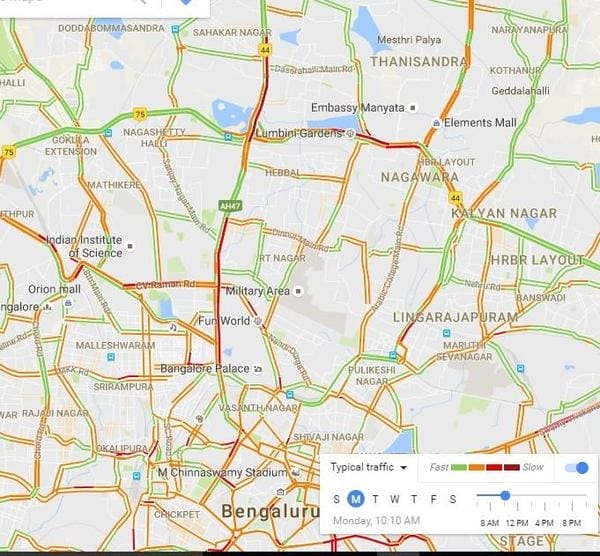
Traffic map on Bellary Road. Courtesy: Google maps
The only change that would happen is that traffic from Chalukya hotel to Hebbal flyover will be a nice green in the map. Will the bottleneck at the Hebbal flyover and along palace grounds go away? Palace grounds, maybe. Hebbal flyover, I am not sure. However, one thing is for sure. All that traffic will be dumped right at Hebbal and at Chalukya circle. Can the roads leading to the flyover, which look quite busy already, supply or evacuate the traffic to and from the steel bridge? How about at Hebbal flyover?
Keep in mind that the steel bridge is also going to attract some additional vehicular traffic through the core city until it becomes a bad as the other alternatives. How long before we have an entirely new mess on our hands? I don’t have the exact numbers or traffic simulations, but it will be a safe bet that the answer is “not very long”.
What is the vision for the city?
The second question set will sound rather philosophical, but it is important. How does this design fit in to our vision for the city. Do we have a vision? What is that vision? What is the process to articulate and give light to that vision?
What the steel flyover plan says out loud is that the intent is to enable motor vehicle movement. The vision I subscribe to is people movement. I submit that a vision should be formulated by gathering inputs from all citizens of the city and a comprehensive planning process executed by a Metropolitan Planning Committee (MPC) and executed by all agencies including a Unified Metropolitan Transit Authority (UMTA) is the way to go. These are not made up terms. They have been articulated over the years at several levels and in various fora and reports. In fact, the MPC is a legal mandate and one exists for this city as a paper agency to meet that requirement.
Think about it. None of us would go about building our own homes without a well thought out plan and without consideration for factors like water and ventilation and lighting and flow of people and energy. We would certainly not agree to build it as per the contractor’s or architect’s specification without our requirements factored in. After all, we are paying! Why should we be willing to accept such an approach for our home, this great city of Bengaluru?
The third question is on what the money buys us. Rs 1800 Crores! Rs 18,00,00,00,000. At Rs 35,00,000 a bus, one can buy 5142 regular buses. In other words, a good chunk of BMTCs 6500 buses, many of which are well past retirement age, spewing toxic soot and PM 10/PM 2.5 pollutants can be replaced with new, higher emission standard buses.
Namma railu can solve congestion with less cost
Here is another alternative. There is a beautiful, under-utilised railway line going right past the trumpet interchange. Based on the old Namma Railu RITES report, with a few hundred crores and a signalling system upgrade, a very good system to move people to the airport from many city railway stations is very doable. We would be also substantially upgrading the city transit infra. All that still leaves money left for new buses and footpaths and other improvements that encourage public transport and NMT all over the city. The point is, there are many better ways to use the money.
Finally, think of what happens under this bridge. Our city is full of examples of all these bridges with just crap underneath. No need to cite examples. If you live here, you have seen the dark underbelly of various elevated structures, with garbage and urine, pedestrian unfriendly, dark foreboding places. Do we need one more?
We have suffered for long with the notorious traffic in our city and pay a very heavy price in terms of time, pollution and lives. I submit that much of this suffering is grossly aggravated by other “plan” equivalents of this steel bridge – expensive, poorly designed, wrongly prioritized solutions implemented without a blue print. The KR Puram flyover, Silkboard interchange, ORR split flyovers, Richmond circle flyover are all examples. Let us stop this today. Let a plan drive the city instead of the city driving the plan. The first step to fight for this change is to join the protest against the #SteelFlyover. That is why I plan to join.
The opinions expressed here are author’s own. Citizen Matters as a news analysis website, makes an attempt to present all sides of the issue, but does not endorse or reject them.
Related Articles
BDA keeps steel flyover on hold after drawing flak from citizens
The project can cost much less if a flyover from National College side of Chalukya circle to
Cauvery theater circle is done. In addition , a 4 lane flyover across hebbal railway gate is enough.
Second project can be a 4 lane road from hosur road to Bagalur road, which will act as a north south expressway.
The steel flyover is a scam, and idiotic.