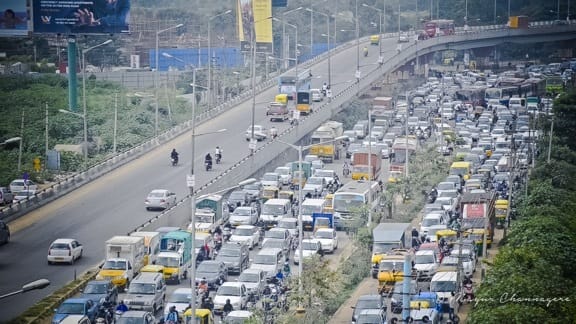
File pic: Mayur Channagere
A press release issued by the Karnataka Department of Information and Public Relations on July 30th about Bengaluru Vision Group sub-committee’s traffic related decisions related to Bengaluru has ruffled feathers. A section of citizens have questioned the sub-committee for taking unilateral decisions for Bengaluru, instead of remaining just an advisory group, as noted by the government during the formation of the Vision Group (Bengaluru Blueprint Action Group or BBPAG).
A lot of information has been floating around about the decisions taken by the sub-committee: starting with their declaration of 12 roads as high density roadsto their intent of making six roads signal-free roads. However, we discovered that the sub-group said to have taken these decisions is not a part of the BBPAG at all, contrary to what has been reported in the press release and the media. In fact, it may not be even correct to label these as ‘decisions’.
Top officials have confirmed to Citizen Mattersthat the traffic sub-committee is an independent committee formed prior to the formation of the BBPAG and has nothing to do with the BBPAG sub-committees. The traffic committee has not taken any decisions as it is not a constitutional body, but these are just some suggestions to improve traffic-related matters in the city. Suggestions, as they stand, may or may not be implemented.
- Declare 12 roads as high density roads.
- Implement new traffic circulation plans on Hosur-Sarjapur Road, Manyata Tech Park on ORR, K R puram – Benniganahalli, Bellandur and Whitefield areas.
- Signal-free corridors – Old Madras Road, Doddanekundi, OM Road – Mutthumariayamma temple, PF Junction, Church Street, Khoday Circle, Goodshed Main Road and Kasturba Road.
- Synchronisation of signal lights on important corridorsIntensive drives against drag racing and wheelingRevive citizens traffic forum meeting.
- Safe route to schoolsRoad safety training programmes for school bus and van drivers.
- Introduce public eye mobile appCases against road and footpath hawkers, jay-walkersShifting 122 bus stops or shelters located near intersections.
- Allow BMTC buses to ply through Russel Market to avoid traffic on Cunningham Road.
- Introduce pre-paid auto stands at 13 important places.
- Strict enforcement of traffic rules on Tender Sure roads.
- Hike the penalty for traffic violators
Source: Information Department press release
According to Mahendra Jain, Additional Chief Secretary, Urban Development Department, the traffic sub-committee is a coordination committee formed sometime in January to discuss traffic-related issues and find solutions. “It is an independent committee (comprising City police commissioner, BMRCL MD, UD Additional Chief Secretary and a few members from the BBPAG). Sub-committees under the BBPAG have not been formed yet. We are preparing the proposal to constitute six sub-committees and the process is underway,” he said.
R Hitendra, Additional Commissioner of Police (Traffic), who is a member of the traffic coordination committee, too clarified that the committee of officials from multiple departments was formed to bring about a coordination between departments in implementing traffic related plans. “It’s an informal group and we have been meeting every month. A few members from the BBPAG were added to the committee recently to get additional inputs,” he said.
To a query on the long list of “decisions” taken in the meeting and the validity of those decisions, he said they were just suggestions or rather the “wishlist” to improve traffic conditions in the city. Those suggestions can not be implemented without the cooperation of other departments including the BBMP, BMTC, Metro etc.
“For example, the high density roads — we have identified 12 roads in Bengaluru as high density roads owing to the traffic congestion. It implies that attention must be paid towards decongesting these roads. The quality of these roads should be improved, they should be widened and new roads should be laid. But all that is possible only if other departments work on the same lines,” the Additional CP said.
Similarly, on making six roads signal-free, he says that this suggestion too can be implemented only if additional infrastructure like a flyover or an underpass is constructed at the signal. “We just can’t declare them signal-free overnight. All the suggestions can be implemented if the other agencies make necessary arrangements,” he noted.
The Committee, according to sources, has directed the concerned departments to come up with their plans for implementing the suggestions, immediately. The traffic police will start executing the plans, once other departments propose their supplementary plans.
When asked about whether a decision was taken to reinstate one-way vehicular movement on Sarjapur Road (Krupanidhi College-St John’s stretch), he said the department is discussing the possibilities, but no decision has been taken yet.