To provide seamless movement of vehicles at toll plazas, FASTag was launched in the year 2014. The FASTag is a passive RFID tag affixed at the centre of the windscreen of vehicles. Vehicles can drive through the FASTag lanes at toll plazas after recharging their Tag accounts and the toll amount will be automatically deducted from the account.
The rules made in 2014 also contained a provision that any non-FASTag vehicle entering the dedicated FASTag lane would have to pay two times the toll amount, i.e., 100% penalty.

The progress of FASTag
The government has now made it mandatory for all vehicles manufactured or sold after 1st December 2017 to have a FASTag. The dealer is mandated to complete the registration and affix the tag as per the procedure. Older vehicles can buy the tag at various point of sale locations or through ICICI or Axis Bank .
A standard operating procedure (SOP) has been developed for both the FASTag users and the toll operators . FASTag is currently active in over 300 toll plazas across the country. Users can also call the customer care numbers of various banks in case of issues.
Parliamentary Standing Committee on amended rules
The parliamentary standing committee on subordinate legislation recently submitted its report on the amended user fee rules that stipulated a 100% penalty on non-FASTag users entering the FASTag lane. The committee broadly looked into the following two issues
- Whether the government has the authority to impose a penalty in the form of user fee and
- Whether such a harsh provision was necessary
Committee differs with government
The Ministry of Road Transport & Highways (MoRTH) in its written submission to the committee maintained that the provisions is simply mandating users to pay twice the user fee and not a penalty.

The committee did not agree with the ministry and said that imposition of any kind of additional charges beyond the prescribed fee for any violation qualifies as penalty. The committee also noted that for substantive matters like imposition of penalties etc., the provisions have to made in the parent act and not through executive orders by the government. The committee recommended that the parent act be amended delegating the powers to impose penalty on the central government.

Collection of penalty has not yet started: Govt
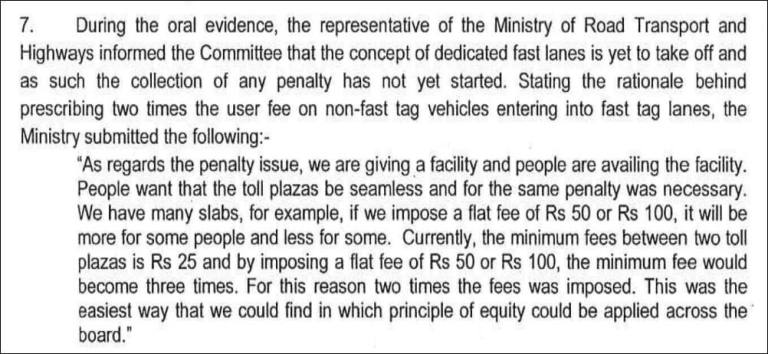
During the course of the committee meetings, a representative of MoRTH informed that the concept of dedicated fast lanes is yet to take off in the country and hence the collection of such penalty has not yet begun notwithstanding the relevant provision to collect penalty. The government said that the non-FASTag users entering the FASTag lane may obstruct the seamless passage and hence two times the user fee will serve as a deterrent. The government also said that large sign boards are present at every toll plaza indicating the dedicated FASTag lanes.
‘Build awareness & ensure availability before imposing penalty’
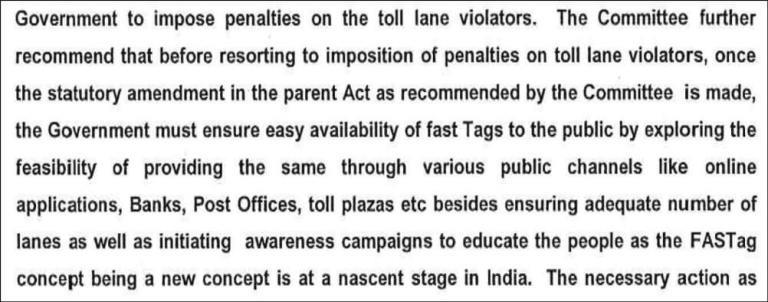
The committee in its recommendations to the government noted that before imposing penalty on violators, the government must ensure easy availability of FASTags through various channels and also educate the people on using the dedicated FASTag lanes since the concept is new.
[This was first published on Factly.in and has been shared here (with edits in headline only) under the CC BY-SA 4.0 licence. The original article can be read here.]