Chennai has taken several strides in climate action in recent years with the setting up of the Green Climate Company to tackle climate change challenges and through the formulation of the Chennai Climate Action Plan.
While the intent to fight climate change has been made clear, how climate action plays out in the city’s streets is the key issue. Key climate issues such as the destruction of Pallikaranai Marshland, the pollution caused by the Thermal Power Plant in Ennore and the recent gas leaks in Manali have shown that urgent measures are the need of the hour.
Climate rallies in the city have demanded exactly that over the past few years. Collectives that fight for different causes associated with the environment have used the rally to call for change and platform the voices of those most affected by climate change. Be it highlighting the impact of the Kattupalli port or showcasing the impact of pollution in North Chennai, climate rallies have played a part in bringing these subjects to the fore.
The eight youth groups that constitute the Climate Action Collective behind the rallies in Chennai are FICUS, Chennai Climate Action Group (CCAG), Palluyir Trust, Project Living Cities (PLC), Visai, Trashtroopers, Young People For Politics (YPP), and Let India Breathe (LIB).
We caught up with Pritika M, the co-founder of the Foundation for Intersectional Climate and Urban Sciences (FICUS), to unpack the broad climate goals for the city and how climate rallies fit into the picture.
Read more: Can Ennore and Pulicat wetlands become Ramsar sites?
Impact of the climate rallies in Chennai
Pritika says, “Each rally was built-up of a series of events which were organized to educate and create spaces for dialogues and discussions on what the climate crisis means for our city. This included the understanding of the kinds of climate change problems created in Chennai and the false solutions proposed, both of which disproportionately affect the working class and oppressed caste communities in addition to the non-human life forms and future generations.”
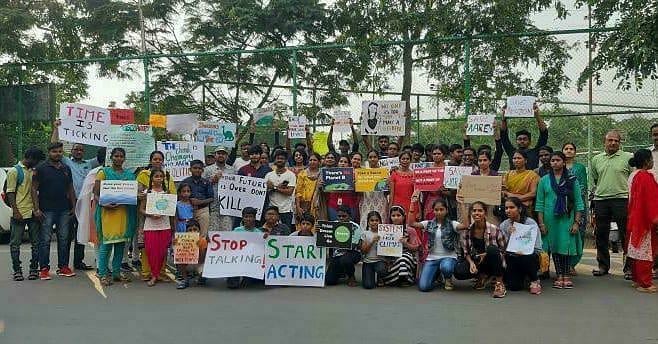
“The events were conducted in several schools and colleges where there was a good reach among the students. They gained an understanding of issues surrounding the climate crisis narratives,” says Pritika, adding that the rallies have helped interested groups and people working on the issues to meet, collaborate and delve into asking critical questions to the right people and to gain a nuanced, intersectional understanding of the climate change issues in Chennai.
In particular, the rallies have helped youth groups to come together to think and decide for themselves instead of sharing what the ‘adults at the top’ have deemed as appropriate climate messaging.
“The climate rallies have helped to look at the action of asking critical questions and demanding answers. I would say that is something to be celebrated apart from democratising the discourse and moving the discussions into actions,” says Pritika.
Evolution of the climate movement in Chennai
A lot of people are now understanding that the climate crisis is beyond the polar bears. Despite nuances of many intersectionalities, they are getting to understand the social justice angle of the climate crisis.
“As a collective, when we meet many groups, we try to bring attention to the specific ways in which Chennai is affected by climate change. Constantly gathering evidence and putting out the demands of the locals affected at the forefront is one way forward. However, what I find more promising is the space to have all these conversations. I find this to be more significant,” says Pritika.
Climate emergencies in Chennai that need greater attention
‘Climate emergencies’ in the context of Chennai are not a recent happening. “For instance, ‘sea-level rise’ is an issue that the communities in North Chennai have been facing for decades, perhaps even before the term ‘climate change’ was coined. They have been facing this issue due to the continued erosion caused by port constructions, which are strategically built in places where working-class communities live in. The ‘emergency’ in this context is the evictions faced by the affected communities and the terrible issues borne by them in the name of ‘relocation and rehabilitation’ facilitated by the government,” points out Pritika.
Similarly, more than 34 Red Category Industries built along wetlands in Chennai are an ‘emergency’ in the context of livelihood loss and air pollution due to unchecked gas leaks and flouting of regulations. “Our perspective of what is labelled as an ‘emergency’ is to address such social justice issues, which when brought to the fore, can help build appropriate climate resilience strategies,” she notes.
Read more: Chennai’s environmental issues put the spotlight on TNPCB
Climate collectives working to platform voices of affected
Climate Collectives in Chennai have always been a platform in which the voices of the affected communities have been at the centre. “They are given the platform to speak, to be heard and we have only been amplifying their voices. This includes the voices of fisherfolks, farmers and the pollution-impacted communities of Ennore and Manali,” Pritika says, adding that the rallies have never been about a singular voice but a collective of voices.
Further, pointing out the collectives have been helping create awareness of how the communities are getting affected, and what these struggles look like to those who otherwise do not show interest in such issues, she notes, “We work with the understanding that an affected community’s issue is not just their issue but everybody’s. We also seek to understand and accept our roles in how we are responsible for the situations such communities find themselves in.”
Engagement with the State government
Speaking about the assessment of the various initiatives taken by the government, Pritika says that there have been quite a few disappointments in the solutions prepared by the government like the indiscriminate construction of stormwater drains for flood mitigation.
“Where we come into the picture is to collaborate and create a space to engage in dialogue with the authorities. We were invited to attend the Tamil Nadu Climate Summit by Poovulagin Nanbargal, which is a positive sign. But, the amount of noise that we have to make to be recognised is quite worrisome,” she says.
What can young people do to get involved and take action?
To not be intimidated by the narratives around the climate crisis and to instead get curious and begin asking questions would be a good start. To proceed further, it would be good to critically think and understand what is being said or not said in conversations around climate change by officials, authorities and people in power.
“They could also join the people and groups who have been asking these questions and who have been doing meaningful, community-centred work,” suggests Pritika.
The jargon used while discussing climate change and climate politics could be intimidating but what is more important is to keep the curiosity alive and ask questions because climate change is a very real threat that we face which can only be fought collectively.
Watch the complete discussion here: