No new coins if you want platform tickets

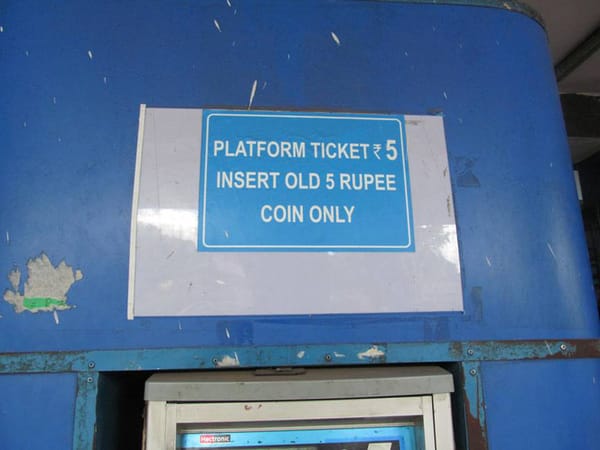
The vending machine dispensing platform tickets at the city railway station is slowly falling into disuse, since it accepts only old coins.

The manual ticket counter is functional again at the city railway station, as the e-ticket machines for platform tickets take in only old-five rupee coins, which are not being minted anymore. Passengers have started depending more on the manual ticket counters as majority of them have only new-five rupee coins.

This has led to a drastic drop in the printing of tickets by the machines to one or maximum two tickets a week.
Pic:author

Hariharan Narayanan, who had come to drop his wife at the railway station said: "The city railway station has e-kiosk to dispense platform tickets. It accepts only old-five rupee coins. What is the use of such a machine?"

People often do not have change, especially when there is a constraint that only old-five rupee coins are accepted. With manual dispensing of platform tickets, congestion is back.

The machines were upgraded last after the budget session of 2012, much after the new-five rupee coins were introduced. C Narendra, Publicity Inspector of Railways, Bangalore says, "The machine is customized in such a way that it accepts only the size of old five rupee coins. The new five rupee coins are smaller and thinner and this is not acceptable by the e-kiosk machines". He said they are aware of the problem and are trying their best to fix it soon.

The machines were first introduced in 2007, when the cost of the platform tickets was Rs 3 per ticket. Post the budget session 2012, the machines were updated as the cost of the tickets was increased to Rs 5 per ticket. At that time, the machines were programmed to accept old-five rupee coins, which is not being minted anymore by the RBI.

Leave a Reply

Your email address will not be published. Required fields are marked *

Similar Story

Bidadi GBIT project: Land acquisition process and compensation raises critical questions

As the goverment focuses on land acquisition for the 7,481-acre project, are farmers' rights and crucial social impact checks being compromised?

The Greater Bengaluru Integrated Township (GBIT) in Bidadi, first notified in March 2025, received its final notification in June 2026 under the Karnataka Urban Development Authorities Act (KUDA Act), 1987. The project is branded as India's first and largest AI City, featuring an AI-integrated township. The project will be implemented by the Greater Bengaluru Development Authority (GBDA) under the same act. Three villages, Kempainapalya, Vaderahalli, and Mandalahalli are notified in the Gazette under Section 19(1) of the KUDA Act for the implementation of a development scheme, deemed as public purpose. The development scheme is spread over a total of 7,481…

Similar Story

Karnataka SIR: How to check your ASDDO list status and next steps

The draft electoral rolls will be published on August 24. Karnataka voters, here's what you can do to complete verification by August 17.

In Karnataka's Special Summary Revision (SIR), all enumeration forms have now been digitised. Out of the state's 5.54 crore electors, Booth Level Officers (BLOs) have signed and collected forms for over 4.45 crore voters. However, 1,09,13,776 voters, representing 19.69% of the electorate, have been categorised under the Absent, Shifted, Dead, Duplicate, and Others (ASDDO) list. Following the publication of the ASDDO list on August 4, election officials verified and removed three lakh voters from the list within the first six days. To check your registration details, search the electoral roll, or access voter verification services, visit the Chief Electoral Officer,…