No new coins if you want platform tickets

The vending machine dispensing platform tickets at the city railway station is slowly falling into disuse, since it accepts only old coins.

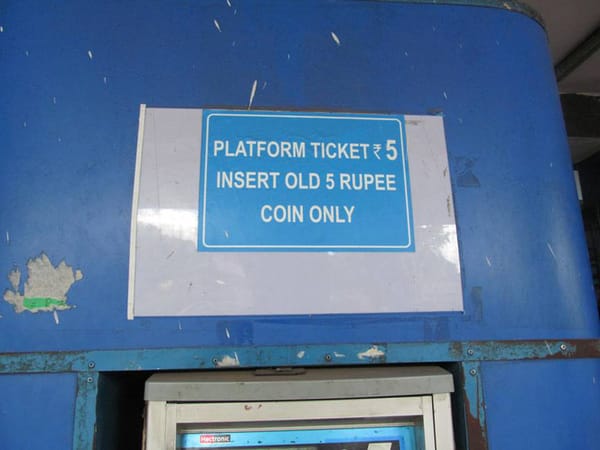
The manual ticket counter is functional again at the city railway station, as the e-ticket machines for platform tickets take in only old-five rupee coins, which are not being minted anymore. Passengers have started depending more on the manual ticket counters as majority of them have only new-five rupee coins.

This has led to a drastic drop in the printing of tickets by the machines to one or maximum two tickets a week.
Pic:author

Hariharan Narayanan, who had come to drop his wife at the railway station said: "The city railway station has e-kiosk to dispense platform tickets. It accepts only old-five rupee coins. What is the use of such a machine?"

People often do not have change, especially when there is a constraint that only old-five rupee coins are accepted. With manual dispensing of platform tickets, congestion is back.

The machines were upgraded last after the budget session of 2012, much after the new-five rupee coins were introduced. C Narendra, Publicity Inspector of Railways, Bangalore says, "The machine is customized in such a way that it accepts only the size of old five rupee coins. The new five rupee coins are smaller and thinner and this is not acceptable by the e-kiosk machines". He said they are aware of the problem and are trying their best to fix it soon.

The machines were first introduced in 2007, when the cost of the platform tickets was Rs 3 per ticket. Post the budget session 2012, the machines were updated as the cost of the tickets was increased to Rs 5 per ticket. At that time, the machines were programmed to accept old-five rupee coins, which is not being minted anymore by the RBI.

Leave a Reply

Your email address will not be published. Required fields are marked *

Similar Story

No city is an island: Urbanists warn against Bengaluru’s unfettered expansion

With Bidadi in the eye of a storm, a look at how Bengaluru’s urban sprawl threatens green belts and livelihoods.

From the medieval bazaars of Baghdad to the intellectual debates of Paris, to the warmth found in Delhi’s winters, poets, artists, writers, and aficionados have long captured what it means to be in a city, amid thousands of people, synchronising their lives to a rhythm entirely different from their rural counterparts. Life in the city is distinct. It is hard, exciting, liberating, and fast. Regimes are born in cities. Revolutions are ignited in them. India’s history, too, has played out against the backdrop of her many urban centres: Prayagraj, Gangaikondacholapuram, Pataliputra, Hampi, Shahjahanabad, Surat, Meerut, Kolkata, New Delhi, Navi Mumbai,…

Similar Story

Stalled projects and cost hikes: Bengaluru commuters demand end to Suburban Rail delays

The BSRP has faced political apathy and governance gaps. Citizens are asking: Do we need big-ticket projects or a reliable suburban rail network?

In 1996, on a train to Bhilwara, Prakash Mandoth had to sit next to the toilets throughout his journey. That’s when he realised how broken India’s railway system is and vowed to fix it. Since then, he has made Bengaluru’s long-delayed dream of a suburban railway, proposed in  1983, as his personal mission. For over 26 years, he has petitioned, emailed decision-makers, met with officials, and voiced his thoughts at public hearings to turn this vision into a reality.  However, much to the frustration of Prakash and citizen activists like him, the Bangalore Suburban Rail Project (BSRP) has seen inordinate delays…