Webinar: How will you track the work of your ward councillor?

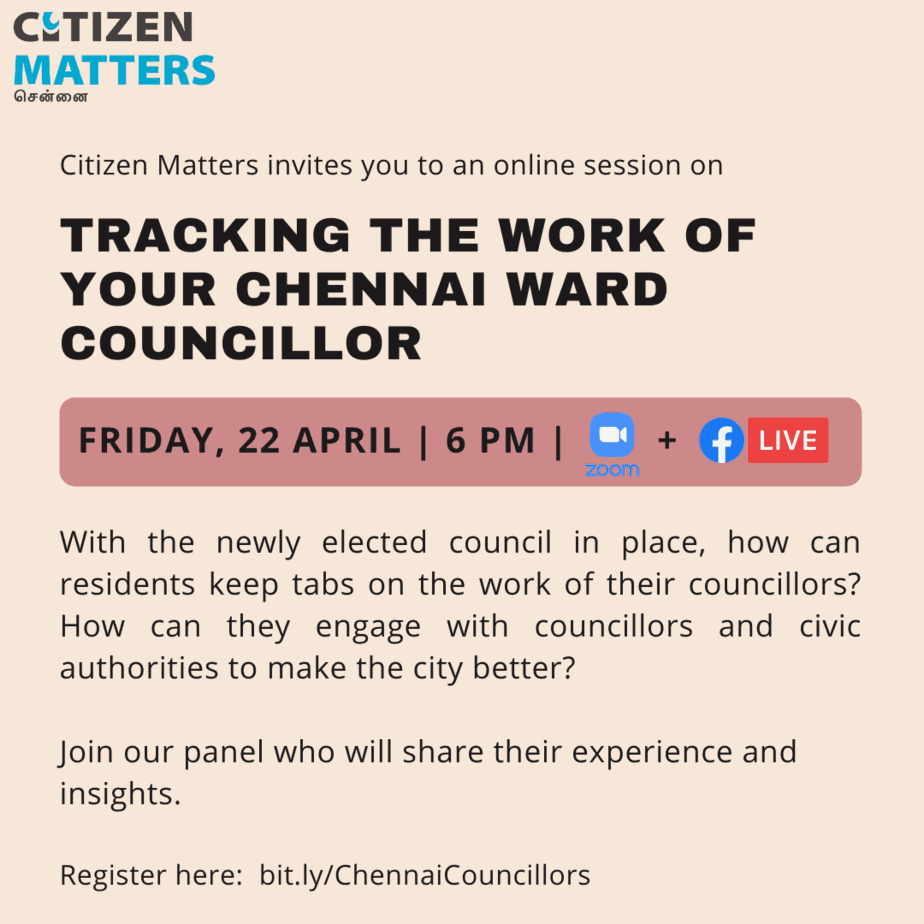
How can the residents of Chennai engage with their ward councillor? What are the ways in which they can demand accountability?

With the swearing-in of the councillors, Chennai has an elected local body for the first time since 2016. The councillors who have taken office are a mix of experienced old-timers and those who have been elected for the first time. Half of the council is represented by women. 

While these are promising developments, Chennaiites must be able to engage with their elected representatives and officials from the civic body to ensure effective administration. The push for ward committees and area sabhas is one way there can be an element of participatory planning in local governance. 


Read more: Chennai in 2022: The time for participatory governance is now!


Citizen Matters brings together a panel of experts to discuss how Chennaiites can track the work of their ward councillors, ensure effective functioning and establish platforms where the collective will of the residents is heard and given due consideration. 

Some of the broader questions we want address are:

  • How can people know more about the functioning of their ward councillors?
  • How to audit the expenditure undertaken at the ward-level?
  • What kind of larger vision for the city is essential for the councillors to work effectively? 
  • What are the gaps to be bridged in terms of access to information that will help residents connect with elected representatives and solve issues?

So mark your calendars and join us for this very important discussion.

Date: April 22, 2022

Time: 6pm – 7pm

The webinar will be followed by a brief Q & A session open to participants.

Register here
webinar annoucement chennai councillors
How can Chennaiites hold elected local representatives accountable?

Read more: Chennai Corporation elections: What can citizens expect from the elected council?


Panelists:

  • Shyam Sundar, News of Chennai
  • Charu Govindan, Voice of People
  • Radhakrishnan, Arappor Iyakkam
  • Raghukumar Choodamani, Community Welfare Brigade
  • Inbarasan K G, Institute of Grassroots Governance

Also read

Leave a Reply

Your email address will not be published. Required fields are marked *

Similar Story

The real estate shift: How Karnataka’s proposed apartment law shortchanges homeowners

Karnataka apartment owners may not get a fair share of their land as the KAOMA 2026 replaces value-based UDI with an area-only formula.

The Karnataka Apartment (Ownership and Management) Bill, 2026 (KAOMA) changes how a homeowner's share of the land is calculated — and the new formula gives the individual less than what the old law, that is the Karnataka Apartment Ownership Act, 1972 (KAOA), promised. The KAOMA Bill was passed by the Karnataka legislature in August, but is yet to receive assent from the Governor, who has sought clarifications on certain provisions. What is UDI and why does it matter? When you buy an apartment, you buy two things: The flat — a depreciating asset (buildings lose value over time). Your Undivided…

Similar Story

Big promises, unheard residents: Bengaluru’s new parking rules need a rethink

The draft rules meant to manage road space demand end up expanding supply, outsourcing enforcement, and pricing residents out of their streets.

On August 11, the Urban Development Department quietly published the draft Greater Bengaluru Authority (Parking) Rules, 2026 — the legal framework  meant to give teeth to Bengaluru's much-discussed Parking Policy 2.0. Citizens have thirty days to send in objections. Yet, few will read all eighteen pages of the notification. Fewer still will notice that a law framed as a way to curb traffic demand is, on close reading, a plan to expand parking supply and hand over enforcement to private players, while leaving the ordinary resident worse off.  That gap between the promise and what’s on paper matters, because parking…