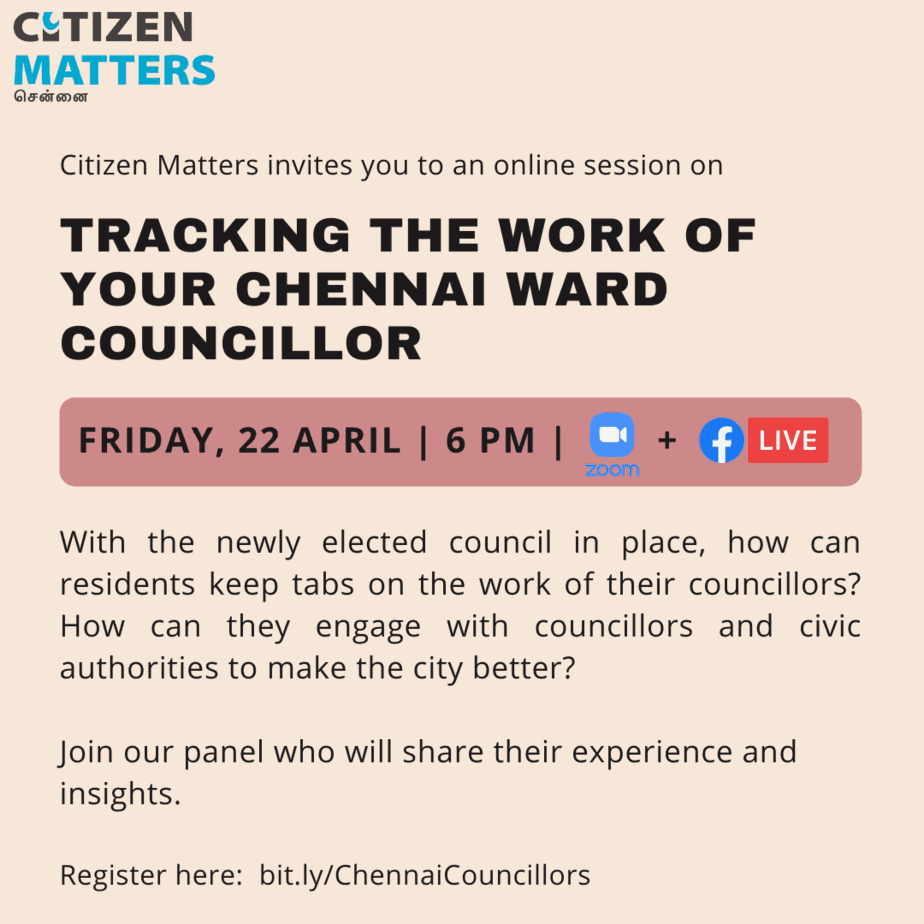
Webinar: How will you track the work of your ward councillor?

How can the residents of Chennai engage with their ward councillor? What are the ways in which they can demand accountability?

With the swearing-in of the councillors, Chennai has an elected local body for the first time since 2016. The councillors who have taken office are a mix of experienced old-timers and those who have been elected for the first time. Half of the council is represented by women. 

While these are promising developments, Chennaiites must be able to engage with their elected representatives and officials from the civic body to ensure effective administration. The push for ward committees and area sabhas is one way there can be an element of participatory planning in local governance. 


Read more: Chennai in 2022: The time for participatory governance is now!


Citizen Matters brings together a panel of experts to discuss how Chennaiites can track the work of their ward councillors, ensure effective functioning and establish platforms where the collective will of the residents is heard and given due consideration. 

Some of the broader questions we want address are:

  • How can people know more about the functioning of their ward councillors?
  • How to audit the expenditure undertaken at the ward-level?
  • What kind of larger vision for the city is essential for the councillors to work effectively? 
  • What are the gaps to be bridged in terms of access to information that will help residents connect with elected representatives and solve issues?

So mark your calendars and join us for this very important discussion.

Date: April 22, 2022

Time: 6pm – 7pm

The webinar will be followed by a brief Q & A session open to participants.

Register here
webinar annoucement chennai councillors
How can Chennaiites hold elected local representatives accountable?

Read more: Chennai Corporation elections: What can citizens expect from the elected council?


Panelists:

  • Shyam Sundar, News of Chennai
  • Charu Govindan, Voice of People
  • Radhakrishnan, Arappor Iyakkam
  • Raghukumar Choodamani, Community Welfare Brigade
  • Inbarasan K G, Institute of Grassroots Governance

Also read

Leave a Reply

Your email address will not be published. Required fields are marked *

Similar Story

Karnataka SIR 2026: Top FAQs and community concerns addressed

As the SIR is underway and voter forms are distributed, much confusion remains about how to fill them. Here are some FAQs to understand the process.

As of July 8, booth level officers (BLOs) have distributed over 4.57 crore enumeration forms for the mandatory Special Intensive Revision (SIR) in Karnataka. Yet despite the 82.45% completion rate, the process has faced widespread criticism and been plagued with problems including BLO burnout, and the Kannada-only forms. If you are still figuring out how to fill the enumeration form, read Part 1 of this series. In this part, you can find answers to some common questions on filling the form, online enumeration, progeny mapping, etc. The SIR process poses specific challenges to transgender and queer communities due to changes…

Similar Story

SIR for Karnataka voters: All you need to know about enumeration 

Voter verification requires linking your 2025 rolls to your 2002 records. Here's how you can fill the forms and register.

Karnataka's Special Intensive Revision (SIR), which began on June 30, requires every voter to complete a fresh verification exercise. The SIR is carried out by the Election Commission of India (ECI) to prepare and revise electoral rolls, and ensure its accuracy. The process especially aims to remove deceased voters and duplicate names in the rolls, including those of  citizens who have migrated and are registered as voters in  multiple places. The election commission announced the process with the aim that ‘no eligible citizen is left out and no ineligible citizen is included in the electoral roll’. In the Special Summary…