So October 2 has come and gone. We duly remembered Mahatma Gandhi on his birthday, and went about our usual business. A few people also speak about cleanliness in our public spaces, since it is also “Swacch Bharat” Day.
From this day, source segregation of waste will be mandatory in Chennai – the city that generates the largest per capita amount of garbage in the country. The Greater Chennai Corporation has been reaching out to all the different categories of waste generators – residential, commercial and industrial- with suggestions, recommendations and guidelines. It is no doubt a great start, but much more needs to be done towards awareness and enforcement. A publicity blitz, as it were, is the need of the hour.
While we wait for that, here is a short note that I wish someone has shared with me, when I first started to segregate waste at home. Segregation of waste at home is really very simple, something our grandparents did intuitively because recycling made economic sense. it still does, but somehow we have lost sight of it in the recent past. Let us try and get back to the basics.
What do we mean by waste segregation?
Waste segregation basically means keeping wet and dry wastes separately, so that dry can be recycled and wet waste can be composted.
Why should I do it?
- So that it reduces waste that reaches landfills and reduces pollution to air and water
- So that different processes- composting, recycling, incineration can be applied to different kinds of waste
How do I practice waste management at home?
- Keep separate containers for dry and wet waste in the kitchen
- Keep a bag for dry waste collection, mainly paper and plastic , for the rest of the household waste
- Keep plastic from the kitchen clean and dry and drop into the dry waste bin. Keep glass /plastic containers rinsed of food matter
- Send wet waste out of the home daily. Store and send dry waste out of the home, once a week.
- Always dispose of sanitary and hazardous waste separately, wrapped in newspaper and clearly marked
- E-waste must be given away or disposed of, to recycling vendors, and NOT given to doorstep waste collectors
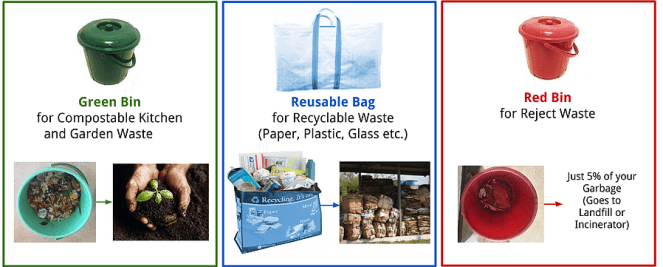
WET WASTE (GREEN BIN)
What is wet waste?
Wet waste consists of kitchen waste – including vegetable and fruit peels and pieces, tea leaves, coffee grounds, eggshells, bones and entrails, fish scales, as well as cooked food (both veg and non-veg).
Often it is possible to compost the wet waste at home, but if that is not an option, it can be given away on a daily basis to the waste collectors who come for door to door collection.
SANITARY WASTE (RED BIN)
What is sanitary waste?
This includes used menstrual clothes, sanitary napkins, disposable diapers, bandages, human hair and any material that is contaminated with blood or other body fluids.
DRY WASTE (WHITE BAG)
What is Dry Waste?
Paper, plastics, metal, glass, rubber, thermocol, Styrofoam, fabric, leather, rexine, wood – anything that can be kept for an extended period without decomposing.
What is the best method of storing dry waste?
Store it in a bag in the utility area after cleaning and drying till it is picked up. There are several agencies in Chennai who are now in the business of recycling dry waste – kuppathotti.com, trashgaadi.com, earthrecycler.in, paperman.in, to name a few.
E-WASTE
What is e-waste?
E-waste or electronic waste consists of batteries, computer parts, wires, electrical equipment of any kind, electrical and electronic toys, remotes, watches, cellphones, as well as bulbs, tubelights and CFLs. Store them in separate container which is kept closed, away from moisture and in which nothing else is put.
Sanitary waste. Wrap in a newspaper, mark with a red cross, and give everyday to the GCC.
HAZARDOUS WASTE
What is hazardous waste?
HHW or household hazardous waste includes, apart from E-waste and sanitary waste, toxic substances such as paints, cleaning agents, solvents, insecticides and their containers. These must be disposed of separately through the recyclers.
GARDEN WASTE
What do I do with garden waste?
Chennai is still a green city, and a large portion of our garbage is green. Garden waste, if in small quantities, can be composted. Large quantities, branches of trees etc, will have to be taken away with prior agreement, by the GCC vehicles.
If you live in an apartment block and would like to get your fellow residents to start segregation of waste at source:
- Form a group of like-minded people
- Explain waste segregation to your family / neighbours in your apartment building.
- Get the staff in the apartment building to also understand
- Get separate storage drums for storing the dry waste and wet waste.
- Make sure the GCC staff collect the wet waste every day, or evaluate the feasibility of composting the wet waste on your own
- Have the dry waste picked up by the GCC or your local scrap dealer
Several areas and apartment complexes in Chennai are already practicing source segregation and composting on their own, with great success. Click here to read the experience of some apartments on Old Mahabalipuram road

This note draws liberally from the great spread of resources on www.2bin1bag.in. I encourage you to visit this site – there are guidelines, FAQs, explainers, for every category of waste generator. Please visit, and use the information to reuse, recycle and reduce the amount of waste going to our landfills.