Missing 6th cross in JP Nagar found

What was thought to be an encroachment was found to be a legally allotted plot. The curious case of missing 6th cross.

Citizen Matters in its investigation found out that part of 6th Cross, 24th Main, 2nd Phase JP Nagar which was thought to have been encroached by land sharks might not be encroached at all. On 24th Main, the entry to 6th Cross has been blocked by a compound that now houses a used car showroom. The stretch was earlier being used by locals as a road, however, it did not have any street lights or have a pucca road.
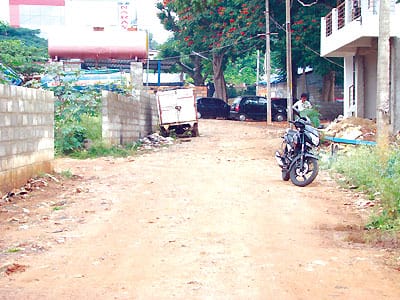
 

The road as seen from behind the used car showroom.
Pic: Yogaraj Mudalgi

A copy of the approved layout plan for 2nd Phase JP Nagar, obtained by Citizen Matters, from the BDA shows that the 6th Cross does not join 24th Main Road and is only an internal road.

When Citizen Matters spoke to Venkatesh, BBMP Assistant Executive Engineer, he said that the stretch of land was converted to a plot some time in the eighties. "It was a village road earlier but since the connectivity has improved, it was decided by the BDA to convert it into a site," he says.

Bangalore Mirror, a city tabloid, on 1 October, reported that a sizable tract of land had been usurped by land sharks. The report also quotes H Siddiaiah, BBMP Commissioner, saying that he is aware of the encroachment and action will be taken soon.

Several locals too seemed unaware whether it is a public road or private property. Keshava, 40, who had an eatery stall on the road for more than 10 years, moved to a new place nearby after he was asked to vacate. "They told us that it is not a road and that it belongs to someone else so I moved," he says. Anuja K, 42, a home maker, living nearby too said that she had assumed it was a road as everyone was using it but didn’t know much about it.

The alleged owner of the land, Bette Gowda, lives nearby. His wife, Lakshmi Gowda affirmed that they were rightful owners of the property and that they had not encroached on public property. However, she refused to furnish any documents.

Leave a Reply

Your email address will not be published. Required fields are marked *

Similar Story

Chennai’s ₹697 crore electric buses: Do they serve people who need it most?

While Chennai has invested crores in cleaner buses, public documents do not show if this deployment has improved mobility in high-density wards.

When Chief Minister M K Stalin flagged off Chennai's first batch of low-floor electric buses in June 2025, the programme was presented as a major step towards cleaner and more modern public transport. The first phase alone involves acquring 625 electric buses at a reported cost of ₹697 crore. The fleet includes 400 non-air-conditioned and 225 air-conditioned buses and is being operated from five depots: Vyasarpadi, Perumbakkam, Central, Tondiarpet-I and Poonamallee. The investment is substantial. Chennai has not inducted a fleet of this size in years. The buses are low-floor, wheelchair accessible and equipped with passenger information systems, CCTV cameras…

Similar Story

Riding the Chennai Metro is a breeze, but last-mile connectivity remains a worry

Chennai needs a unified transit system to ensure seamless travel for metro commuters on either side of the journey.

Stepping off the Thirumangalam metro at 6.45 pm, the train ride seemed effortless. It was cool, fast, and on time, taking just fifteen minutes from the office. Now comes the hard part. Standing at the station exit, finding a ride home is a struggle, as I switch between three apps to book an auto. The metro feeder bus only runs every 40 minutes and has just left. By the time I reach home, the "fast" metro trip has cost an extra half-hour and ₹120 in surge-priced rides, a last-mile problem the metro itself was built to solve. This is the…