Missing 6th cross in JP Nagar found

What was thought to be an encroachment was found to be a legally allotted plot. The curious case of missing 6th cross.

Citizen Matters in its investigation found out that part of 6th Cross, 24th Main, 2nd Phase JP Nagar which was thought to have been encroached by land sharks might not be encroached at all. On 24th Main, the entry to 6th Cross has been blocked by a compound that now houses a used car showroom. The stretch was earlier being used by locals as a road, however, it did not have any street lights or have a pucca road.
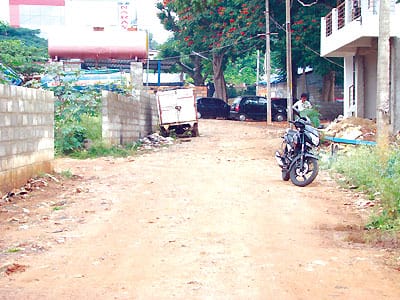
 

The road as seen from behind the used car showroom.
Pic: Yogaraj Mudalgi

A copy of the approved layout plan for 2nd Phase JP Nagar, obtained by Citizen Matters, from the BDA shows that the 6th Cross does not join 24th Main Road and is only an internal road.

When Citizen Matters spoke to Venkatesh, BBMP Assistant Executive Engineer, he said that the stretch of land was converted to a plot some time in the eighties. "It was a village road earlier but since the connectivity has improved, it was decided by the BDA to convert it into a site," he says.

Bangalore Mirror, a city tabloid, on 1 October, reported that a sizable tract of land had been usurped by land sharks. The report also quotes H Siddiaiah, BBMP Commissioner, saying that he is aware of the encroachment and action will be taken soon.

Several locals too seemed unaware whether it is a public road or private property. Keshava, 40, who had an eatery stall on the road for more than 10 years, moved to a new place nearby after he was asked to vacate. "They told us that it is not a road and that it belongs to someone else so I moved," he says. Anuja K, 42, a home maker, living nearby too said that she had assumed it was a road as everyone was using it but didn’t know much about it.

The alleged owner of the land, Bette Gowda, lives nearby. His wife, Lakshmi Gowda affirmed that they were rightful owners of the property and that they had not encroached on public property. However, she refused to furnish any documents.

Leave a Reply

Your email address will not be published. Required fields are marked *

Similar Story

A four-hour commute: The daily transport struggles of women from Chennai’s resettlement areas

Watch this video to understand how absence of last-mile connectivity and unreliable public transport in Chennai is failing those who need it the most.

Chennai has long had a tradition of public transport usage, with commuters having the choice of the suburban railway network, Metropolitan Transport Corporation (MTC) buses operating in the city and the Metro Rail for their daily transit. Despite the government introducing new services recently, especially electric buses, private vehicles numbers have soared and bus ridership has gone down considerably. Last mile connectivity issues, poor coverage in certain areas and the inability of the government to encourage residents to use public transport are major impediments. In fact, private vehicles make up 65 per cent of all motorised transport in the Chennai…

Similar Story

The infrastructure of waiting: How Bengaluru’s gridlock steals our right to time

Bengaluru needs accessible infrastructure that makes life easier for everyone, not tunnels and corridors built for a privileged few.

Selomi's text arrived at 7 am. "Let's leave by 8.30. The traffic will be brutal otherwise." We both live about 10 kilometres from the government office we had been going to every day for the last two weeks. The nearest metro station is four kilometres from our homes, which means forty minutes to reach it, twenty on the metro, and twenty-five on foot from Vidhana Soudha to the office. An hour and twenty minutes each way, assuming nothing goes wrong. In Bengaluru, something always does. By the end of the second week, we had the routine down. Coffee in a…