Mayor and Deputy Mayor’s wards get highest allocation

Even as the opposition cried hoarse about the revenue plans for the budget, the Palike budget has shot up by 184 crores at the final count.

When the BBMP budget was passed on Saturday, September 3rd, 171 corporators had got additional grants for ward works. While the allocation was Rs 1-4 crore for most wards, the highest allocation was for Mayor Sharadamma’s ward Shettihalli (ward number 12). Mayor’s ward received Rs 15 cr.

The second highest allocation was Rs 8 cr, for Deputy Mayor S Harish’s ward Nagapura (67).
Rs 5 cr were allocated to Shanthinagar (117) and BTM layout (176), both of which are represented by Congress.

The additional ward grants have taken the budget outlay from the earlier Rs 9196 cr to Rs 9380 cr. This addition of Rs 184 cr was given even as opposition was arguing that the budget was unrealistic and that funds cannot be mobilised this year.
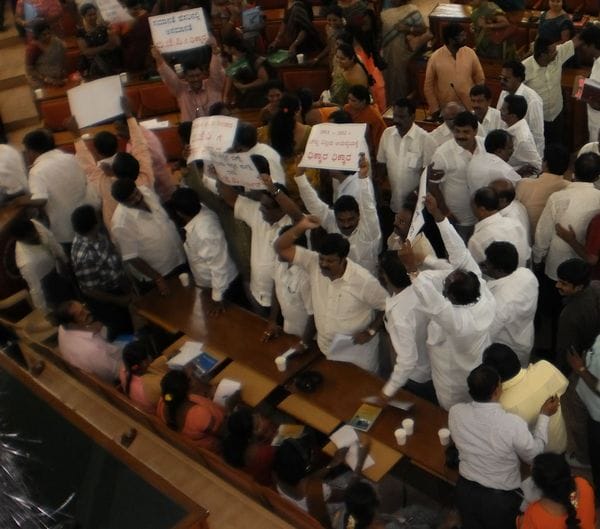
Opposition councillors voicing their protest. Pic: Navya P K

BJP has no clear answers on how Rs 184 cr will be mobilised. BJP leader B R Nanjundappa says that this amount will be channelised from MLA funds and by cutting down on unnecessary spending.

The budget was passed on Saturday even as the opposition was protesting. Congress and JD(S) corporators had raised several questions on the budget during the four-day discussion from August 23 – 26. On September 3rd, Taxation and Finance Committee Chairman Manjunath Raju and BBMP Commissioner H Siddaiah responded to these questions.

The response however was mainly a reiteration of the promises made in the budget. As opposition continued its protest, Mayor Sharadamma read out a speech saying that the budget was approved, putting an end to the discussion. As the budget was passed, opposition members protested, moving into the well of the House with placards and slogans.

The Council does not have a process of counting corporators’ votes for budget approval; the approval process is completed as soon as the Mayor declares so.

Comments:

  1. Divya Harave says:

    What a shame!

Leave a Reply

Your email address will not be published. Required fields are marked *

Similar Story

Karnataka SIR 2026: Top FAQs and community concerns addressed

As the SIR is underway and voter forms are distributed, much confusion remains about how to fill them. Here are some FAQs to understand the process.

As of July 8, booth level officers (BLOs) have distributed over 4.57 crore enumeration forms for the mandatory Special Intensive Revision (SIR) in Karnataka. Yet despite the 82.45% completion rate, the process has faced widespread criticism and been plagued with problems including BLO burnout, and the Kannada-only forms. If you are still figuring out how to fill the enumeration form, read Part 1 of this series. In this part, you can find answers to some common questions on filling the form, online enumeration, progeny mapping, etc. The SIR process poses specific challenges to transgender and queer communities due to changes…

Similar Story

SIR for Karnataka voters: All you need to know about enumeration 

Voter verification requires linking your 2025 rolls to your 2002 records. Here's how you can fill the forms and register.

Karnataka's Special Intensive Revision (SIR), which began on June 30, requires every voter to complete a fresh verification exercise. The SIR is carried out by the Election Commission of India (ECI) to prepare and revise electoral rolls, and ensure its accuracy. The process especially aims to remove deceased voters and duplicate names in the rolls, including those of  citizens who have migrated and are registered as voters in  multiple places. The election commission announced the process with the aim that ‘no eligible citizen is left out and no ineligible citizen is included in the electoral roll’. In the Special Summary…