Every year, like clockwork, Mumbai floods after excessive rains that bring the city to a standstill, leaving behind severe damages to infrastructure, and throwing up new challenges for the city administrators to handle. This despite substantial annual budgets sanctioned for desilting storm water drains and attempts to rejuvenate rivers, including Mithi.
So predictable and perennial is Mumbai’s experience with flooding, that political parties had included specific promises in their 2017 BMP poll manifestos to tackle the issue. However, five years down the line, as they face the electorate again in 2022, the ground reality is that the promises have remained on paper. And Mumbai continues to lose lives and money every monsoon season.
What did parties promise in 2017?
The Shiv Sena promised it would install pumping stations at Mahul and Mogra nallas, to augment the pumping stations at Lovegrove, Cleavland and Brittania. This is part of the ongoing and pending BRIMSTOWAD project, meant to mitigate flooding in the city.
The Bharatiya Janata Party (BJP) promised a flood free Mumbai and additional Floor Space Index for those residing in low-lying areas. Their solution for flooding was to accelerate the process of redevelopment for residents staying on ground floors in these areas. It also promised to augment the existing storm water drain network with small drains to be created alongside roads, and additional facilities at major city nallahs like Somaiya nalla, Gazdarbandh and Mogra for quicker dispersal of flood waters.
There were no specific promises for flooding in the Congress manifesto,, but the Nationalist Congress Party (NCP) promised to complete the Brimstowad project. The NCP also promised to introduce international technology to tackle flooding and get better technology to clean up the city’s nallas. It also promised to rejuvenate the city’s wate bodies and to beautify the spaces around them.
Current status of flood relief measures
Mumbai’s defense against excessive rains continues to depend on its British built century-old storm water drains. The Brimstowad project, which was supposed to help take care of the annual flooding by building eight major pumping stations, is yet to be completed.
Read more: Explainer: why does Mumbai flood?
As of now, only six pumping stations have been built. The Mogra and Mahul pumping stations are marred by land acquisition issues, according to the Environment Status Report 2020-21. The city is currently prepared to deal with a maximum daily rainfall of only 25 mm. Mumbai received 253.3 mm of rainfall on July 16, 2021, one of the wettest day in the city.
Crores of money allocated to different projects aimed at reducing flooding, have not resulted in any effective solution. The Brimstowad project that was to cost Rs 616.30 crores when it was proposed in 1991 was meant to be completed in 12 years. As of April 2021, Rs 2439.35 crores have been spent on this project including Rs 1000 crore from the union government, and it still needs an investment of another Rs 2700 crores, according to the ESR- 2020-21 report.
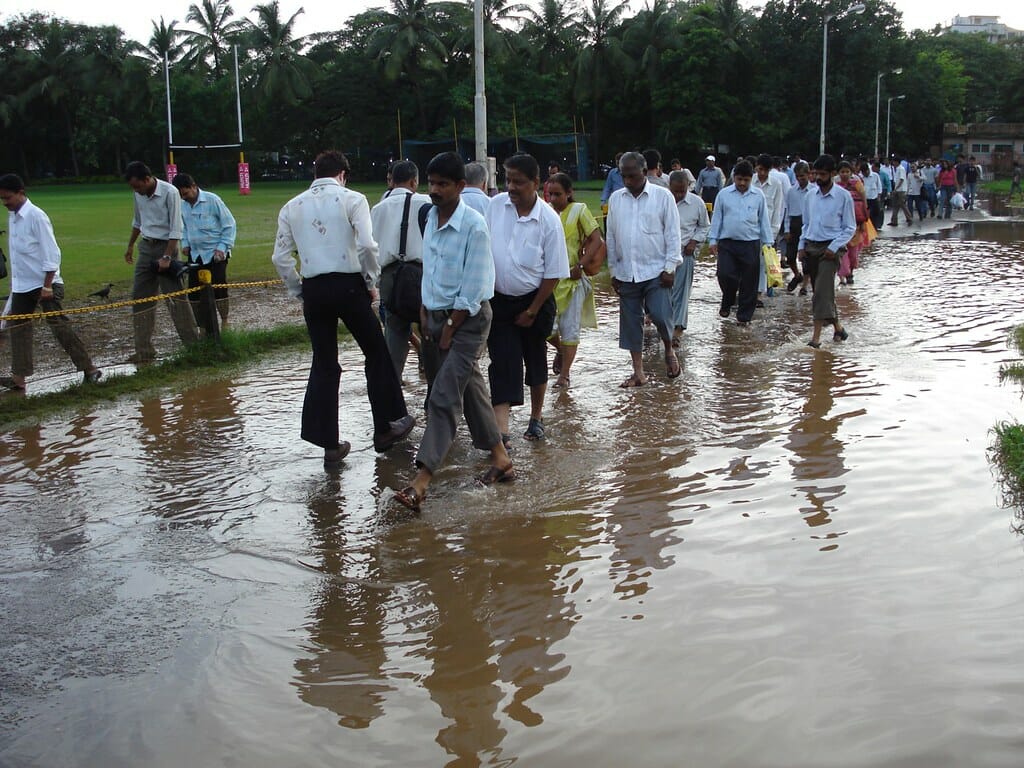
Recently, the BMC proposed building underground water tanks at a cost of Rs 67 crore with the capacity of six crore litres to prevent flooding at Hindmata junction, one of the city’s chronic flooding spots, which have increased due to construction projects and excessive rainfall, according to the BMC.
So, why do the promises fail?
Though work is happening on the rejuvenation and restoration of the rivers of Dahisar, Poisar and Mithi, clearly a lot else needs to be done.
For one, the city lacks an overall vision and ends up investing in piecemeal solutions, according to Gopal Jhaveri, founder of River March. “Flooding just shifts to other spaces instead,” said Jhaveri “The recommendations of the Chitale Commission report in the wake of the massive 2005 flooding to do hydrological planning and contour mapping of the city, is yet to be implemented. Bridges are planned with landings on mangroves without factoring in their impact on flooding or on people living there. Roads are built without providing water drainage options”.
“Solutions undertaken or proposed are not meant to alleviate flooding but in reality are only opportunities to spend large sums of money, even get aid from financial agencies like the World Bank. They have not even spared infrastructural development in the salt pans now,” says Stalin Dayanand, director of Vanashakti, which has been legally pursuing the issues of river rejuvenation and developments on catchments of Mithi river.
As Mumbai prepares for another election and monsoon season, the city must question it’s political class over promises undelivered about all these promises made but not delivered.