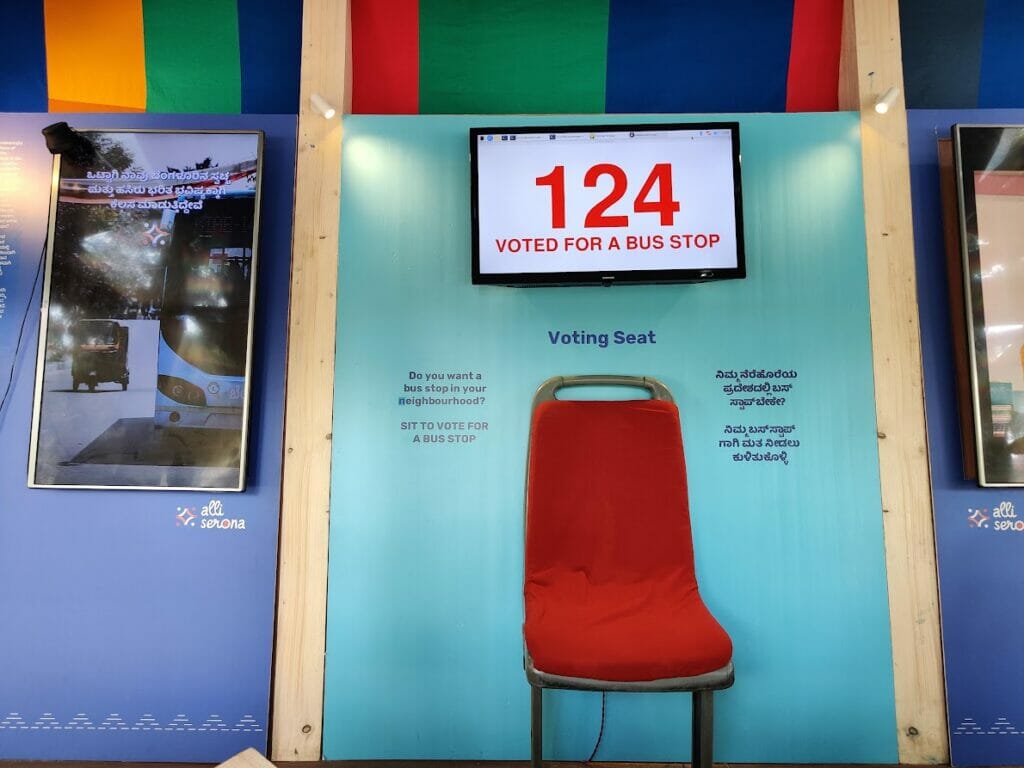
There is a small patch of land adjacent to the Baiyappanahalli metro station. This is the first stop for the mobile Alli Serona bus stop, a colourful art installation. The roof of the bus stop is draped in colourful fabric, the inside features tablets for visitor surveys, digital screens with the story of the bus stop and a single red chair. If you sit on the chair you are voting for a bus stop. Over four hundred people did that on the first day of the exhibition on October 5th.
The beginnings of Alli Serona
The bus stop is a mobile art installation/campaign statement hoping to draw the attention of BMTC and BBMP to issues with bus connectivity in the city. There is an actual BMTC bus stand beside the colourful Alli Serona bus stand. It is dilapidated, with the roof caving in and no commuters or buses. It is a perfect example of the kind of issues bus commuters, especially women, face across the city.
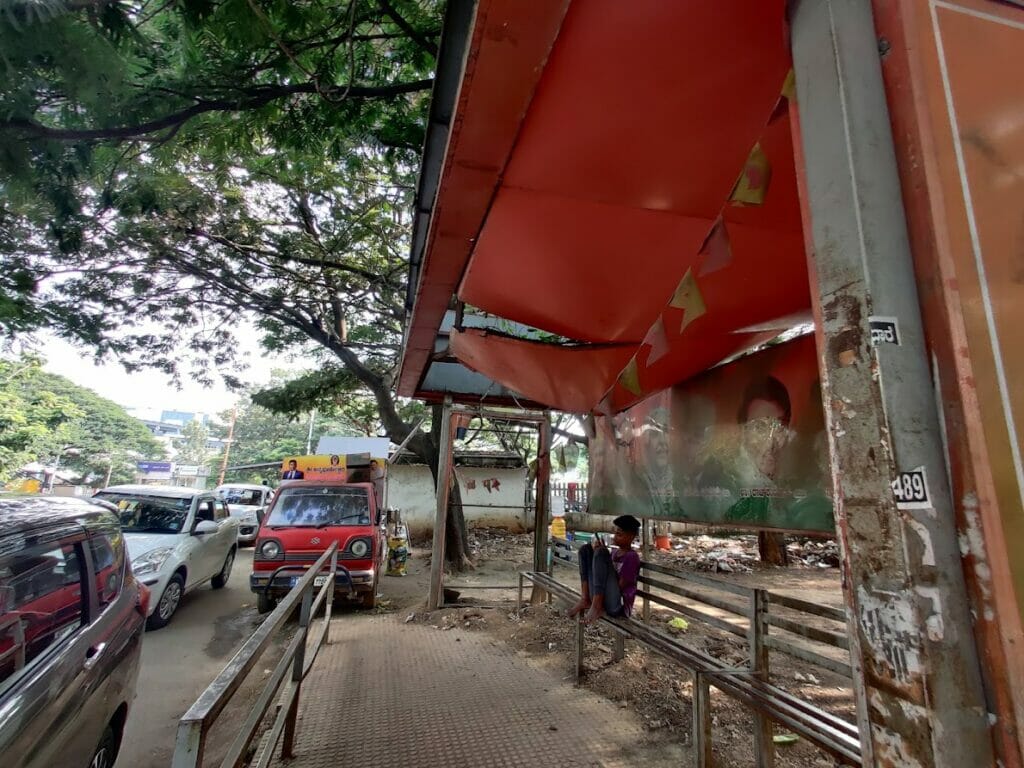
The Alli Serona bus stop aims to draw attention to several key issues through a participatory art approach. These issues include the current condition of the bus stop, the shortage of bus stops, the lack of bus routes, and the limited accessibility to BMTC buses for people who need and depend on them the most. However, the question remains: will this method work?
Alli Serona, which means ‘let us gather there’ in Kannada, was chosen by informal women workers as the name for the collective. This diverse collective includes self-help groups, artists, designers, civil society organisations and think tanks.
The purpose of the collective was to ensure that the voices of informal workers, particularly women, are heard by policymakers planning for climate change transitions, explained Tanisha Arora of Bengaluru Moving.
Enabling affordable and well-connected public transport in cities is a big part of building climate resilience and lowering carbon emissions, she says. “Informal workers, especially women, are the most affected by climate change and most dependent on public transport, particularly buses,” she added during a conversation in June this year.
Bus stop audits
Researchers, urban planners and artists collaborated with civil society organisations and self-help groups, which work with or comprise informal workers in Bengaluru. Together, they aimed to document the challenges that informal women workers face when commuting across the city.
Read more: BMTC needs more support for a sustainable free bus scheme
The collective includes women from eight neighbourhoods in the city: Hosa Nagar and Chikka Banaswadi in CV Raman Nagar, Priyank Nagar and Seegehalli in KR Pura, Byrasandra in Jayanagar, LR Nagar in Koramangla, AKG Colony and Vijayanagara in Mahadevapura.
All the women work in the informal sector, largely as domestic workers. Between November and December last year, these women conducted audits of bus connectivity in their neighbourhoods and documented problems ranging from the lack of bus stops to poor connectivity. The audits have led to this beautiful, odd bus stop that everyone hopes will capture the attention of civic agencies.
Participatory art approach
The entire journey has been participatory, explains Mallika Arya Campaign Manager for Bengaluru Moving, a public transport campaign that is a part of Alli Serona. From conducting audits of the bus stop to planning the design of the mobile bus stop, women from the communities participated and weighed in on every aspect of this campaign, she says.
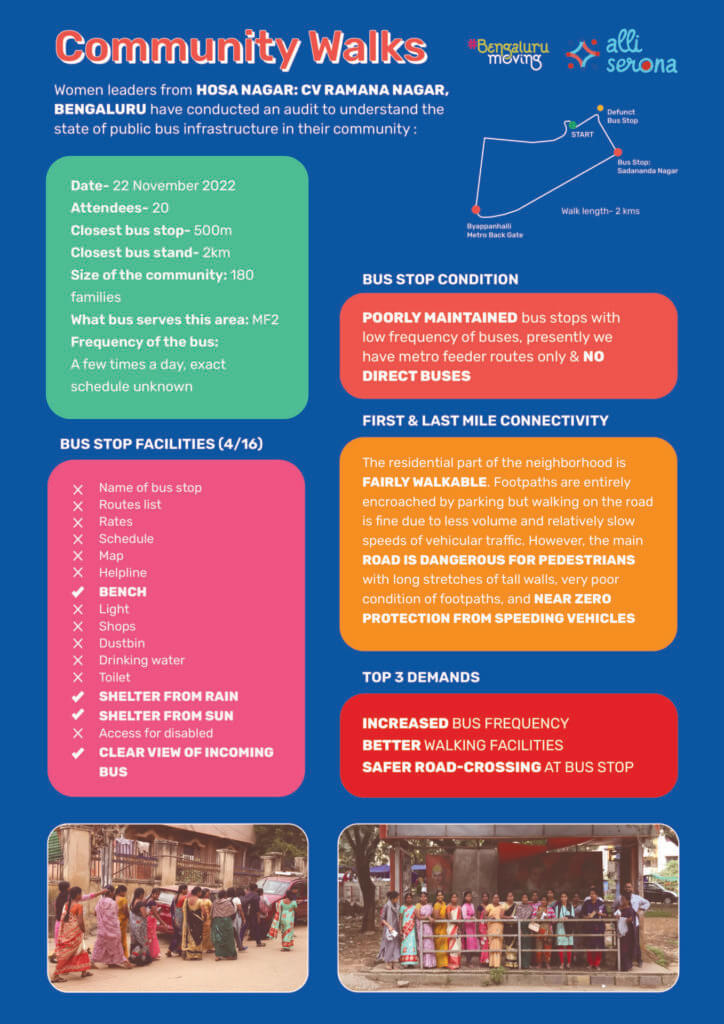
In June this year, I witnessed one such ideation process at Hosa Nagar, a colony behind the Baiyappanahalli metro station. Around 10-12 women had gathered to plan the design of the mobile bus stand. For inspiration, they looked to a now-defunct BMTC bus stop just a few hundred metres from their home. Buses have stopped coming to this bus stop. So, the women have to walk around 2kms to the nearest stop, adjacent to the Baiyappanahalli metro.
“What would make a nice bus stand?” asked designers from Studio Sorted, a design agency that had joined the Collective. Using chart paper, markers, rangoli and umbrellas, the women began designing.
First, the basics.
They said it should be well-lit, have seating, a roof and good visibility of the bus. With prodding from the designers, the conversation veers to more exciting features.
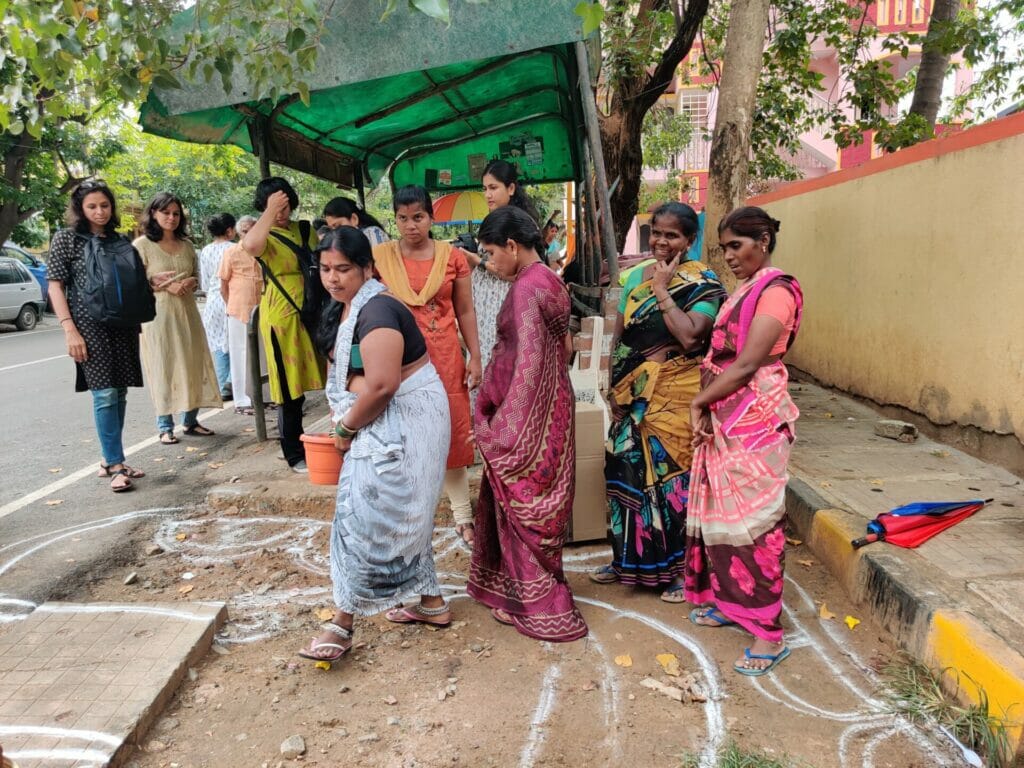
The seating could be semi-circular instead of straight-backed benches, so waiting commuters can easily chat with one another. The roof could be sloping so that rainwater would easily run off.
The bus stand could be extended on both sides to accommodate more people. A speaker would announce the expected time of the next bus. Someone suggested games like hopscotch drawn on the floor to keep children occupied while waiting for a bus. It is also important to leave enough space for the Paani Puri cart that regularly sets up next to the bus stand at 3 p.m. sharp.
Everyone joked that no one will leave the bus stand and go home.
The workshop ended two hours later with tea and a debrief at the Hosa Nagar Anganwadi. Roseline, one of the participants and a domestic worker, says she enjoyed the session. “It gave us a really good idea of what a bus stand should have. If someone came and made an actual bus stand we can give suggestions now.”
The final product
Cut to four months later, Hosa Nagar’s women found themselves looking at the fruit of their imagination. The Alli Serona bus stop looks like a small, bright shipping container. As you enter the bus stop, iPads at either end note down details of the visitors and their thoughts on BMTC travel.
On the walls of the bus stop are two large screens showing photos of the collective throughout this campaign journey. In the middle of the bus stop is a bright red chair. If you sit on the chair, you vote for a bus stop, more buses and better connectivity.
How much of those design workshops in June translated into the making of the bus stand?
“The bus stop is all the ideas and aspirations that the women across all those communities had, in 3-D form,” says Sandra George, from Studio Sorted, the design agency that built the bus stop.
The workshops were crucial to ensure that the women felt ownership of the idea, adds Netra Ajjampur, also from Studio Sorted. “It allowed them to identify what a public infrastructure like this should have,” she says.
The roof of the mobile bus stop was particularly interesting. Underneath the sloping acrylic roof structure, hung a canopy of colourful textiles. It was inspired by a handmade blanket that women in Hosa Nagar made with scraps of old cloth, usually when they were pregnant and resting at home. Renuka, a resident and domestic worker, showed her blanker at the Anganwadi in June. “We really wanted to use materials that the women in the communities use. It’s what brings a sense of familiarity and warmth,” says Sandra.
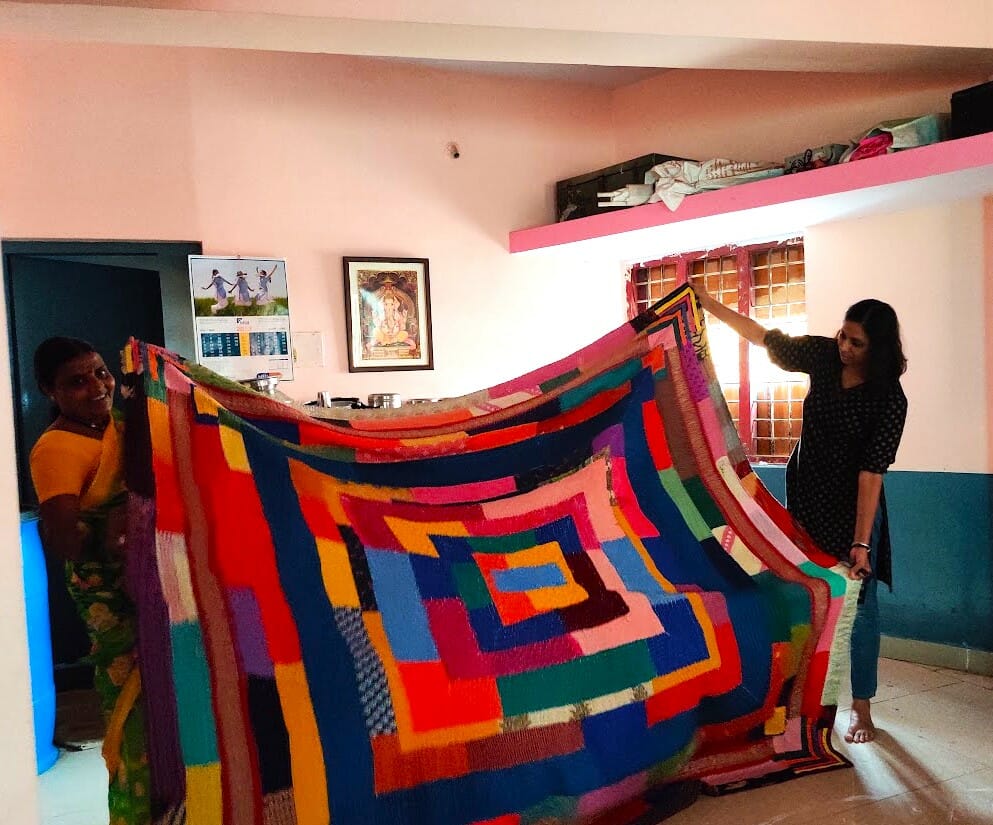
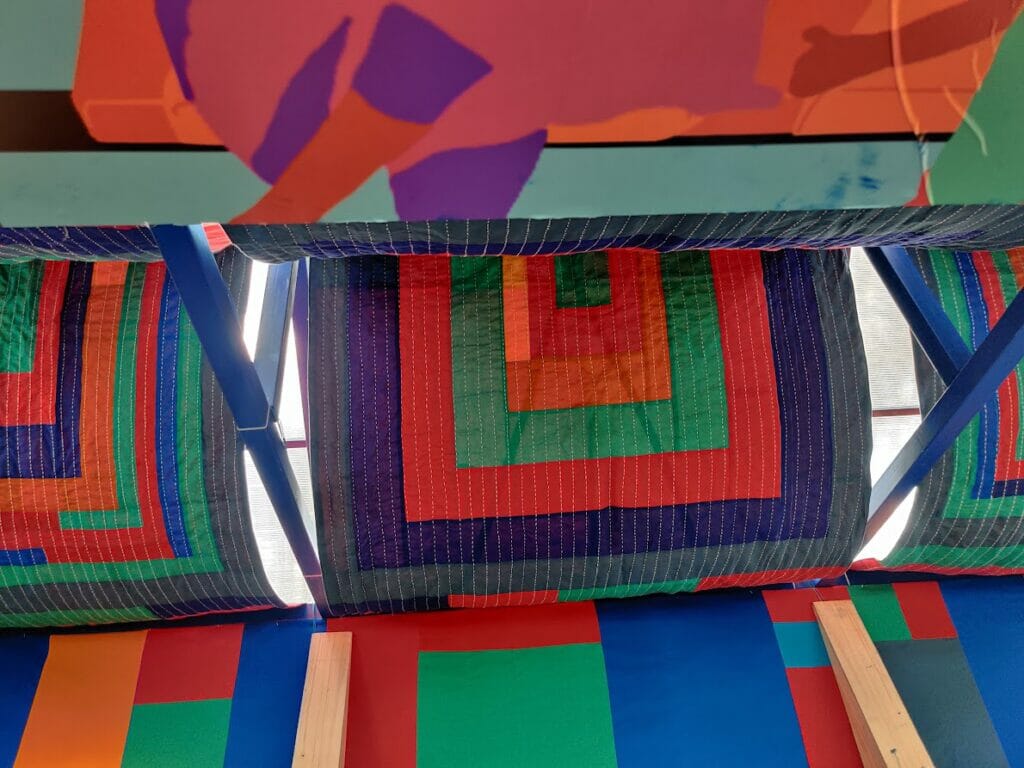
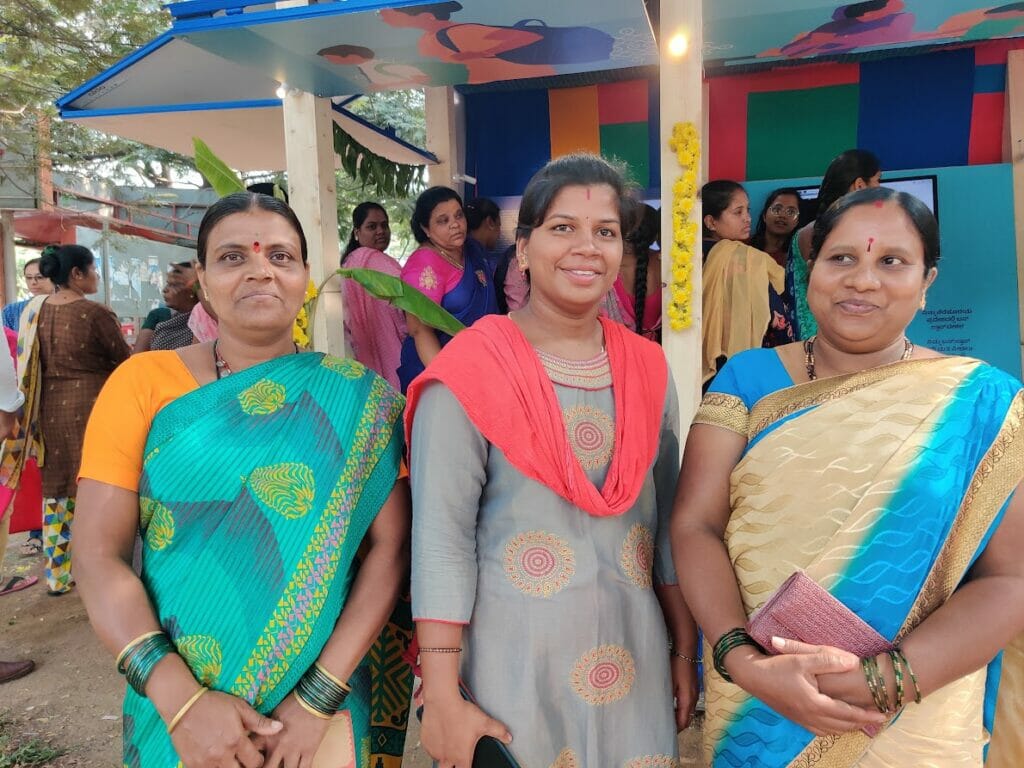
Even though some details, such as circular seating and games for children, were not incorporated, the women of Hosa Nagar appeared to be satisfied with the bus stop. “I didn’t think it would be so beautiful,” says Roseline, when I meet her four months later at the Hosa Nagar installation. And it appears to have drawn attention. “Many passers-by have stopped and asked us what’s going on,” says Ambika.
Read more: Public data enthusiasts evaluate access to public transport in Bengaluru
Will an art installation change policy?
The important question is if it has caught the attention of the authorities.
Hosa Nagar is about two kilometres from the Baiyappanahalli metro station where the Alli Serona bus stands. “It takes 20-30 minutes to get to the bus stop,” says Renuka. “Elderly people have to spend on autos to reach here,” she adds. “We also don’t have regular buses from here. Ideally, we need regular buses to ply to areas like Indiranagar. That is where we get work and a better pay than this area,” says Roseline.
After the audits, which revealed the issues with bus connectivity, the collective shared their findings with G Sathyavathy, Managing Director of BMTC and the BMTC IT Director. “They were really positive and promised to assess the routes with poor bus service immediately,” says Mallika. Sathyavathy also visited the mobile bus stand as it moved across the city. However, I was unable to reach the BMTC director for comment.
While the campaign appears to have caught the attention of bus officials, the question remains: can this participatory art model be replicated across the city?
“Certainly,” says Mallika. “Art has always piqued people’s interest and moved them. It is a great way to draw attention to key issues.” The trick, according to her, is to identify people already working on the ground with the communities in question. “In our case, we worked with a lot of self-help groups and civil society organisations like the Association for Promoting Social Action (APSA). This meant we didn’t have to start from scratch.”
Regardless of the outcome, Thayamma, another domestic worker from Hosa Nagar, says she enjoyed the entire process. “It feels like we built this. And we enjoyed it all the way.” She also remains optimistic about the outcome. “So many of us are saying we need more buses for our area. Surely, the government is going to listen,” she says.