There is always a price tag attached to unbridled growth, and Bengaluru’s unmanageable growth has ensured that the quality of life in the city is fast declining.
Urban Vision launched the Civic Dialogue Bengaluru 2010 in August, as a forum to develop ideas for a better Bengaluru. Civic Dialogue is structured as a series of monthly competitions where we address a specific theme and invite participants – students and young professionals – to report civic problems around that theme, strategize to solve them and implement ideas with our NGO Collaborative. The competition takes place online click here.
The challenge for September was to offer ideas on improving the green cover of the city. Citizens were also invited to report on illegal tree cutting and neglected parks. The winners of the contest will be announced at the site by October 10.
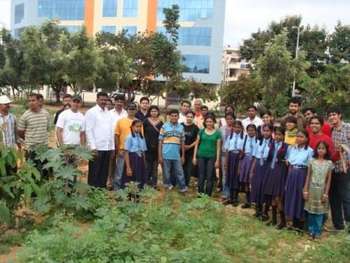
Around 35 volunteers participated in the tree planting event in Madivala. Pic Courtesy: IYCN and Say Tree Volunteers.
For the implementation part of the September challenge, a tree planting drive was organized on 3rd October. Around 35 volunteers from Urban Vision, Say Trees, the Indian Youth Climate Network (IYCN) and residents of Parappana Agrahara, planted saplings in an open space adjacent to Madivala Lake. The area is proposed to be made into a park by BBMP. BBMP backed the event by sponsoring the 100 saplings.
The theme of October Dialogue is ‘How to make Bangalore clean’. Ideas are invited on garbage disposal issues. The NGO collaborative for this month will be "Lets Clean Bengaluru".
Here are some responses we received for the September Dialogue:
Nitish Jayavant Shanbhag says:
Growing grass consumes three times more time and 14 times more money than planting trees. Those who maintain parks should be allowed to grow trees and to enjoy their produce; currently the law does not allow this.
Smitha Kanekanti says:
(i) For every tree that has been cut, four saplings must be immediately planted. Heritage trees must not be cut.
(ii)Special tree zones must be identified and BBMP gardeners or tree protection specialists must be appointed to take care of them. Tree protection specialists should take care of roadside trees.
(iii) The city must be made plastic-free and segregation of waste at residences should be made compulsory. Each ward must have BBMP stalls selling jute bags, which would spur domestic income-generation activities.
(iv) Green stalls actively supported by BBMP’s Horticulture department must be opened at each ward to promote home gardening and urban agriculture.
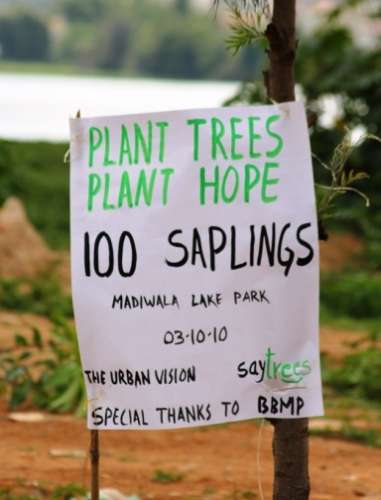
BBMP sponsored saplings for the green initiative by the NGOs. Pic Courtesy: IYCN and Say Tree Volunteers.
M Sholla says:
An audit of carbon footprint resulting from different activities should be done. Trees cut for road widening should be replaced with new saplings at least 10 times the number of trees cut.
Apartment builders maintain lawns and flowering plants inside complexes rather than trees, for beautification and to accommodate drive ways and open car parks. There should be a rule to ensure that builders plant tree saplings which is at least half the number of flats in the complex. A deposit should be collected from the builder, which will be returned after ensuring that the saplings have grown for at least five years.
Rajath Ravikumar says:
1. IT firms should use recycled paper or lay emphasis on softcopies rather than hardcopies.
2. The forest department should form a research team to select and plant trees after studying the soil, underwater reserve and the annual rainfall of a particular area. In future, if a tree has to be cut, its replacement must be planted 4-6 years well in advance. Trees like polyalthia longifolia should be planted along the roadside as they provide shade and do not consume much space.
3. BBMP should make it mandatory for those approaching for housing plan sanction to include a small 6X2 feet of open space to plant trees in their site.
4. IT companies benefiting from infrastructure projects can participate in the green movement by giving financial support or by organizing tree planting drives.
5. Unplanned infrastructure development should stop. For example, a flyover near Richmond circle, which was constructed after cutting down several trees, is now a one-way. ⊕